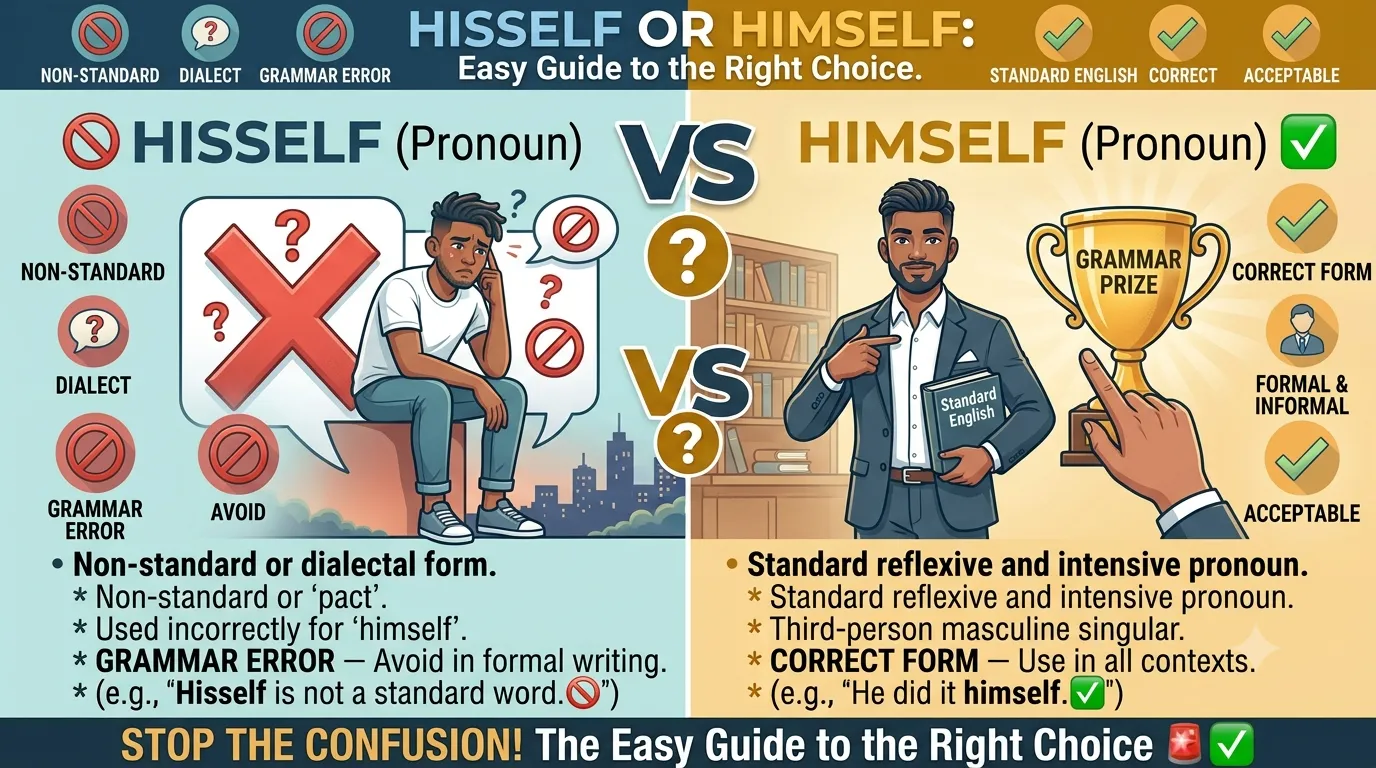
Himself is the correct reflexive pronoun used to refer to a male person previously mentioned. Hisself is a nonstandard, informal dialect variant that is considered grammatically incorrect in standard English writing, such as saying “he made the dinner himself.”
Have you ever sat in a high-stakes meeting, opened your mouth to speak, and suddenly froze over a single basic pronoun? Years ago, during my first term teaching high school English, I was leading a lively debate on classic literature. A bright student raised his hand and confidently stated that the main character had brought the trouble upon “hisself.” Half the classroom giggled, while the other half looked completely blank. I felt a sudden wave of empathy for the speaker.
That awkward classroom moment stayed with me for a long time. It made me realize just how deeply confusing reflexive pronouns can be. People search for this topic because our language follows an uneven pattern. We naturally say myself, yourself, and herself using possessive roots like my, your, and her. It feels completely logical to follow that same exact pattern to create hisself.
This comprehensive guide will clear up the pronoun confusion once and for all. You will explore the historic roots of these words. You will see how they perform in real-world environments. Most importantly, you will learn exactly how to choose the right term to ensure your writing remains sharp, clear, and professional.
Hisself or Himself, Quick Answer
The short answer is that himself is the only grammatically correct reflexive pronoun in standard modern English. It serves to point back to a male subject who is performing an action to or for his own person.
- The baker built the entire brick oven himself.
- He taught himself how to play the acoustic guitar over the summer.
The word hisself is considered a nonstandard dialect form. It should be completely avoided in formal writing, public speaking, and professional communications.
The Origin and Background of Hisself or Himself
To truly understand why this linguistic trap exists, we have to travel back several centuries into the history of middle English. The confusion is not random. It actually stems from a structural clash in how English pronouns grew over time.
Our modern reflexive pronouns are built in two completely different ways. The first group uses possessive determiners. This is why we say myself (my + self) and yourself (your + self). The second group uses objective pronouns. This is why we say himself (him + self) and themselves (them + self).
During the Middle Ages, regular people tried to make the whole system match. They created hisself (his + self) so that masculine pronouns would follow the exact same logic as myself. Great writers like John Bunyan even used it in famous old books. However, when early dictionary makers sat down to standardize modern English grammar rules, they rejected the possessive pattern for men. They declared himself as the sole official standard, leaving the other form behind as a regional dialect.
Hisself or Himself Explained: Key Differences or Variations
While the basic meaning refers back to a male individual, the two words sit in completely different categories of acceptable speech and writing.
| Term | Meaning | When to Use | Region or Context |
| Himself | Refers back to a male subject | Use in all professional and formal tasks | Standard global English |
| Hisself | Dialect version of himself | Use only in direct fiction dialogue | Southern US / Old British dialects |
Let us examine how these variations look in contrasting sentences:
- Standard English: The runner pushed himself to cross the finish line.
- Regional Dialect: He went down to the fishing pier all by hisself.
Standard grammar rules require the objective form. Even though the possessive form sounds regular to our ears, it violates modern academic standards.
Which Version Should You Use?
Your choice should depend strictly on your target audience, your writing goals, and the specific setting of your text. Here are direct recommendations:
For Professionals and Business Leaders
Always deploy himself. Whether you are drafting a critical team email or constructing a performance report, this spelling shows your attention to detail. It projects competence and mastery of standard business English.
For Academic Students and Test Takers
Stick exclusively to himself on all essays, research papers, and standardized exams. Automated grading systems and essay evaluators will immediately flag the alternative spelling as a serious grammatical error.
For Creative Writers and Novelists
You may carefully use hisself when you are writing authentic dialogue for specific characters. If your story takes place in the rural American South or historic Britain, this word can help establish a true sense of place and personality.
Common Mistakes with Hisself or Himself
Even native speakers often stumble when trying to apply these terms. Let us review the most frequent errors so you can keep them out of your daily work.
1. Following the possessive pattern blindly
Writers often think that because myself is correct, the masculine version must match its structure.
- Incorrect: The manager took the responsibility upon hisself.
- Correct: The manager took the responsibility upon himself.
2. Splitting the pronoun into two separate words
Never break the standard reflexive pronoun into two isolated terms within your sentence.
- Incorrect: He managed to fix the broken radiator all by him self.
- Correct: He managed to fix the broken radiator all by himself.
3. Using it as a basic subject pronoun
Reflexive pronouns need an anchor. You cannot use them as the primary subject of a sentence without naming the person first.
- Incorrect: Himself went to the store to buy groceries.
- Correct: He went to the store himself to buy groceries.
Hisself or Himself in Real-World Examples
Let us look at how standard usage functions across multiple media formats to help train your visual memory.
A Professional Email
“Dear Team, John has volunteered to lead the upcoming product demonstration himself, so please send your feature questions directly to his desk.”
A News Headline
“Local Governor Pledges to Investigate the Budget Shortfall Himself“
A Social Media Post
“Shoutout to my brother who built this entire backyard treehouse completely by himself over the weekend! 🛠️🌳”
A Formal Document or Report
“The CEO verified the financial audit data himself before submitting the final quarterly paperwork to the board of directors.”
Hisself or Himself: Data, Trends, and Usage
Global search and publishing data reveal an overwhelming preference for standard grammar. Himself commands nearly all formal print, digital media, and academic publishing space worldwide.
This is an informational search topic. Most online queries come from individuals who are writing a formal document. They hit a moment of doubt and want to double-check their grammar before submission.
This matters today because digital spell-checkers can sometimes overlook regional speech patterns in casual typing. Knowing the firm boundary between standard English and informal dialect ensures your message always lands with clarity and authority.
Standalone Comparison Table
Keep this clean reference tool nearby whenever you are polishing a new piece of text.
| Term/Variant | Meaning | Region or Context | Best Used When |
| Himself | Reflexive masculine pronoun | Universal standard | Writing formal essays, emails, journalism, and books |
| Hisself | Nonstandard dialect spelling | Informal speech / Fiction | Developing deep character voice in creative stories |
FAQ Section
Q: What does himself mean?
A: It is a reflexive pronoun used when a male person is both the doer and the receiver of an action. It can also add emphasis to a male subject.
Q: How do you use himself correctly in a sentence?
A: Place it after a masculine noun or pronoun to show self-directed action. For example: “The boy hurt himself on the playground.”
Q: Hisself vs himself, what is the key difference?
A: Himself is the approved, standard grammar choice across the globe. Hisself is an informal, nonstandard variant used only in specific local dialects.
Q: Is the word hisself acceptable in professional writing?
A: No, it is never acceptable in professional writing. Using it in a corporate space can make your message look unpolished.
Q: Which version is correct on standard grammar tests?
A: Only himself is marked correct on academic exams and school tests. The other form is treated as a spelling and grammar error.
Q: Where does the confusion between these two words come from?
A: It comes from our regular pronoun system. People expect the masculine form to use the possessive his, just like the feminine form uses her.
Q: Can himself be used for emphasis?
A: Yes, you can use it as an intensive pronoun to highlight a person. For example: “The President himself signed the new decree.”
Conclusion
To wrap things up, let us review the most vital lessons from this guide. First, himself is the single correct choice for standard English writing. Second, hisself is an informal dialect word that does not belong in business or academic settings. Third, the uneven pattern of English pronouns is what causes this common mix-up.
My ultimate recommendation is to completely eliminate the nonstandard form from your professional vocabulary. Trust the standard spelling to keep your communication clear and authoritative.
Bookmark this guide so you never second-guess hisself or himself again.
See More: Peak or Peek: The Complete Guide to Using the Right Word

I am an English language expert dedicated to exploring the nuances of words and their meanings. Through detailed comparisons and practical insights, I help readers understand the finer points of language and use words with accuracy and confidence.