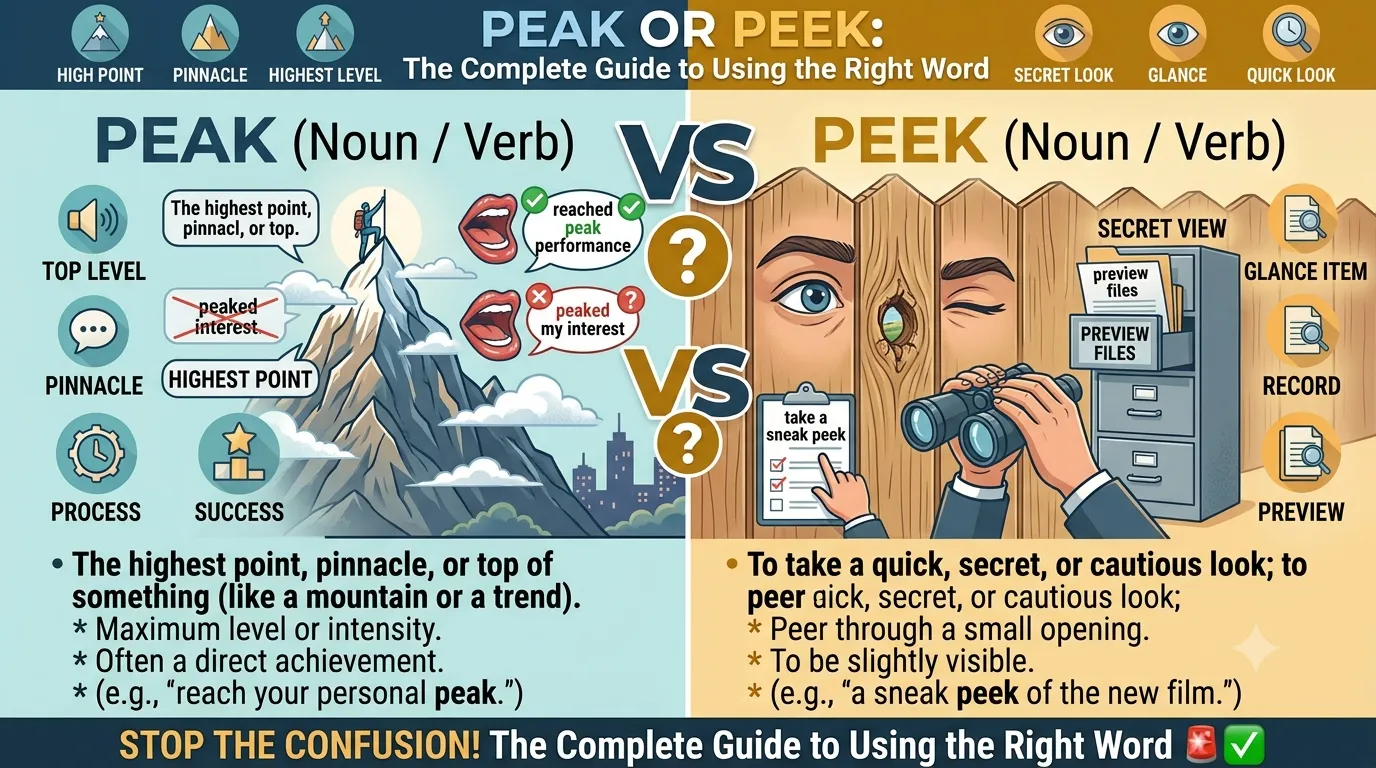
Peak refers to the highest point, level, or achievement. Peek means to take a quick or secret look at something.
A few years ago, I was editing a blog post when I spotted a sentence that read, “Take a peak at our new product.” The meaning was clear, but the spelling was not. The writer wanted readers to have a quick look at the product, yet they used peak instead of peek.
This is one of the most common word mix-ups in English. The two words sound exactly alike. Because of that, even experienced writers sometimes use the wrong one.
You may have seen phrases like “sneak peak” or “take a peak” online. They appear so often that many people start to think they are correct. In reality, these mistakes can make your writing look less polished and professional.
If you’ve ever wondered whether to use peak or peek, you’re in the right place. The difference is simple once you know what each word means.
By the end of this guide, you’ll understand the meanings, origins, key differences, common mistakes, and real-world uses of both words. More importantly, you’ll never confuse them again.
Peak or Peek, Quick Answer
The difference comes down to meaning.
- Peak = the highest point.
- Peek = a quick look.
Examples
We reached the mountain peak at sunrise.
Can I peek inside the gift box?
Sales reached their peak in December.
She took a peek at the answers.
A simple memory trick is that peek contains two “e” letters, just like eyes. Since you look with your eyes, peek means to look.
The Origin / Background of Peak or Peek
Understanding where these words came from makes them easier to remember.
Origin of Peak
Peak comes from words related to pointed tops or mountain summits.
Over time, the meaning expanded to include:
- Highest level
- Maximum point
- Greatest achievement
Today, people use peak in business, sports, science, and everyday conversation.
Origin of Peek
Peek appeared later in English and referred to looking quickly or secretly.
The word has always been connected to sight and observation.
Why the Confusion Exists
The confusion happens because:
- Both words sound identical.
- English spelling is not always predictable.
- Many people learn the words through speech before seeing them in writing.
Despite their similar pronunciation, the meanings are completely different.
Peak or Peek Explained: Key Differences
The easiest way to separate them is to think about action versus position.
Peak describes a high point.
Peek describes looking.
| Term | Meaning | When to Use | Region/Context |
| Peak | Highest point or level | Mountains, performance, success, sales | All English varieties |
| Peek | Quick or secret look | Looking briefly at something | All English varieties |
Examples of Peak
- The climbers reached the peak.
- Traffic is heavy during peak hours.
- Her career reached its peak.
- Demand hit its peak last year.
Examples of Peek
- Don’t peek at your birthday gift.
- He took a quick peek through the window.
- Can I peek at the report?
- The child peeked around the corner.
Easy Memory Trick
Think:
Peak = mountain peak
Peek = eyes looking
This simple connection helps most people remember the difference instantly.
Which Version Should You Use?
Your choice depends entirely on the meaning.
For Students
Use peek when talking about looking.
Example:
- I took a peek at the test answers.
Use peak when discussing the highest point.
Example:
- We climbed to the mountain peak.
For Business Professionals
Use peak when discussing performance, growth, or maximum levels.
Example:
- Sales reached their peak in July.
For Content Creators
Use peek when giving audiences a preview.
Example:
- Here’s a quick peek at our upcoming project.
For Global English
The meanings remain the same in American, British, Canadian, and Australian English.
Best Recommendation
Ask yourself:
Am I talking about a high point or a quick look?
- High point → Peak
- Quick look → Peek
Common Mistakes with Peak or Peek
These mistakes appear everywhere online.
| Mistake | Correct Version |
| Take a peak at this. | Take a peek at this. |
| Sneak peak. | Sneak peek. |
| I peaked inside the box. | I peeked inside the box. |
| The company hit its peek. | The company hit its peak. |
| Peak through the door. | Peek through the door. |
Why These Errors Happen
1. They Sound the Same
Most people learn them by hearing them.
2. Popular Internet Mistakes
Incorrect phrases spread quickly online.
3. Similar Spellings
Only one letter separates the words.
4. Fast Writing
Writers often choose the first spelling that comes to mind.
Peak or Peek in Real-World Examples
Professional Email
“Please take a peek at the attached document before our meeting.”
News Headline
“Tourism Numbers Reach New Peak This Summer.”
Social Media Post
“Here’s a sneak peek of our next product launch.”
Formal Report
“Energy consumption reached its annual peak during August.”
Everyday Conversation
“Can I peek inside the package?”
Peak or Peek: Data, Trends & Usage
Searches for peak or peek remain consistently popular because these words are common homophones.
Search Intent
Primary intent:
- Informational
Users want to know:
- Which spelling is correct
- What each word means
- How to avoid common mistakes
Most Interested Audiences
- Students
- English learners
- Bloggers
- Teachers
- Editors
- Business professionals
Regions With High Search Interest
- United States
- United Kingdom
- Canada
- Australia
- India
Why It Matters Today
Digital communication has increased the amount of writing people do every day. Small spelling mistakes can affect credibility. Knowing the difference between peak and peek helps your writing look more accurate and professional.
Peak vs Peek Comparison Table
| Term/Variant | Meaning | Region/Context | Best Used When |
| Peak | Highest point, maximum level | Universal English | Talking about mountains, success, growth, or maximum performance |
| Peek | Quick or secret look | Universal English | Talking about looking briefly at something |
Frequently Asked Questions
Q: What does peak mean?
A: Peak means the highest point or level of something. It can refer to mountains, performance, sales, or achievements.
Q: What does peek mean?
A: Peek means to take a quick or secret look at something. It is often used when someone looks briefly.
Q: Is it sneak peak or sneak peek?
A: Sneak peek is correct. The phrase means a quick preview of something before its official release.
Q: How do you use peek correctly?
A: Use peek whenever you’re talking about looking. Example: “She peeked through the window.”
Q: How do you use peak correctly?
A: Use peak when referring to the highest point or maximum level. Example: “The athlete reached peak performance.”
Q: Is peak acceptable in formal writing?
A: Yes. Peak is commonly used in professional, academic, and business writing.
Q: Which version is correct, peak or peek?
A: Both are correct words. The right choice depends on whether you mean a high point (peak) or a quick look (peek).
Q: Can peak and peek be used interchangeably?
A: No. They have completely different meanings. Using one in place of the other creates a spelling error.
Conclusion
The difference between peak and peek is easier than it first appears.
Keep these points in mind:
- Peak means the highest point or level.
- Peek means a quick look.
- Mountain tops, success, and maximum performance relate to peak.
- Looking briefly or secretly relates to peek.
Whenever you’re unsure, ask yourself whether you’re talking about a high point or looking at something. That simple question will usually give you the answer.
Mastering word pairs like peak and peek helps your writing become clearer, more accurate, and more professional.
Now you know exactly how to use peak or peek, go try it in your next piece of writing. Bookmark this guide so you never second-guess these words again, and share it with someone who’s been confused about them.
See More: Minute or Minuet: The Easy Guide to Using the Right Word🕒💃

I am an English language expert dedicated to exploring the nuances of words and their meanings. Through detailed comparisons and practical insights, I help readers understand the finer points of language and use words with accuracy and confidence.