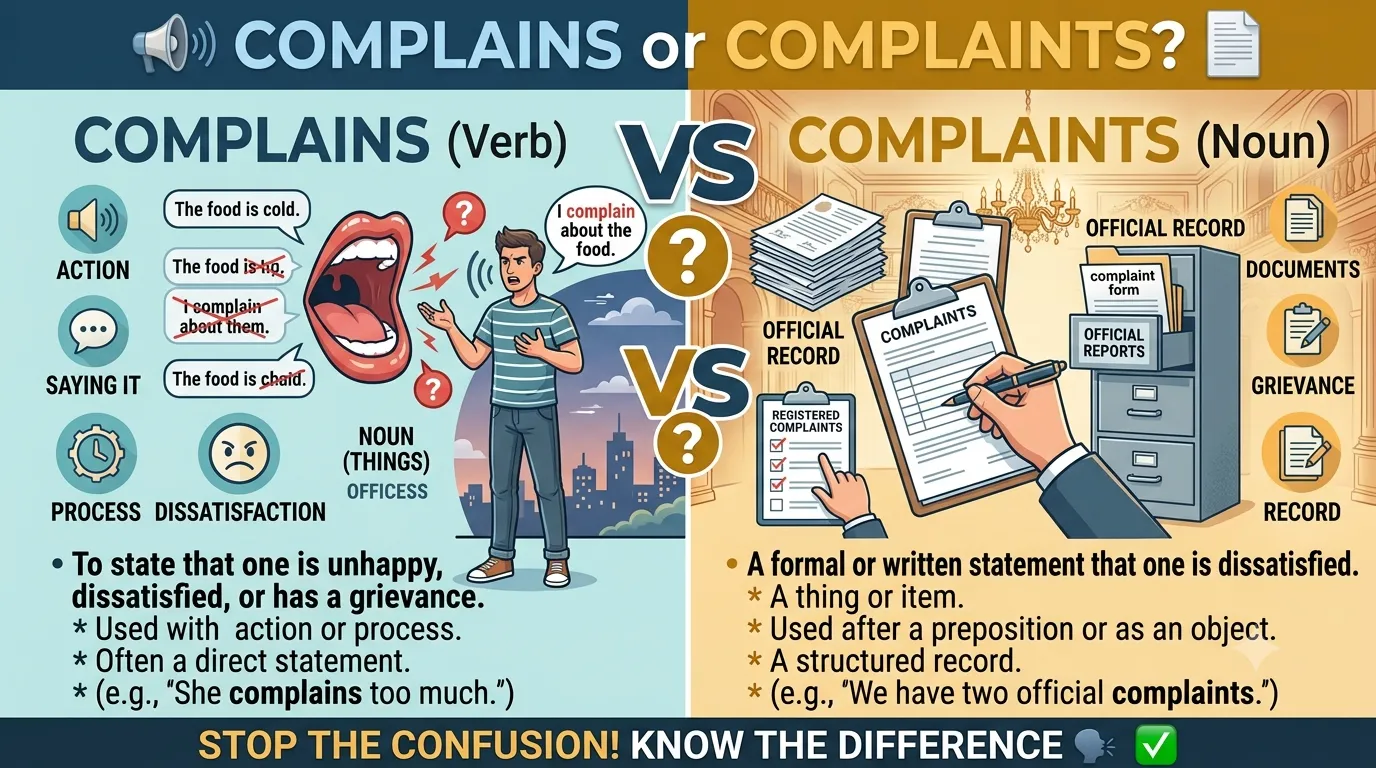
Complains is a verb that means someone expresses dissatisfaction. Complaints is a noun that refers to the concerns or problems being reported.
A few years ago, I was reviewing a student’s essay when I noticed a sentence that read, “The customer sent several complains to the company.” The meaning was clear, but the word choice was not. The correct word should have been complaints.
This mix-up happens more often than you might think. Both words come from the same root word, complain, and they look very similar. Because of that, many writers use them interchangeably. Unfortunately, doing so can make your writing look unprofessional.
You may have seen these words in emails, customer service messages, business reports, school assignments, or social media posts. Knowing which one to use can help you communicate more clearly.
The good news is that the difference is simple once you understand it. In this guide, you’ll learn what complains and complaints mean, how they differ, when to use each one, and how to avoid common mistakes.
Let’s clear up the confusion once and for all.
Complains or Complaints, Quick Answer
The easiest way to remember the difference is this:
- Complains = an action (verb)
- Complaints = a thing (noun)
Examples
✅ She complains about the noise every night.
✅ The manager received several complaints from customers.
In the first sentence, someone is performing an action. In the second, the word refers to reported concerns.
The Origin / Background of Complains or Complaints
Both words come from the verb complain, which entered English from Old French and ultimately from Latin.
The original meaning was to express sorrow, grief, or dissatisfaction.
Over time, English developed different forms:
- Complain = base verb
- Complains = third-person singular verb
- Complaint = singular noun
- Complaints = plural noun
The confusion exists because the words look almost identical. The only difference is the ending. Yet that small change completely changes the word’s role in a sentence.
Complains or Complaints Explained: Key Differences
| Term | Meaning | When to Use | Region/Context |
| Complains | Expresses dissatisfaction | As a verb | All English-speaking regions |
| Complaints | Reports, concerns, or grievances | As a noun | All English-speaking regions |
Complains
Use complains when someone is doing the action of expressing dissatisfaction.
Examples:
- He complains about traffic every morning.
- My neighbor complains whenever the music is loud.
Complaints
Use complaints when referring to concerns, reports, or grievances.
Examples:
- The company received many complaints.
- Customer complaints increased this month.
Which Version Should You Use?
For Students
Use complains when describing what a person does.
Example:
- The student complains about homework.
Use complaints when referring to issues or reports.
Example:
- The teacher received several complaints.
For Business Professionals
Customer service teams usually deal with complaints, not complains.
Example:
- We received five customer complaints today.
For Everyday Writing
Ask yourself a simple question:
Is someone doing an action?
If yes, use complains.
Are you talking about concerns or issues?
If yes, use complaints.
Global Recommendation
Use:
- Complains for actions
- Complaints for things
This rule works everywhere English is spoken.
Common Mistakes with Complains or Complaints
Mistake 1
❌ The company received several complains.
✅ The company received several complaints.
Why?
Because the company received concerns, not actions.
Mistake 2
❌ He complaints about everything.
✅ He complains about everything.
Why?
Because the person is performing an action.
Mistake 3
❌ Customer complains increased this year.
✅ Customer complaints increased this year.
Why?
The sentence refers to reports, not actions.
Mistake 4
❌ She filed a complains against the store.
✅ She filed a complaint against the store.
Why?
A filed report is a noun.
Mistake 5
❌ My brother always complaints.
✅ My brother always complains.
Why?
The word functions as a verb.
Complains or Complaints in Real-World Examples
Professional Email
We have received several customer complaints regarding delayed deliveries.
News Headline
Residents complains about rising utility costs.
More commonly:
Residents complain about rising utility costs.
Social Media Post
My friend always complains when it rains.
Formal Report
Customer complaints increased by 12% during the last quarter.
These examples show how each word naturally appears in different contexts.
Complains or Complaints: Data, Trends & Usage
People frequently search for this topic because:
- The words look very similar.
- They come from the same root.
- Both appear in business communication.
- English learners often confuse verbs and nouns.
Most Interested Audiences
- Students
- ESL learners
- Bloggers
- Customer service professionals
- Business writers
Search Intent
Informational
Most users want to know which word is correct in a specific sentence.
Why This Matters Today
Clear communication matters more than ever. Whether you’re writing an email, report, article, or social media post, choosing the correct word improves credibility and professionalism.
Comparison Table
| Term/Variant | Meaning | Region/Context | Best Used When |
| Complains | Expresses dissatisfaction | Everyday English | Describing an action |
| Complaint | One reported concern | Formal and informal writing | Referring to a single issue |
| Complaints | Multiple reported concerns | Business, education, customer service | Referring to several issues |
| Complain | Base verb form | General English | Describing the act itself |
Frequently Asked Questions
Q: What does complains mean?
A: Complains is a verb. It means someone expresses dissatisfaction or concern about something.
Q: What does complaints mean?
A: Complaints is a plural noun. It refers to reported problems, concerns, or grievances.
Q: How do you use complains correctly?
A: Use complains when a person is performing the action. Example: “She complains about the weather.”
Q: How do you use complaints correctly?
A: Use complaints when referring to issues being reported. Example: “The hotel received several complaints.”
Q: Which is correct: complains or complaints?
A: Both are correct. The right choice depends on whether you need a verb (complains) or a noun (complaints).
Q: Is complaints acceptable in formal writing?
A: Yes. The word is common in business reports, legal documents, customer service records, and professional communication.
Q: Can complains be used in business communication?
A: Yes. It is often used when describing customer behavior. Example: “The customer complains about delayed service.”
Conclusion
The difference between complains and complaints is small but important. One word describes an action. The other refers to a concern or problem.
Remember these key points:
- Complains is a verb.
- Complaints is a noun.
- Use complains when someone expresses dissatisfaction.
- Use complaints when talking about reported issues.
A simple test can help. Ask yourself whether the sentence needs an action or a thing. If it needs an action, choose complains. If it needs a concern or report, choose complaints.
Once you learn this rule, the choice becomes easy.
Now you know exactly how to use complains and complaints. Bookmark this guide so you never second-guess these words again, and share it with someone who has been confused by them.
See More: 🎓DDS or DMD? How to Choose the Right Dentist

I am an English language expert dedicated to exploring the nuances of words and their meanings. Through detailed comparisons and practical insights, I help readers understand the finer points of language and use words with accuracy and confidence.