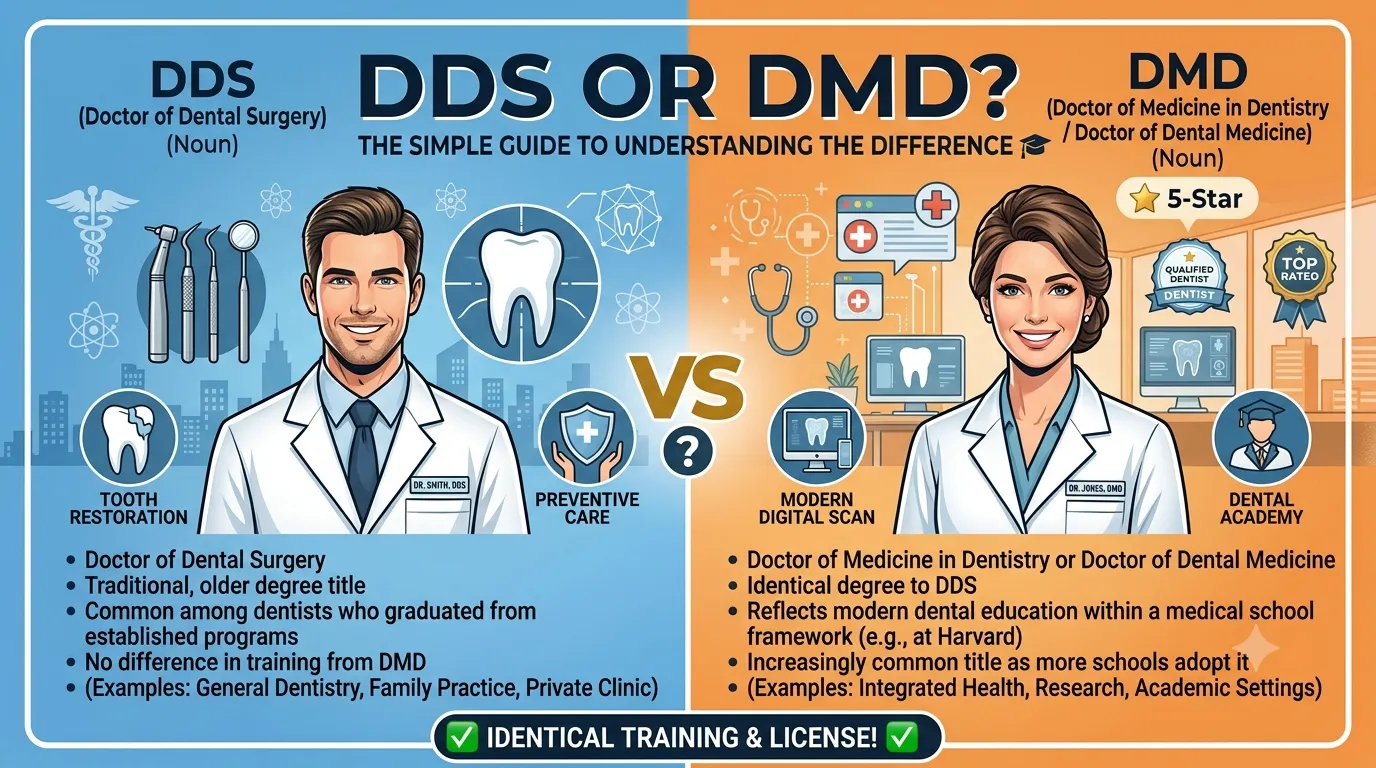
DDS and DMD are dental degrees that mean the same thing. Both dentists receive the same education, training, and licensing requirements. The only difference is the title awarded by their dental school.
A few years ago, I was looking for a new dentist. While checking clinic websites, I noticed something strange. One dentist had DDS after their name, while another had DMD.
At first, I assumed one degree was better than the other. Many people make the same mistake.If you’ve ever searched for a dentist, you’ve probably seen both titles and wondered which one is more qualified. Is a DDS more experienced? Does a DMD have extra training? Should you choose one over the other?
The confusion is understandable. The two abbreviations look different, and they often appear on dental office signs, business cards, and websites.
The good news is that the answer is simple.
In this guide, you’ll learn what DDS and DMD mean, where they came from, how they compare, and whether the difference matters when choosing a dentist.
Let’s clear up the confusion once and for all.
DDS or DMD: Quick Answer
Both DDS and DMD are professional degrees for dentists.
- DDS stands for Doctor of Dental Surgery.
- DMD stands for Doctor of Medicine in Dentistry or Doctor of Dental Medicine.
Despite the different names, the education is the same.
Examples
- Dr. Sarah Jones, DDS, performs routine dental checkups.
- Dr. Michael Lee, DMD, performs the same procedures and treatments.
Patients receive the same level of care from both.
The Origin / Background of DDS or DMD
The story begins in the 1800s.
The first dental school in the United States awarded the DDS degree. As more dental schools opened, most followed the same tradition.
Later, one famous dental school wanted its degree title to match the Latin language used by the university.
That school chose DMD instead of DDS.
The curriculum stayed the same.
Over time, other schools adopted the DMD title while many continued using DDS.
This created two degree names for the same profession.
That history is the main reason people still get confused today.
DDS or DMD Explained: Key Differences or Variations
The biggest surprise is that there is almost no difference between DDS and DMD.
| Term | Meaning | When to Use | Region/Context |
| DDS | Doctor of Dental Surgery | Professional dental title | Common in many dental schools |
| DMD | Doctor of Dental Medicine | Professional dental title | Used by certain dental schools |
What Is the Same?
Both DDS and DMD dentists:
- Attend accredited dental schools
- Study the same subjects
- Pass licensing exams
- Complete clinical training
- Can pursue specialties
What Is Different?
The only real difference is:
- The name of the degree
- The dental school that awards it
Example
A patient needing a filling can visit either a DDS or a DMD dentist and receive the same treatment.
Which Version Should You Use?
The best choice depends on your situation.
For Patients
Focus on:
- Experience
- Reviews
- Communication skills
- Specializations
Do not choose based only on DDS or DMD.
For Students Considering Dentistry
Apply to schools that fit your goals.
The degree title should not be the deciding factor.
For Writers and Researchers
Use the degree exactly as the dentist lists it.
For Global Readers
Treat DDS and DMD as equivalent credentials.
Recommendation
If you’re choosing a dentist, look beyond the letters after their name. Their skills, training, and patient care matter far more.
Common Mistakes with DDS or DMD
Many people misunderstand these terms.
Mistake 1
❌ DDS is higher than DMD
✅ DDS and DMD are equal degrees
Why it happens: The names sound different, so people assume one is more advanced.
Mistake 2
❌ DMD dentists cannot perform certain procedures
✅ Both can perform the same treatments if properly licensed
Why it happens: Patients often think the titles represent different specialties.
Mistake 3
❌ DDS means surgeon only
✅ DDS dentists provide many dental services, not just surgery
Why it happens: The word “surgery” creates confusion.
Mistake 4
❌ DMD is newer and better
✅ Neither degree is superior
Why it happens: People often assume newer titles are more advanced.
Mistake 5
❌ Insurance treats DDS and DMD differently
✅ Insurance companies generally recognize them equally
Why it happens: Different titles can appear confusing on documents.
DDS or DMD in Real-World Examples
Professional Email
“Thank you for scheduling your appointment with Dr. Roberts, DDS, on Monday.”
News Headline
“Local DMD Opens New Family Dental Clinic Downtown.”
Social Media Post
“Had a great experience with my new DDS today. Friendly staff and excellent care!”
Formal Report
“The procedure was completed by a licensed DMD specializing in restorative dentistry.”
These examples show that both titles are used naturally in professional settings.
DDS or DMD: Data, Trends & Usage
Interest in DDS and DMD has grown steadily because patients often research healthcare providers online before making appointments.
Who Searches This Topic?
- Dental patients
- Students interested in dentistry
- Parents seeking family dentists
- Healthcare researchers
- Job applicants
Search Intent
The primary search intent is:
Informational
People want to know whether one degree is better than the other.
Regions With High Interest
Searches are most common in:
- United States
- Canada
- Other countries with American dental education influence
Why This Matters Today
Patients have more information than ever before. Understanding dental credentials helps people make confident healthcare decisions.
DDS vs DMD Comparison Table
| Term/Variant | Meaning | Region/Context | Best Used When |
| DDS | Doctor of Dental Surgery | Many dental schools | Referring to dentists with DDS credentials |
| DMD | Doctor of Dental Medicine | Certain dental schools | Referring to dentists with DMD credentials |
| DDS or DMD | Equivalent dental degree | General discussion | Comparing dental qualifications |
| Dental Specialist | Additional advanced training | Specialty dentistry | Discussing orthodontists, surgeons, or specialists |
Frequently Asked Questions
Q: What does DDS mean?
A: DDS stands for Doctor of Dental Surgery. It is a professional degree awarded to licensed dentists.
Q: What does DMD mean?
A: DMD stands for Doctor of Dental Medicine or Doctor of Medicine in Dentistry. It represents the same level of education as DDS.
Q: Is DDS better than DMD?
A: No. Both degrees are equal. Dentists with either title receive similar education and licensing requirements.
Q: How do you use DDS or DMD correctly?
A: Use the degree that appears after the dentist’s name. For example, Dr. Smith, DDS or Dr. Jones, DMD.
Q: Are DDS and DMD accepted in formal writing?
A: Yes. Both are professional credentials and are commonly used in official documents, websites, and healthcare records.
Q: Where do DDS and DMD come from?
A: The difference comes from university traditions and naming preferences. The educational standards remain the same.
Q: Can a DDS and DMD perform the same procedures?
A: Yes. Both can provide the same dental treatments if they hold the required licenses and certifications.
Conclusion
The DDS versus DMD debate sounds more complicated than it really is.
The key takeaway is simple. Both degrees represent qualified dentists who completed accredited dental education and passed licensing requirements.
Remember these important points:
- DDS and DMD are equivalent degrees.
- The difference comes from school naming traditions.
- Neither title is more advanced.
- Patient care depends on the individual dentist, not the degree abbreviation.
When choosing a dentist, focus on experience, reputation, communication, and the services you need. Those factors matter far more than whether the name ends with DDS or DMD.
Now you know exactly what DDS and DMD mean. Bookmark this guide so you never second-guess these dental credentials again, and share it with anyone who has wondered about the difference.
See More: Breach or Breech? Stop the Confusion🚨✅

I am an English language expert dedicated to exploring the nuances of words and their meanings. Through detailed comparisons and practical insights, I help readers understand the finer points of language and use words with accuracy and confidence.