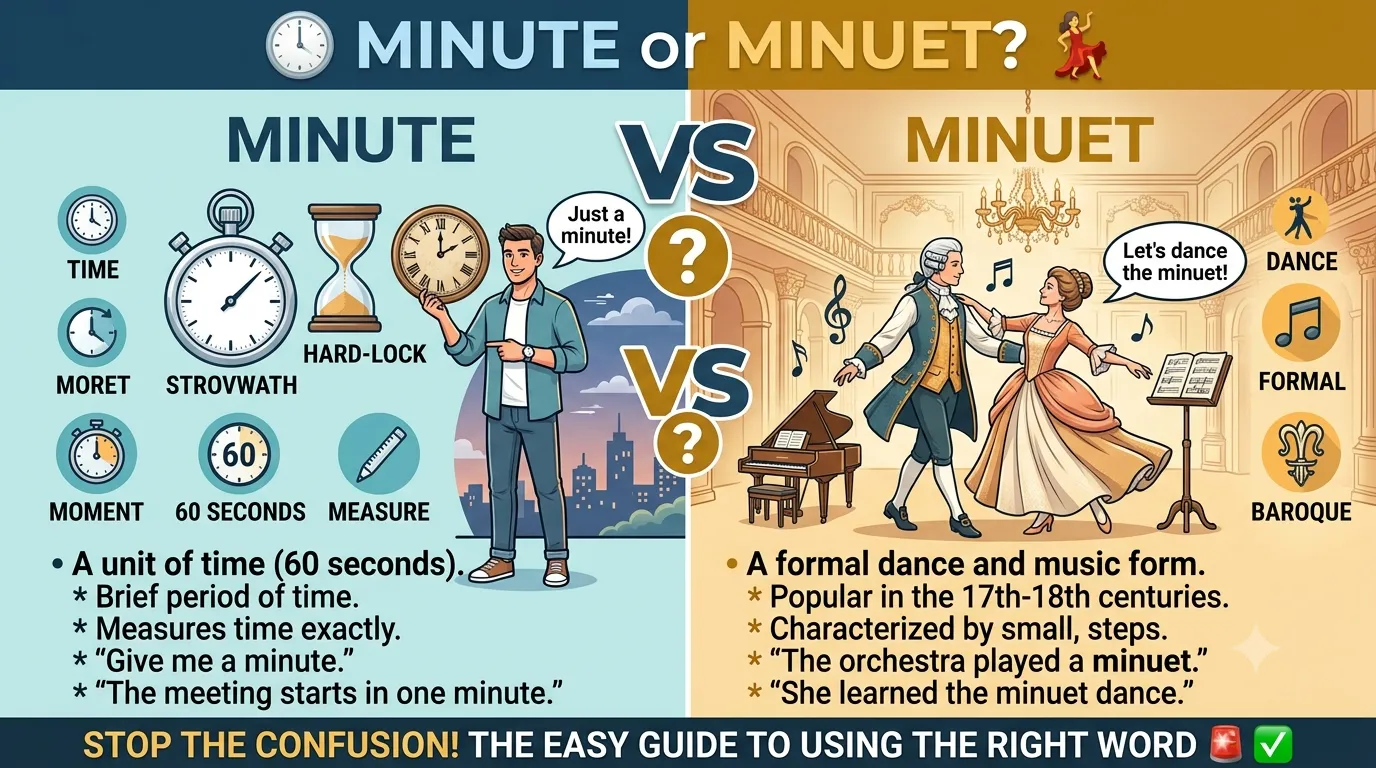
Minute is usually a unit of time equal to 60 seconds, while minuet is a slow, elegant dance from the 17th and 18th centuries. Although they sound alike, they have completely different meanings and uses.
I still remember reading a sentence in a student essay that said, “The dancers performed a beautiful minute.” At first, I thought it was a typo. Then I realized the writer meant minuet, not minute.
You’re not alone if these two words confuse you.
They sound very similar when spoken. Yet they belong to completely different worlds. One helps you measure time. The other belongs to music and dance history.
Many people search for “minute or minuet” because they hear the words but are unsure which spelling is correct. Spell-check tools do not always catch the mistake. That makes the confusion even more common.
The good news is that the difference is easy to remember once you know what each word means.
In this guide, you’ll learn the meaning of both words, where they came from, common mistakes to avoid, and simple tricks to help you choose the correct spelling every time.
Let’s clear up the confusion.
Minute or Minuet, Quick Answer
The word minute refers to a period of time equal to 60 seconds. It can also mean something very small when pronounced differently.
The word minuet refers to a formal dance that became popular in Europe centuries ago.
Simple Examples
- Please wait one minute.
- The orchestra played a beautiful minuet.
One measures time. The other describes a dance.
The Origin / Background of Minute or Minuet
The word minute comes from the Latin word minutus, which means “small.”
Over time, it became associated with divisions of time. A minute became one-sixtieth of an hour.
The word minuet comes from the French word menuet.
It described a graceful ballroom dance performed by European nobility during the 1600s and 1700s.
The confusion exists because the two words sound alike in many accents. Their spellings differ by only one letter. Yet their histories are completely unrelated.
Minute or Minuet Explained: Key Differences or Variations
The easiest way to understand these words is to compare them side by side.
| Term | Meaning | When to Use | Region/Context |
| Minute | A unit of time equal to 60 seconds | Talking about time | Worldwide |
| Minute | Extremely small or tiny | Descriptive writing | Worldwide |
| Minuet | A formal historical dance | Music, dance, history | Worldwide |
Minute Examples
- I’ll be there in a minute.
- The scientist noticed a minute detail.
Minuet Examples
- The dancers performed a minuet.
- Mozart composed music for a minuet.
Easy Memory Trick
Think of the letter “u” in minuet as standing for music.
If the topic involves dancing or music, use minuet.
Which Version Should You Use?
The correct choice depends on what you mean.
For Students
Use minute when discussing time.
Use minuet when discussing music or dance history.
For Writers
Check the context carefully.
If readers might think you’re discussing time, use minute.
For History Lovers
Choose minuet when describing classical European dances.
For Everyday Communication
You’ll almost always use minute.
Most people rarely need the word minuet unless discussing music or history.
Best Recommendation
If you’re talking about seconds, hours, waiting, schedules, or timing, choose minute.
If you’re talking about dancing or classical music, choose minuet.
Common Mistakes with Minute or Minuet
These errors happen more often than you might think.
Mistake 1
❌ Wait a minuet.
✅ Wait a minute.
Why it happens: The words sound similar.
Mistake 2
❌ The dancers performed a beautiful minute.
✅ The dancers performed a beautiful minuet.
Why it happens: Writers confuse the spelling.
Mistake 3
❌ Mozart wrote several famous minutes.
✅ Mozart wrote several famous minuets.
Why it happens: People mistakenly replace the musical term.
Mistake 4
❌ The meeting lasted twenty minuets.
✅ The meeting lasted twenty minutes.
Why it happens: Typing errors can create confusion.
Mistake 5
❌ The orchestra played a lovely minute.
✅ The orchestra played a lovely minuet.
Why it happens: The sound of the words leads people astray.
Minute or Minuet in Real-World Examples
Professional Email
“Please join the meeting five minutes before the scheduled start time.”
News Headline
“Historic Minuet Performance Draws Large Crowd at Cultural Festival.”
Social Media Post
“Just finished a 30-minute workout. Feeling great!”
Formal Report
“The ensemble concluded the event with a traditional minuet from the eighteenth century.”
These examples show how differently the two words are used.
Minute or Minuet: Data, Trends & Usage
Interest in “minute or minuet” often comes from spelling questions and language learning.
Who Searches This Topic?
- Students
- English learners
- Writers
- Editors
- Music enthusiasts
Search Intent
The search intent is mainly:
Informational
People want to know which spelling is correct.
Where Is It Most Common?
Interest appears most often in:
- English-speaking countries
- Educational settings
- Grammar-focused websites
Why It Matters Today
Modern spell-checkers sometimes miss correctly spelled but incorrectly used words. Knowing the difference helps improve writing accuracy.
Standalone Comparison Table
| Term/Variant | Meaning | Region/Context | Best Used When |
| Minute | Unit of time | Everyday language | Discussing seconds, hours, schedules |
| Minute | Very small | Formal descriptions | Describing tiny details |
| Minuet | Formal dance | Music and history | Discussing classical dance |
| Minuets | Multiple dances | Music and history | Referring to several dances |
Frequently Asked Questions
Q: What does minute mean?
A: Minute usually means a period of 60 seconds. It can also mean extremely small depending on how it is pronounced.
Q: What does minuet mean?
A: Minuet is a formal dance that became popular in Europe during the 17th and 18th centuries.
Q: How do you use minute correctly?
A: Use minute when talking about time or something very small. Context will make the meaning clear.
Q: Minute vs minuet, what’s the difference?
A: Minute relates to time or size. Minuet refers to a historical dance and musical form.
Q: Is minuet still used today?
A: Yes, especially in music education, classical music, dance history, and cultural discussions.
Q: Which spelling is correct, minute or minuet?
A: Both are correct. The right choice depends on what you want to say.
Q: Can minuet be used in modern writing?
A: Yes. It is still used when discussing classical music, historical dances, and cultural events.
Conclusion
The difference between minute and minuet is simple once you know the meaning behind each word.
Remember these key points:
- Minute usually refers to 60 seconds.
- Minute can also mean very small.
- Minuet is a traditional European dance.
- Context tells you which word belongs in your sentence.
Most everyday conversations require minute. The word minuet appears mainly in music, dance, and historical discussions.
A quick memory trick can help. If the topic involves music, dancing, or classical culture, think of the “u” in minuet as standing for music.
Now you know exactly how to use minute and minuet correctly. Bookmark this guide so you never second-guess these words again, and share it with someone who mixes them up.
See More: 🎓DDS or DMD? How to Choose the Right Dentist

I am an English language expert dedicated to exploring the nuances of words and their meanings. Through detailed comparisons and practical insights, I help readers understand the finer points of language and use words with accuracy and confidence.