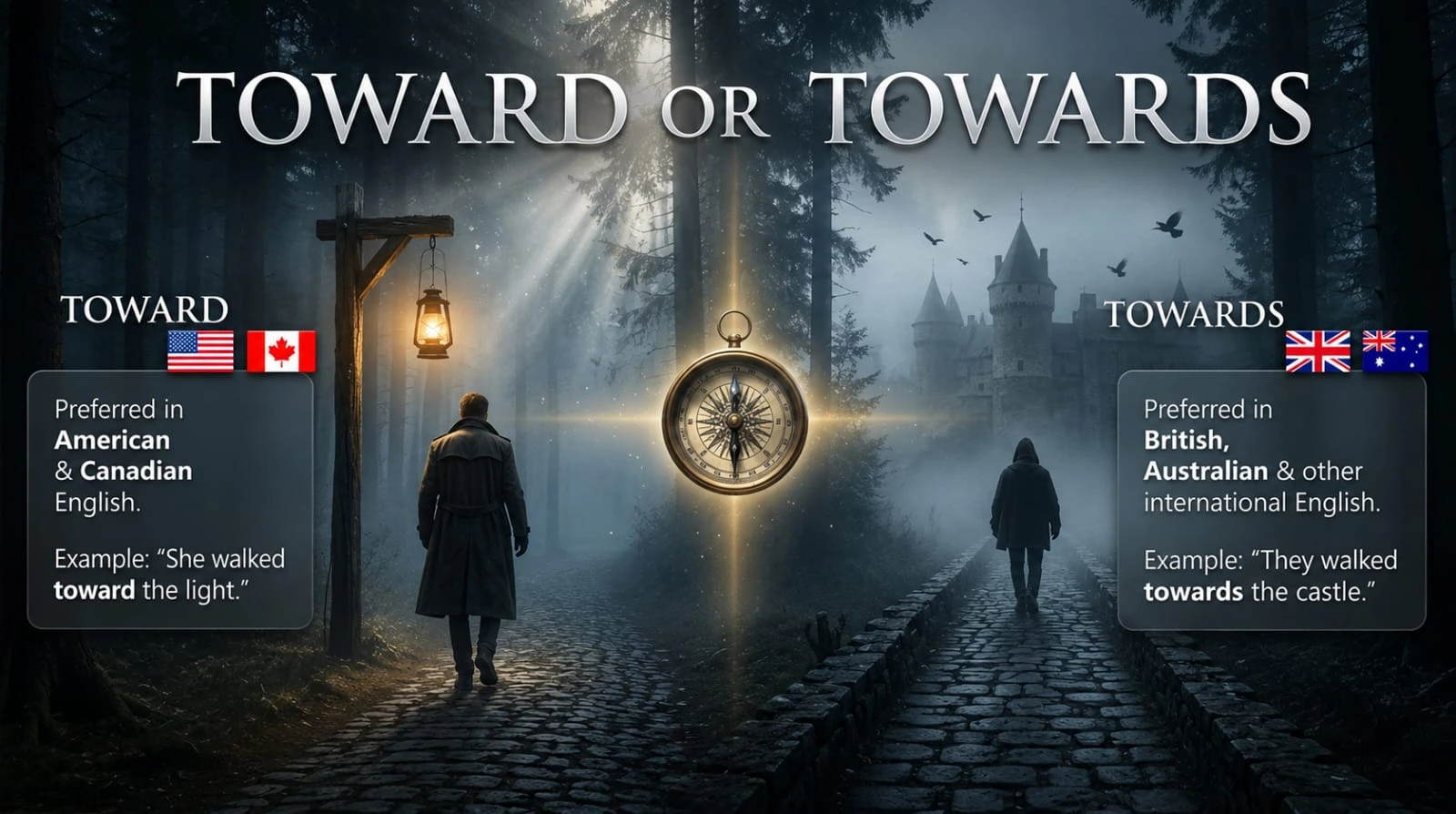
Both “toward” and “towards” are correct. “Toward” is the preferred spelling in American English, while “towards” is more common in British and Commonwealth English. _______________________________________________________________________________________________
A coworker based in London once emailed me, “Let’s move towards a final decision by Friday.” I nearly hit reply and swapped it to “toward,” thinking she’d made a typo. I stopped myself just in time.
Turns out, neither of us was wrong. Both spellings exist, and both are correct, depending on which side of the Atlantic you’re writing from.
This is one of those word pairs that dictionaries accept in both forms, yet nobody explains clearly why one shows up more in American writing and the other in British writing. If you’ve ever paused before typing this word, you’re definitely not alone.
This guide breaks down exactly when to use “toward,” when to use “towards,” and why the split exists in the first place.
Toward or Towards: Quick Answer
Both words are correct, and they mean exactly the same thing: in the direction of.
- ✅ American English: “She walked toward the exit.”
- ✅ British English: “She walked towards the exit.”
The only real rule to remember: pick one spelling and stay consistent throughout your writing, based on your intended audience.
The Origin of Toward/Towards
“Toward” comes from Old English toweard, combining “to” with the directional suffix “-weard,” meaning “in the direction of.” Like several other directional words, English speakers in different regions eventually added an extra -s to some of them, forming a second accepted spelling.
This pattern shows up across a whole family of words:
- forward → forwards
- backward → backwards
- upward → upwards
- toward → towards
American English gradually dropped the extra -s during the 1800s and 1900s, favoring the shorter form. British English kept it, which explains why the split still exists today. Neither version is more “correct” than the other, they simply developed along separate paths.
British English vs American English Spelling
The difference comes down almost entirely to regional convention, not grammar rules.
| Context | American English | British English | Example |
|---|---|---|---|
| General direction | Toward | Towards | He walked toward(s) the station. |
| Formal writing | Toward | Towards | Both accepted, region-dependent. |
| News and journalism | Toward | Towards | Style guides differ by publication. |
| Everyday speech | Toward | Towards | Common in casual conversation both ways. |
Unlike some spelling pairs, “toward” and “towards” don’t carry different meanings or grammatical roles. The choice is purely stylistic, based on regional habit.
Which Spelling Should You Use?
For American audiences
Use toward. Most US style guides, including AP style, favor the shorter form without the -s.
For British or Commonwealth audiences
Use towards. This spelling is standard across the UK, Australia, Canada, and India.
For global or mixed audiences
Either spelling works, but stay consistent throughout the same document or piece of writing.
For academic or professional writing
Check your organization’s style guide first. Many American publications specify “toward,” while British publications typically default to “towards.”
Common Mistakes with Toward/Towards
Mistake 1: Mixing spellings within the same document
✅ He drove toward the city, then turned toward the coast.
❌ He drove toward the city, then turned towards the coast.
Why it happens: Writers switch unconsciously, especially when copy-pasting from different sources or writers.
Mistake 2: Assuming one spelling is simply “wrong”
✅ Both “toward” and “towards” are correct, depending on dialect.
❌ “Towards” is a typo for “toward.”
Why it happens: People assume American English spelling rules apply everywhere.
Mistake 3: Ignoring house style guides
✅ Check your publication’s style guide, then stay consistent.
❌ Randomly switching between “toward” and “towards” in the same report.
Why it happens: Writers aren’t always aware their organization has a preferred spelling.
Mistake 4: Overcorrecting a British colleague’s writing
✅ Recognize regional spelling differences before editing someone else’s work.
❌ Changing every “towards” to “toward” without checking the audience.
Why it happens: Writers assume their own regional spelling is the universal standard.
Mistake 5: Using inconsistent spelling in SEO content
✅ Pick one spelling for your target audience and use it throughout the article.
❌ Alternating between “toward” and “towards” across different blog posts on the same site.
Why it happens: Multiple writers on one team may each default to their own regional habit.
Toward/Towards in Everyday Examples
Professional email:
“We’re moving toward a final decision and expect to confirm details by end of week.”
News headline:
“Economists Point Toward Slower Growth in Coming Quarter”
Social media post:
“Taking small steps towards a healthier lifestyle this year. 🌱”
Formal document:
“The committee agreed to work toward a resolution within thirty days.”
Notice how both spellings fit naturally into any of these contexts, the choice simply depends on your audience’s regional expectations.
Toward/Towards: Google Trends & Usage Data
Search interest in “toward vs towards” is steady and mostly informational, driven by writers, editors, and students confirming which spelling fits their audience. American users overwhelmingly search “toward,” while UK, Australian, and Indian users lean toward “towards” in everyday queries.
This mirrors the exact same pattern seen in “backward/backwards” and “forward/forwards”, proof that this isn’t a random inconsistency, but a consistent regional pattern running across a whole family of English directional words. Global brands and content teams increasingly standardize on one spelling to keep their writing consistent across markets.
Flautist or Flutist: The Easy Guide to Choose the Right Word
Toward vs Towards: Comparison Table
| Term/Variant | Meaning | Region/Context | Best Used When |
|---|---|---|---|
| Toward | In the direction of | American English | Writing for a US audience |
| Towards | In the direction of | British and Commonwealth English | Writing for UK, Australian, or Canadian audiences |
| Towardly | Rare, archaic variant | Not used in modern English | Avoid entirely |
Frequently Asked Questions
Q: What does “toward” or “towards” mean?
A: Both words mean “in the direction of” something. The meaning is identical, only the spelling changes based on regional preference.
Q: How do you use “toward” correctly in a sentence?
A: Use “toward” the same way you’d use “towards”, for example, “She looked toward the horizon” works exactly like “She looked towards the horizon.”
Q: Toward vs towards, what’s the difference?
A: The difference is regional, not grammatical. American English favors “toward,” while British English favors “towards.” Both are equally correct.
Q: Is “towards” acceptable in formal writing?
A: Yes, especially in British, Australian, or Commonwealth contexts. American style guides like AP typically prefer “toward” instead.
Q: Which version is correct, toward or towards?
A: Both are correct. Choose based on your audience’s region, and stay consistent throughout your writing.
Q: Where does “toward” come from?
A: It comes from Old English toweard, combining “to” with the suffix “-weard,” meaning “in the direction of.” The extra -s in “towards” developed later in some English dialects.
Q: Can “towards” be used in American English?
A: Yes, it’s not incorrect, just less common. American readers will understand it perfectly, though “toward” remains the more standard choice.
Final Takeaway
Here’s the short version. Both “toward” and “towards” are correct, the choice depends on your audience, not on right versus wrong.
Key points to remember:
- The rule: No grammatical difference exists between the two spellings
- Regional split: American English favors “toward”; British and Commonwealth English favor “towards”
- Consistency matters: Pick one style per document and stick with it
- Same family: This pattern matches “backward/backwards” and “forward/forwards”
Once you know your audience, choosing between “toward” and “towards” becomes automatic.
Bookmark this guide so you never second-guess “toward” vs “towards” again, and share it with anyone writing for an international audience.
Onward or Onwards: The Complete Usage Guide ✅

As an English language enthusiast, I love diving into the tricky details of word differences and spelling variations. My mission is to explain confusing terms and make them accessible to everyone, helping readers to communicate with clarity and confidence.