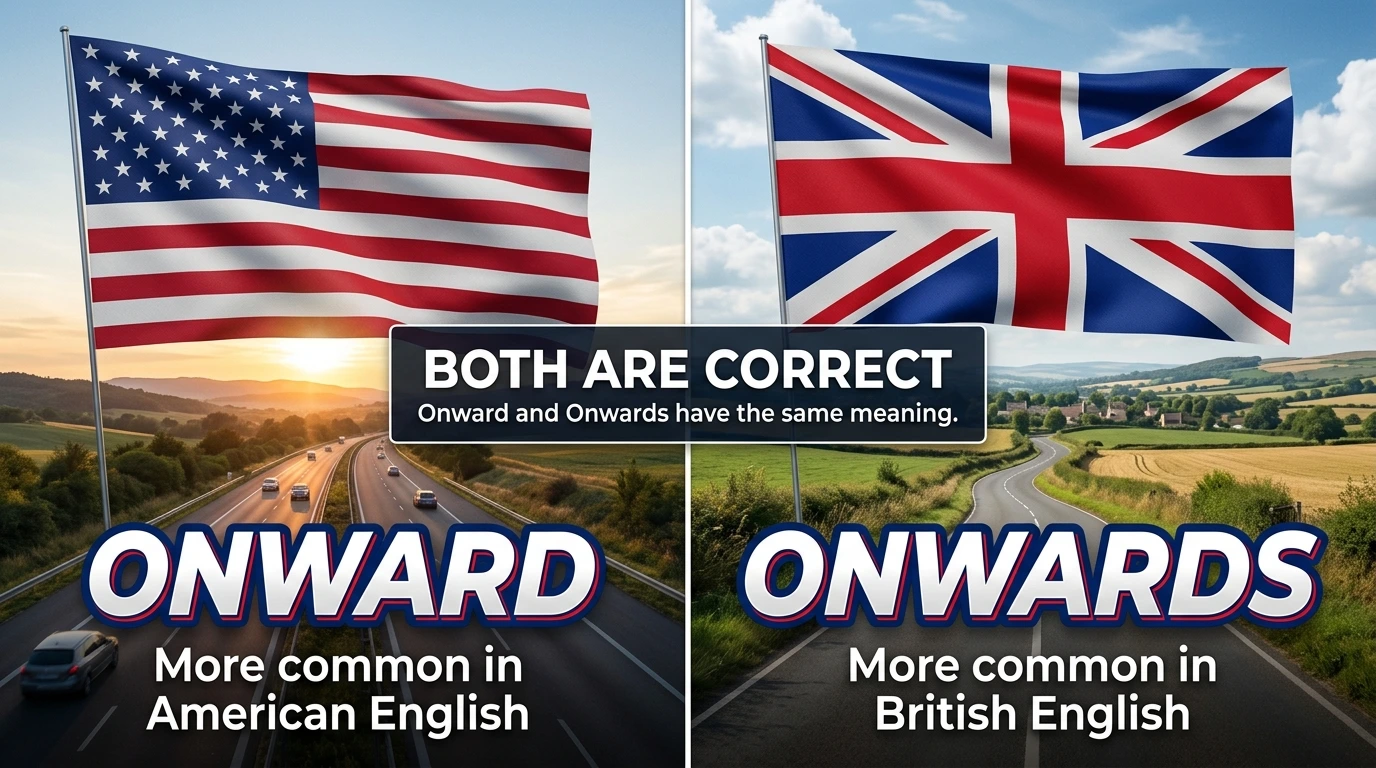
Onward and onwards have the same meaning.” The main difference is that onward is more common in American English, while onwards is more common in British English.
A few years ago, I was editing content for an international website when I noticed something interesting. One article said, “The project will move onward next month.” Another used, “The project will move onwards next month.” At first, it looked like someone had made a mistake.
After checking style guides and dictionaries, I discovered that both versions were correct.
That small discovery taught me a valuable lesson about English. Sometimes two words can mean exactly the same thing while still following different regional preferences.
If you’ve searched for onward or onwards, you’re probably wondering which version is correct, whether one sounds more professional, and which spelling you should use in your writing.
The good news is that the answer is simple once you understand how English works across different countries. By the end of this guide, you’ll know the difference, avoid common mistakes, and choose the best option for your audience.
Let’s move forward and clear up the confusion.
Onward or Onwards: Quick Answer
Both onward and onwards mean moving forward, continuing ahead, or progressing.
The meaning does not change.
Examples
- We traveled onward to the next city.
- The journey continued onwards through the mountains.
Both sentences are correct.
The choice usually depends on regional writing style.
The Origin: Background of Onward or Onwards
The word onward dates back centuries in English. It developed from combining “on” with a directional ending that suggested forward movement.
Later, the version onwards appeared with the added -s, much like other directional words:
- Toward → Towards
- Backward → Backwards
- Forward → Forwards
Over time, both forms became accepted.
Different English-speaking regions developed preferences.
American English generally favors forms without the extra -s.
British English often prefers versions ending in -s.
That is why both words exist today.
Neither is more correct than the other.
Onward or Onwards Explained: Key Differences or Variations
The biggest difference is regional preference.
| Term | Meaning | When to Use | Region/Context |
| Onward | Moving forward or continuing | General writing | More common in American English |
| Onwards | Moving forward or continuing | General writing | More common in British English |
Example Sentences
Onward
- The team moved onward after the challenge.
- From this point onward, we will follow new rules.
- She looked onward toward the future.
Onwards
- The group marched onwards through the valley.
- From now onwards, meetings will start earlier.
- The adventure continued onwards into the night.
Notice that the meaning stays exactly the same.
Which Version Should You Use?
The best choice depends on your audience.
For Students
Follow your school’s preferred style guide.
American schools usually favor onward.
British schools often use onwards.
For Bloggers
Choose one version and stay consistent.
Consistency helps your writing look polished.
For Business Professionals
Match your audience’s location.
- US audience → onward
- UK audience → onwards
For Academic Writing
Follow the style guide required by your institution or publisher.
For Global Audiences
Either version works.
Many international companies choose one style and use it consistently across all content.
Direct Recommendation
If you’re writing primarily for Americans, use onward.
If you’re writing primarily for British readers, use onwards.
Common Mistakes with Onward or Onwards
The words themselves are simple, but writers still make a few common errors.
| Mistake | Correct Form |
| onwardsly | onward or onwards |
| onword | onward |
| onwords | onwards |
| Mixing both forms in one article | Choose one style |
| Assuming one form is wrong | Both are correct |
Macau or Macao: The Complete Guide to the Right Name
Why These Mistakes Happen
Mistake 1: Mixing spelling systems
Writers often switch between British and American English.
Mistake 2: Overcorrecting
Some people believe the version with -s must be wrong.
Mistake 3: Typing too quickly
The words are easy to misspell because they sound similar.
Mistake 4: Ignoring audience expectations
Readers often expect spelling that matches their regional English.
Onward or Onwards in Real-World Examples
Professional Email
“From this point onward, all project updates will be shared weekly.”
News Headline
“Company Moves Onward After Major Expansion”
Social Media Post
“Excited for what lies ahead and onwards!”
Formal Report
“The organization will continue onward with its strategic plan.”
British Publication Example
“The charity’s work will continue onwards despite funding challenges.”
These examples show that both versions appear naturally in everyday writing.
Onward or Onwards: Data, Trends & Usage
Search interest remains strong because writers frequently encounter both forms online.
Who Searches Most?
- Students
- Bloggers
- Editors
- Business professionals
- English learners
- Content creators
Search Intent
The primary search intent is informational.
People want to know:
- Which version is correct
- Whether one is more formal
- Which spelling to use
- How regional English affects word choice
Regional Trends
- Onward appears more frequently in American publications.
- Onwards appears more frequently in British publications.
- Both are understood worldwide.
Why This Matters Today
Global communication means your audience may come from different countries. Understanding regional preferences helps your writing feel natural and professional.
Onward or Onwards Comparison Table
| Term/Variant | Meaning | Region/Context | Best Used When |
| Onward | Moving forward | American English | US-focused writing |
| Onwards | Moving forward | British English | UK-focused writing |
| Forward | Toward the front | Universal English | General direction |
| Forwards | Toward the front | Often British English | Informal movement references |
Frequently Asked Questions
Q: What does onward or onwards mean?
A: Both words mean moving forward, continuing ahead, or progressing. They have the same meaning and usage.
Q: How do you use onward or onwards correctly?
A: Choose the version that matches your audience. Use onward for American English and onwards for British English.
Q: Onward vs onwards : what’s the difference?
A: The only major difference is regional preference. The meaning remains exactly the same.
Q: Is onward acceptable in formal writing?
A: Yes. It is commonly used in formal documents, reports, academic writing, and professional communication.
Q: Which version is correct : onward or onwards?
A: Both are correct. Neither version is grammatically wrong.
Q: Where does onward come from?
A: It developed in English as a word meaning forward movement or progression. The form onwards later emerged as a regional variation.
Q: Can onward or onwards be used in business communication?
A: Absolutely. Both are widely accepted. The best choice depends on whether your audience uses American or British English.
Conclusion
The debate over onward or onwards is not about right versus wrong. It is about choosing the version that best fits your audience.
Remember these key points:
- Both words mean the same thing.
- Onward is more common in American English.
- Onwards is more common in British English.
- Both forms are correct in formal and informal writing.
- Consistency matters more than the choice itself.
The next time you encounter these words, you won’t need to stop and wonder which one is correct. Simply think about who you’re writing for and choose the version that matches their expectations.
Now you know exactly how to use onward or onwards go try it in your next piece of writing. Bookmark this guide so you never second-guess the difference again, and share it with someone who’s been confused about it.
Onward or onwards explained meaning, usage differences and examples Learn which version fits your audience and writing style best
Honoured or Honored: The Complete Usage Guide

As an English language enthusiast, I love diving into the tricky details of word differences and spelling variations. My mission is to explain confusing terms and make them accessible to everyone, helping readers to communicate with clarity and confidence.