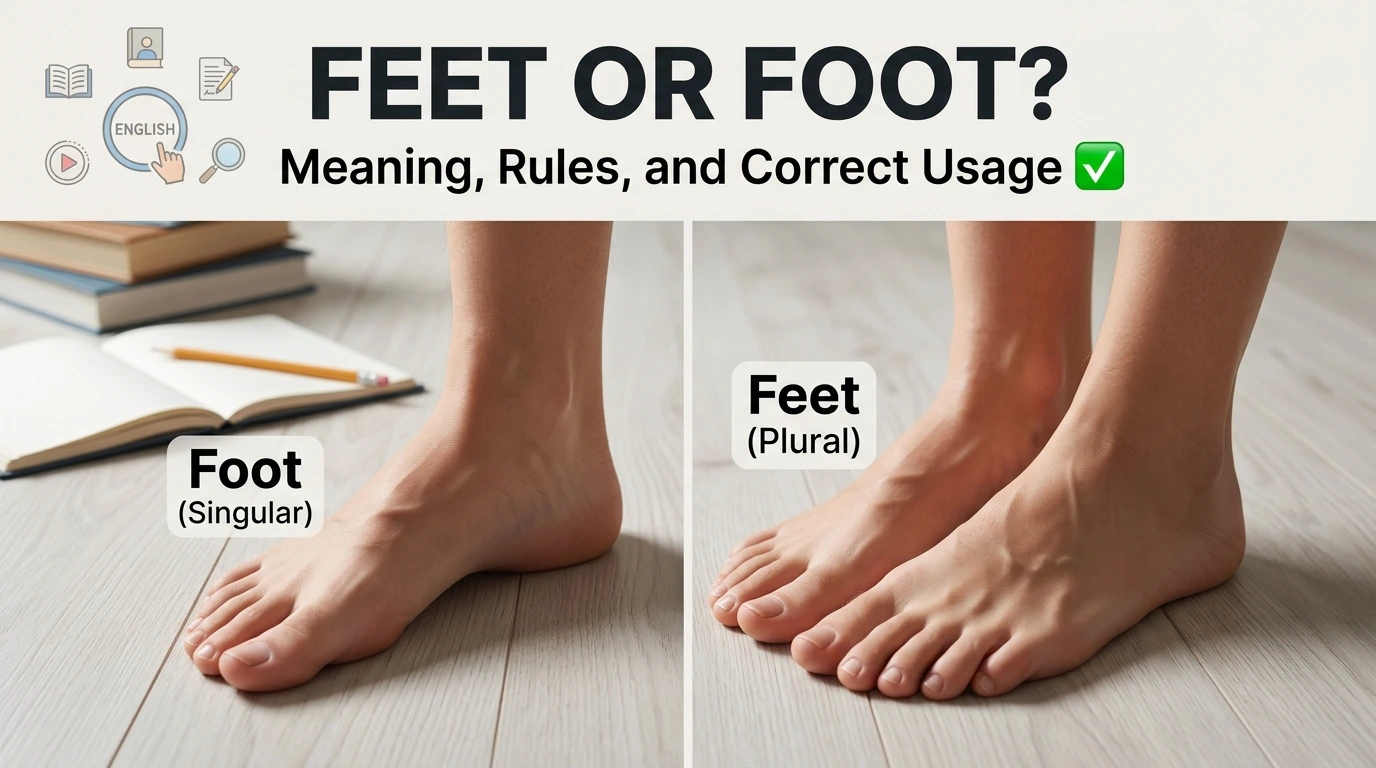
Foot is singular and refers to one foot, while feet is plural and refers to two or more feet.
A few years ago, while helping a student improve their English writing, I noticed the same mistake appear again and again. They would write sentences like, “My feet is sore” or “I have one feet.” The meaning was clear, but the grammar was not.
If you’ve ever paused while writing and wondered whether to use feet or foot, you’re not alone.
This is one of the most common English grammar questions for beginners and even intermediate learners. The confusion happens because foot does not follow the normal plural rule. Most English words simply add -s to become plural. For example, book becomes books. However, foot changes completely and becomes feet.
Understanding this difference is important for speaking, writing, school assignments, emails, and everyday conversations.
By the end of this guide, you’ll know exactly when to use foot and feet, how to avoid common mistakes, and why English uses these unusual forms in the first place.
Feet or Foot: Quick Answer
The difference is simple.
- Foot = one foot (singular)
- Feet = more than one foot (plural)
Examples
✅ I injured my foot while running.
✅ My feet were tired after the long walk.
Think of it this way:
- One = foot
- Two or more = feet
The Origin and Background of Feet or Foot
The story behind these words is surprisingly interesting.
The word foot comes from Old English fōt. Hundreds of years ago, English used different ways to form plurals. Instead of adding -s, some words changed their vowel sound.
That is exactly what happened with foot.
Over time:
- Foot → Feet
- Tooth → Teeth
- Goose → Geese
- Man → Men
These are known as irregular plurals.
Most English nouns now use -s for the plural form, but a small group of older words kept their traditional forms.
That is why we say feet instead of foots.
Feet or Foot Explained: Key Differences
The main difference involves number.
| Term | Meaning | When to Use | Region/Context |
| Foot | One foot | Singular situations | All English-speaking regions |
| Feet | Two or more feet | Plural situations | All English-speaking regions |
When to Use Foot
Use foot when talking about:
- One foot
- A single measurement unit
- One side of the body
Examples:
- My left foot hurts.
- The ladder is one foot wide.
- She stepped on my foot.
When to Use Feet
Use feet when talking about:
- Two feet
- Multiple people’s feet
- Measurements larger than one foot
Examples:
- My feet are cold.
- The room is ten feet long.
- Their feet were covered in mud.
Which Version Should You Use?
The answer depends on the number you are describing.
For Students
Use foot when referring to one.
Example:
- One foot was injured.
Use feet when referring to more than one.
Example:
- Both feet were wet.
For Writers
Check the number carefully.
- Singular noun = foot
- Plural noun = feet
For Measurements
Use:
- 1 foot
- 2 feet
- 5 feet
- 10 feet
Examples:
✅ The wall is one foot thick.
✅ The wall is six feet thick.
For Global English
The rule is the same in:
- American English
- British English
- Canadian English
- Australian English
No regional variation exists here.
Clothes or Cloths: Easy Guide to Never Mix Them Up
Common Mistakes with Feet or Foot
Many English learners make the same errors.
| Mistake | Correct Version |
| One feet | One foot |
| Two foot | Two feet |
| My feet is sore | My feet are sore |
| My foot are sore | My foot is sore |
| Ten foot tall | Ten feet tall |
Why These Mistakes Happen
Mistake 1: Using “feet” for one foot
❌ I hurt my feet.
✅ I hurt my foot.
This happens because learners remember the word but forget the singular form.
Mistake 2: Using “foot” for plural measurements
❌ The room is ten foot wide.
✅ The room is ten feet wide.
Plural numbers require feet.
Mistake 3: Incorrect verb agreement
❌ My feet is cold.
✅ My feet are cold.
Since feet is plural, use are.
Mistake 4: Forgetting irregular plurals
Many learners expect:
❌ foots
The correct plural is:
✅ feet
Feet or Foot in Real-World Examples
Professional Email
I injured my foot during training and may need a few days to recover.
News Headline
Runner Breaks Record in Six-Foot High Jump Event
Social Media Post
My feet are exhausted after walking around the city all day!
Formal Report
The structure measures twenty feet in height and five feet in width.
Everyday Conversation
My foot slipped on the wet floor.
My feet hurt after standing all day.
Feet or Foot: Data, Trends & Usage
Where Is This Topic Most Searched?
Interest is highest among:
- English learners
- Students
- ESL teachers
- Grammar enthusiasts
- Content writers
Which Audiences Care Most?
People searching for feet or foot often include:
- School students
- Language learners
- Test preparation candidates
- Professional writers
- Business professionals
Search Intent Category
Informational
Most users want a quick grammar answer and practical examples.
Why This Matters Now
English is used globally in education, work, and online communication. Small grammar mistakes can affect clarity and confidence. Understanding irregular plurals like foot and feet helps you communicate more accurately.
Comparison Table
| Term/Variant | Meaning | Region/Context | Best Used When |
| Foot | Singular form | Worldwide English | Referring to one foot |
| Feet | Plural form | Worldwide English | Referring to two or more feet |
| Foot (measurement) | Unit of length | Construction, engineering, daily use | One-foot measurement |
| Feet (measurement) | Multiple units of length | Construction, engineering, daily use | Two or more feet |
Frequently Asked Questions
Q: What does feet or foot mean?
A: Foot is the singular form, while feet is the plural form. They refer either to the body part or a unit of measurement.
Q: How do you use foot correctly?
A: Use foot when talking about one foot. Example: “My right foot hurts.”
Q: How do you use feet correctly?
A: Use feet when talking about two or more feet. Example: “My feet are tired.”
Q: Which version is correct: feet or foot?
A: Both are correct. The right choice depends on whether the noun is singular or plural.
Q: Is feet acceptable in formal writing?
A: Yes. Feet is the standard plural form and is fully accepted in academic, professional, and formal writing.
Q: Where does the word feet come from?
A: It comes from Old English, where some nouns changed vowels instead of adding -s to form plurals.
Q: Can feet be used for measurements?
A: Yes. For any measurement greater than one foot, use feet. Example: “The building is fifty feet tall.”
Conclusion
The difference between feet or foot is simple once you understand the rule.
Remember these key points:
- Foot means one foot.
- Feet means two or more feet.
- The plural is irregular.
- Foots is not correct.
- The same rule applies to body parts and measurements.
Whenever you’re unsure, check the number. If you’re talking about one, use foot. If you’re talking about more than one, use feet.
Mastering small grammar rules like this can make your writing clearer and more professional. Now you know exactly how to use feet or foot correctly. Bookmark this guide so you never second-guess the difference again, and share it with someone learning English.
Feet or foot explained clearly with meanings, grammar rules, examples, usage tips, and mistakes. Learn the correct choice.
Vallies or Valleys: The Easy Way to Spell It Right

As an English language enthusiast, I love diving into the tricky details of word differences and spelling variations. My mission is to explain confusing terms and make them accessible to everyone, helping readers to communicate with clarity and confidence.