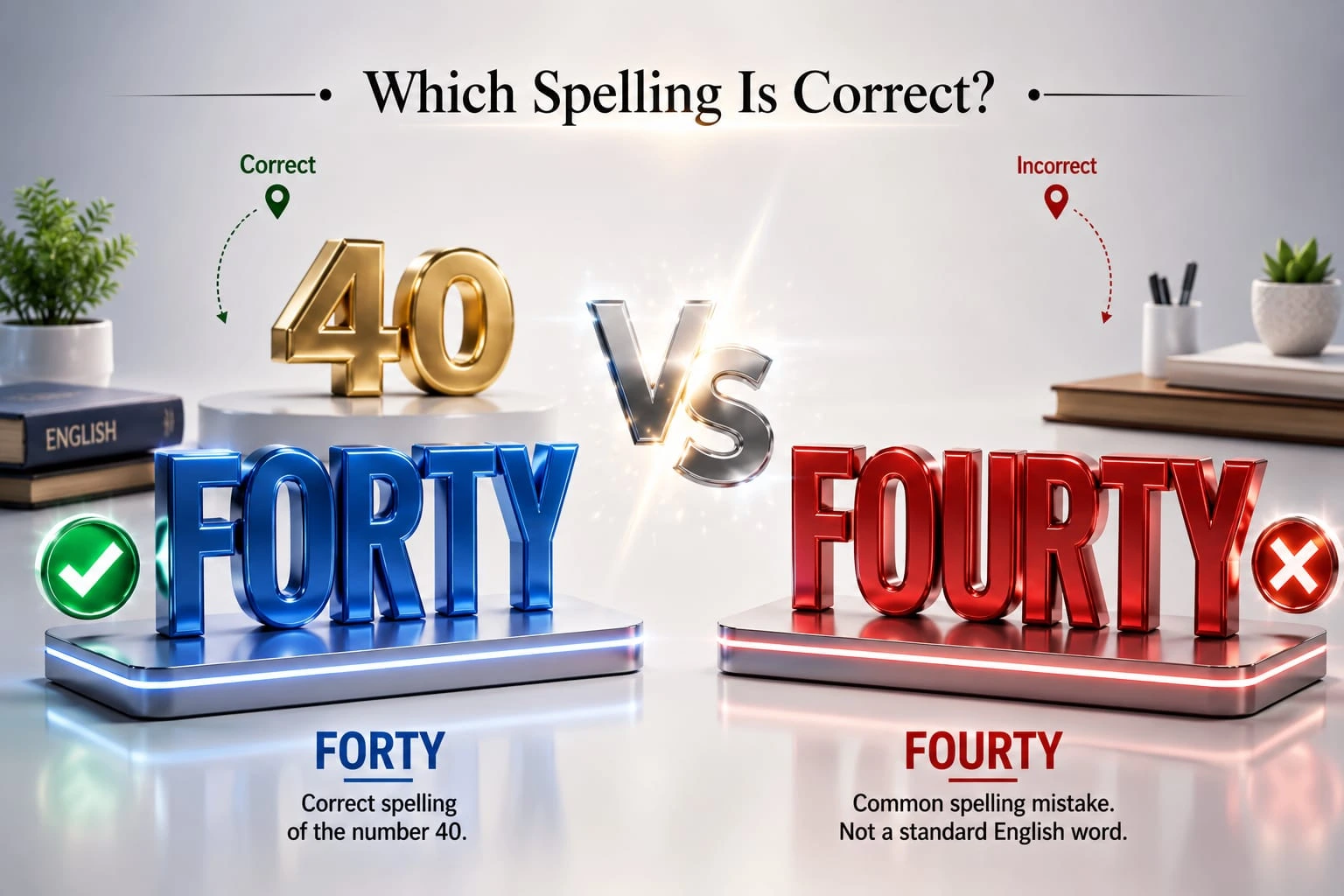
“Forty” is the correct spelling. “Fourty” is a common misspelling even though “four” has a u, its number-word “forty” drops it. ____________________________________________________________________________________________________
Years ago, I filled out a check and wrote “Fourty Dollars” across the top. The bank teller gave me a polite smile and asked me to rewrite it. I was embarrassed; I’d used “four” my whole life, so why didn’t “forty” have the same u?
If you’ve ever paused before writing this number, you’re far from alone. This is one of the most commonly misspelled numbers in English, and the reason is oddly simple once you see it.
This guide clears up exactly why “forty” drops the u, where the confusion comes from, and how to spell it correctly every single time: no more hesitating over checks, invoices, or emails.
Forty or Fourty: Quick Answer
“Forty” is always correct. “Fourty” is a spelling error, not an accepted alternative.
- ✅ She turned forty last week.
- ❌ She turned fourty last week.
The confusion happens because “four” keeps its u, but “forty” doesn’t. It’s one of the rare number words in English that doesn’t follow the base number’s spelling exactly.
The Origin of Forty
“Forty” comes from Old English feower·tig, meaning “four tens.” As English evolved through Middle English, the spelling of numbers shifted and simplified in different ways.
Here’s the twist: “four” kept its u from Old French influence, but “forty,” “fourteen,” and “fourth” didn’t all evolve identically.
- four → 4
- fourteen → keeps the u
- fourth → keeps the u
- forty → drops the u
Linguists believe “forty” lost its u simply through centuries of common usage and spelling drift — the word was written and spoken so often that the shorter form stuck. It’s an inconsistency, not a rule you can predict from “four” alone.
Forty Explained: Key Differences and Variations
| Word | Correct Spelling | Keeps the “u”? | Example |
| Four | Four | Yes | I have four apples. |
| Fourteen | Fourteen | Yes | She is fourteen years old. |
| Fourth | Fourth | Yes | He finished in fourth place. |
| Forty | Forty | No | The building is forty stories tall. |
Notice that “forty” is the outlier in this family of words — every other “four-” based number keeps the u, but “forty” doesn’t.
Which Spelling Should You Use?
- For everyday writing → Always use forty. There’s no context where “fourty” is correct.
- For students and ESL learners → Memorize “forty” as the one exception in the “four” word family.
- For professional or financial documents → Double-check checks, invoices, and contracts, since “fourty” often slips through in handwriting.
- For global or neutral use → “Forty” is standard across American, British, Australian, and all other English dialects — there’s no regional variation here.
Common Mistakes with Forty
Mistake 1: Writing “fourty” instead of “forty”
✅ We waited forty minutes for the bus.
❌ We waited fourty minutes for the bus.
Why it happens: Writers assume “forty” follows the same spelling as “four,” since it’s built from that number.
Mistake 2: Misspelling compound numbers
✅ forty-two, forty-five, forty-nine
❌ fourty-two, fourty-five, fourty-nine
Why it happens: The mistake carries over into every compound number built from “forty.”
Mistake 3: Confusing “forty” with “fourteen”
✅ She is forty years old. He is fourteen years old.
❌ She is fourty years old. He is fourteen years old. (mixing up which one needs the u)
Why it happens: The words look and sound similar, so writers assume they follow the same spelling rule.
Mistake 4: Writing checks or legal documents with “fourty”
✅ Pay to the order of: Forty dollars
❌ Pay to the order of: Fourty dollars
Why it happens: Formal, handwritten documents get less spellcheck support than typed text.
Mistake 5: Assuming spellcheck will always catch it
✅ Always proofread numbers written out in full.
❌ Relying only on autocorrect, which doesn’t always flag “fourty.”
Why it happens: Some spellcheck tools miss this error depending on settings and language packs.
Peak or Peek: The Complete Guide to Using the Right Word
Forty in Real-World Examples
Professional email:
“The project is now forty percent complete, with the remaining phase due next month.”
News headline:
“City Marks Forty Years Since Historic Bridge Opening”
Social media post:
“Turning forty and feeling better than ever. 🎉”
Formal document:
“The contract is valid for a period of forty days from the signing date.”
In every case, forty is the only correct spelling: regardless of tone or formality.
Forty or Fourty: Data, Trends & Usage
Search interest in “forty vs fourty” is steady year-round, with spikes around birthdays, financial documents, and back-to-school spelling lessons. This falls into the informational search category: people want a fast, reliable answer, often right before writing something formal like a check or a legal document.
ESL learners and students search this term often, since English number spelling doesn’t always follow predictable rules. Financial and legal professionals also check it regularly, since a check written with “fourty” can occasionally cause processing delays or confusion at the bank.
Forty vs Fourty: Comparison Table
| Term/Variant | Meaning | Region/Context | Best Used When |
| Forty | Correct spelling of the number 40 | Universal, all English dialects | Always in any writing context |
| Fourty | Misspelling, not a real word | None incorrect everywhere | Never avoid entirely |
| 40 | Numeral form | Universal | Casual writing, lists, data, forms |
Frequently Asked Questions
Q: What does “forty” mean?
A: “Forty” is the written-out form of the number 40, used in dates, ages, quantities, and financial documents.
Q: How do you use “forty” correctly in a sentence?
A: Use “forty” any time you’re writing the number 40 in words, such as “He ran forty miles” or “The class has forty students.”
Q: Forty vs fourty: what’s the difference?
A: There’s no real difference in meaning, since “fourty” isn’t a correct word at all. “Forty” is the only accepted spelling.
Q: Is “forty” acceptable in formal writing?
A: Yes, completely. “Forty” is the standard spelling in legal documents, checks, academic writing, and professional reports.
Q: Which version is correct: forty or fourty?
A: “Forty” is correct. “Fourty” is a spelling error that doesn’t appear in any English dictionary.
Q: Where does the word “forty” come from?
A: It comes from Old English feowertig, meaning “four tens.” Over time, the spelling simplified and dropped the u that “four” kept.
Q: Can “forty” be used in casual conversation and texting?
A: Yes. The spelling never changes based on tone, it’s “forty” whether you’re texting a friend or signing a contract.
Final Takeaway
Here’s the short version. “Forty” is always correct. “Fourty” is always wrong.
Key points to remember:
- The rule: “Forty” drops the u that “four,” “fourteen,” and “fourth” all keep
- Memory trick: Think of “forty” as the exception in the “four” family, not the rule
- Watch compound numbers too: It’s “forty-two,” never “fourty-two”
- No exceptions: “Forty” is standard in every English dialect, formal or casual
Once you remember that “forty” breaks the pattern, you’ll never write “fourty” again.
Bookmark this guide so you never second-guess “forty” vs “fourty” again and share it with anyone who’s made the same mistake on a check or an email.
Suit or Suite? The Complete Guide to the Correct Word🏨

As an English language enthusiast, I love diving into the tricky details of word differences and spelling variations. My mission is to explain confusing terms and make them accessible to everyone, helping readers to communicate with clarity and confidence.