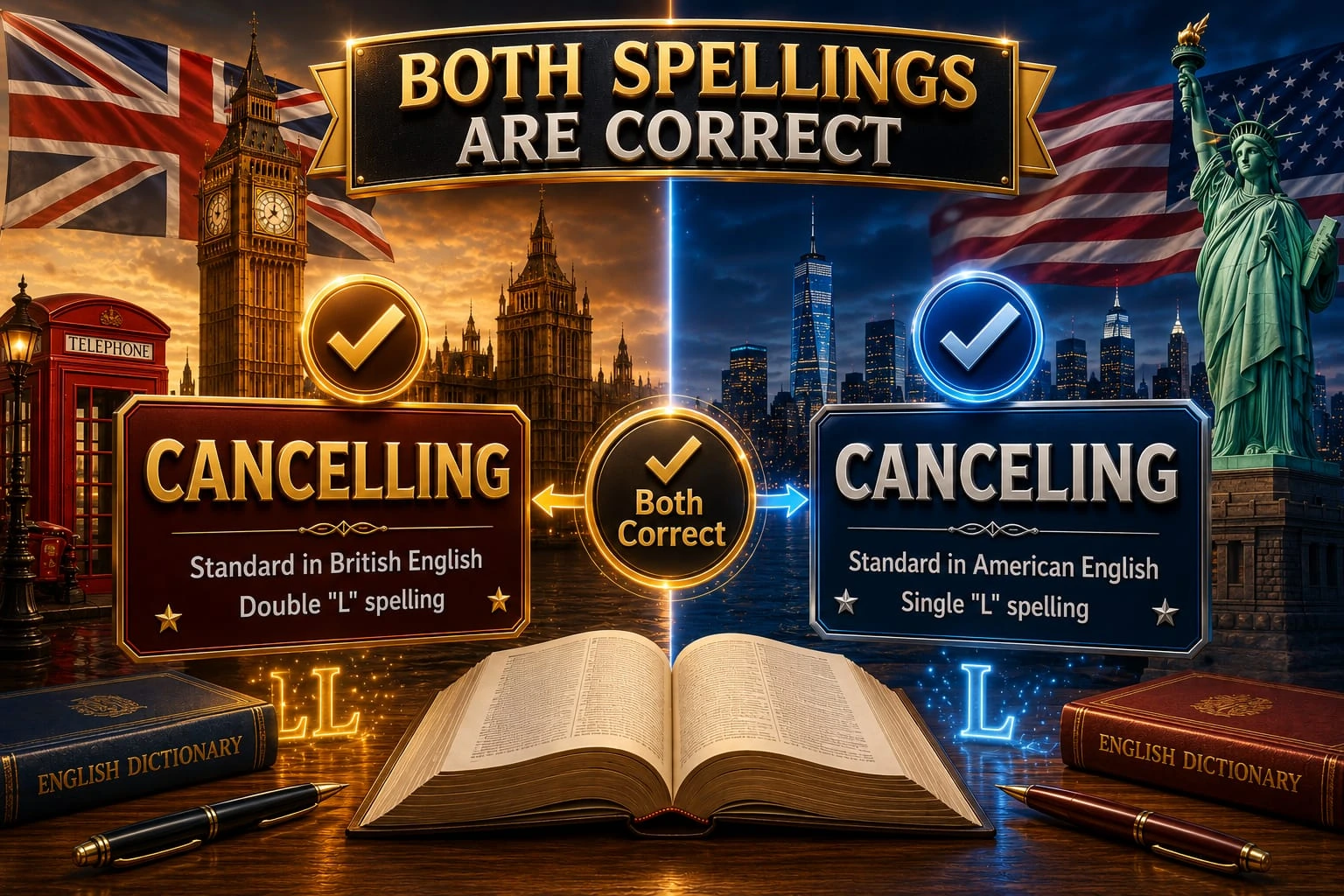
Both "cancelling" and "canceling" are correct. "Canceling" is the standard spelling in American English, while "cancelling" is standard in British and Commonwealth English.
I once drafted a customer service email that read, “We are canceling your subscription as requested.” My manager, who studied in London, changed it to “cancelling” before it went out. I assumed she’d made a typo. She hadn’t.
Turns out, both spellings are correct, and the difference comes down to which side of the Atlantic you’re writing for. This is one of those words that dictionaries accept in two forms, yet almost nobody explains the actual rule behind it.
If you’ve ever paused mid-sentence wondering whether to double that L, you’re definitely not alone. This is one of the most commonly searched spelling questions in business and customer service writing.
This guide breaks down exactly when to use “canceling,” when to use “cancelling,” and the simple rule that explains the whole split.
Cancelling or Canceling: Quick Answer
Both spellings are correct. The difference is regional, not grammatical.
- ✅ American English: “The airline is canceling several flights today.”
- ✅ British English: “The airline is cancelling several flights today.”
The rule to remember: American English tends to use a single L before adding -ing or -ed, while British English tends to double it.
The Origin of Cancelling/Canceling
“Cancel” comes from the Latin word cancellare, meaning to cross out or make void, related to the lattice pattern of a “cancelli,” or crossed bars. English absorbed the word centuries ago, and like many verbs, it needed a consistent rule for adding endings like -ing and -ed.
Here’s where the split began. English spelling reform in the United States, largely influenced by Noah Webster in the early 1800s, favored simpler spellings with fewer doubled letters. British English kept the older convention of doubling the final consonant in many two-syllable words ending in a single vowel plus consonant.
This same pattern shows up in other verb pairs:
- travel → traveling (US) / travelling (UK)
- label → labeling (US) / labelling (UK)
- cancel → canceling (US) / cancelling (UK)
“Cancel” isn’t an isolated case. It’s part of a whole family of words that split the same way, all tracing back to that same 19th-century American spelling reform.
Cancelling vs Canceling Explained: Key Differences and Variations
| Term | Meaning | When to Use | Region/Context |
| Canceling | Present participle of “cancel” | American English writing | US audiences, American style guides |
| Cancelling | Present participle of “cancel” | British English writing | UK, Australian, Canadian, Indian audiences |
| Canceled | Past tense of “cancel” | American English writing | US audiences |
| Cancelled | Past tense of “cancel” | British English writing | UK and Commonwealth audiences |
Notice the same single-L versus double-L pattern applies to both the -ing form and the past tense form, not just one or the other.
Which Spelling Should You Use?
For American audiences
Use canceling and canceled. Most US style guides, including AP style, favor the single-L spelling.
For British or Commonwealth audiences
Use cancelling and cancelled. This is standard across the UK, Australia, Canada, and India.
For global or mixed audiences
Either spelling works, but stay consistent throughout the same document or website.
For business and customer service writing
Match your company’s primary market. A US-based company writing to American customers should default to “canceling,” while a UK-based company should use “cancelling.”
Common Mistakes with Cancelling/Canceling
Mistake 1: Mixing spellings within the same document
✅ We are canceling your order, and your refund has been processed.
❌ We are cancelling your order, and your refund has been canceled.
Why it happens: Writers switch unconsciously, especially when copy-pasting from different templates or sources.
Mistake 2: Assuming one spelling is simply “wrong”
✅ Both “canceling” and “cancelling” are correct, depending on dialect.
❌ “Cancelling” is a typo for “canceling.”
Why it happens: People assume American English spelling rules apply universally, when they don’t.
Mistake 3: Ignoring the same rule in past tense
✅ The flight was canceled. (US) The flight was cancelled. (UK)
❌ The flight was canceled in a British-audience document, or cancelled in an American one, without checking style.
Why it happens: Writers remember the -ing rule but forget it also applies to the past tense form.
Mistake 4: Inconsistent spelling in SEO or marketing content
✅ Pick one spelling for your target audience and use it throughout your website.
❌ Alternating between “canceling” and “cancelling” across different blog posts on the same site.
Why it happens: Multiple writers on one team may each default to their own regional habit.
Mistake 5: Overcorrecting a colleague’s writing
✅ Recognize regional spelling differences before editing someone else’s work.
❌ Changing every “cancelling” to “canceling” without checking the intended audience.
Why it happens: Writers assume their own regional spelling is the only correct standard.
Judgements or Judgments: Which Spelling Is Correct?
Cancelling/Canceling in Real-World Examples
Professional email:
“We regret to inform you that your appointment is being canceled due to a scheduling conflict.”
News headline:
“Airline Cancelling Dozens of Flights Amid Staff Shortages”
Social media post:
“Just canceling my plans for tonight, self-care day instead. 🛁”
Formal document:
“This agreement may be cancelled by either party with thirty days written notice.”
Notice how both spellings fit naturally, the right choice simply depends on the audience reading the message.
Cancelling/Canceling: Data, Trends & Usage
Search interest in “cancelling vs canceling” spikes heavily around subscription services, flight disruptions, and event postponements, when businesses need to communicate clearly and consistently. This falls into the informational search category, with customer service teams, editors, and content writers checking the correct spelling before publishing.
American users search “canceling” far more often, while UK, Australian, and Indian users lean toward “cancelling.” This mirrors the same regional pattern seen in “traveling/travelling” and “labeling/labelling”, confirming this isn’t a random inconsistency, but a predictable spelling pattern tied to Noah Webster’s American spelling reforms.
Cancelling vs Canceling: Comparison Table
| Term/Variant | Meaning | Region/Context | Best Used When |
| Canceling | Present participle of cancel (single L) | American English | Writing for a US audience |
| Cancelling | Present participle of cancel (double L) | British and Commonwealth English | Writing for UK, Australian, or Canadian audiences |
| Canceled/Cancelled | Past tense forms, same regional split | US (canceled) / UK (cancelled) | Match your audience’s dialect |
Frequently Asked Questions
Q: What does “cancelling” or “canceling” mean?
A: Both words mean the act of stopping or voiding something that was previously planned, such as an order, a flight, or a subscription. The meaning is identical, only the spelling changes by region.
Q: How do you use “canceling” correctly in a sentence?
A: Use “canceling” the same way you’d use “cancelling,” for example, “She is canceling her gym membership” works exactly like “She is cancelling her gym membership.”
Q: Cancelling vs canceling, what’s the difference?
A: The difference is regional, not grammatical. American English uses a single L, while British English doubles the L. Both are equally correct.
Q: Is “cancelling” acceptable in formal writing?
A: Yes, especially in British, Australian, or Commonwealth contexts. American style guides like AP typically prefer “canceling” instead.
Q: Which version is correct, cancelling or canceling?
A: Both are correct. Choose based on your audience’s region, and stay consistent throughout your writing.
Q: Where does the word “cancel” come from?
A: It comes from the Latin word cancellare, meaning to cross out, related to a lattice or crossed-bar pattern used to mark something void.
Q: Can “canceling” be used in British English?
A: It’s understood perfectly, but it’s less common. British readers will typically expect “cancelling” in formal or published writing.
Final Takeaway
Here’s the short version. Both “canceling” and “cancelling” are correct, the choice depends on your audience, not on right versus wrong.
Key points to remember:
- The rule: American English uses a single L; British English doubles the L
- Same pattern in past tense: Canceled (US) versus cancelled (UK)
- Part of a bigger family: This split matches “traveling/travelling” and “labeling/labelling”
- Consistency matters: Pick one style per document and stick with it
Once you know your audience, choosing between “canceling” and “cancelling” becomes automatic.
Bookmark this guide so you never second-guess “canceling” vs “cancelling” again, and share it with anyone writing customer emails or business documents.
Onward or Onwards: The Complete Usage Guide ✅

As an English language enthusiast, I love diving into the tricky details of word differences and spelling variations. My mission is to explain confusing terms and make them accessible to everyone, helping readers to communicate with clarity and confidence.