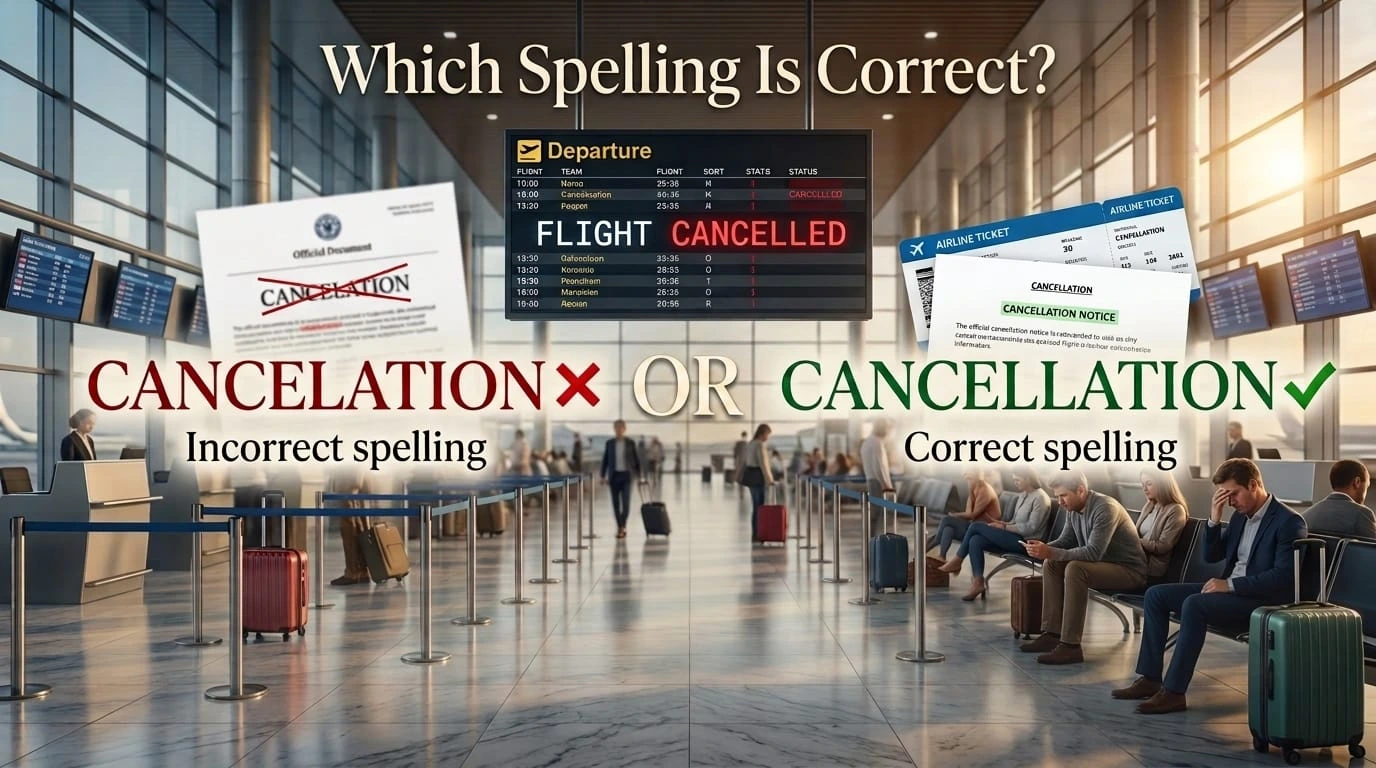
The correct spelling is cancellation with two ls. Cancelation is an accepted but much less common variant in American English. ____________________________________________________________________________________________________
A few years ago, I was proofreading an article for a client when one word stopped me in my tracks: cancelation. My first thought was that it had to be a typo. But after checking several trusted dictionaries, I discovered something surprising. While cancellation is the standard spelling used around the world, cancelation is also listed as an accepted variant in some American dictionaries.
That small discovery reminded me how confusing English spelling can be. Just when you think you’ve memorized the rules, a word comes along that makes you question everything.
If you’ve searched for cancelation or cancellation, you’re probably wondering which spelling is actually correct. Maybe you’re writing an email, preparing a report, creating website content, or finishing a school assignment. You don’t want to use the wrong spelling or look unprofessional.
The good news is that the answer is simpler than it first appears. In this guide, you’ll learn the difference between the two spellings, why both exist, where each one is used, and which version you should choose with confidence.
Cancelation or Cancellation: Quick Answer
The short answer is simple.
Cancellation is the standard and preferred spelling in both British English and American English. It appears far more often in books, newspapers, business writing, and academic publications.
Cancelation, on the other hand, is a recognized American English variant, but it is much less common.
Examples
✅ The airline announced the cancellation of all flights due to severe weather.
✅ We received a cancellation notice by email this morning.
⚠️ The event’s cancelation surprised many guests.
(Technically acceptable in American English, but uncommon.)
Quick tip: If you’re unsure which spelling to use, choose cancellation. It is the version that almost everyone expects to see.
The Origin and Background of Cancellation
Understanding where these spellings come from makes the difference much easier to remember.
The word cancel comes from the Latin word cancellare, meaning to cross out or strike through. It later entered Old French before becoming part of the English language.
As English evolved, the noun cancellation developed by adding the suffix -ation to the verb cancel.
This is where things became slightly confusing.
In English, many words ending with a stressed final syllable double the final l before adding a suffix.
For example:
- travel → travelling (British English)
- compel → compelling
- cancel → cancellation
Because of this spelling pattern, cancellation naturally became the dominant form.
So where did cancelation come from?
Some American spelling reformers preferred simpler spellings that removed what they saw as unnecessary doubled letters. As a result, cancelation appeared in dictionaries as an alternative spelling.
However, unlike words such as color or center, this simplified version never became the standard.
Today, most publishers, universities, newspapers, businesses, and style guides still recommend cancellation.
Why Do People Get Confused?
There are several reasons this word causes uncertainty.
1. Both spellings appear in dictionaries.
Seeing both versions listed makes many writers think they are equally common.
They are not.
2. American English sometimes simplifies spelling.
Many people assume the American version always removes extra letters.
For example:
- travelled → traveled
- travelling → traveling
That assumption leads people to believe cancelation should also be standard.
In reality, cancellation remains much more common.
3. Spell checkers vary.
Some spell-check tools accept both spellings, while others automatically correct cancelation to cancellation.
Cancelation vs Cancellation Explained
Although these words look different, their meanings are exactly the same.
Both refer to:
- ending an event
- calling something off
- stopping an agreement
- withdrawing a reservation
- terminating a service
The only real difference is which spelling people expect to see.
| Term | Meaning | When to Use | Region / Context |
| Cancellation | The act of canceling something | Recommended for nearly all writing | Worldwide, business, education, publishing, media |
| Cancelation | Same meaning | Rare alternative spelling | Occasionally appears in American English |
Example 1
✅ Flight cancellation due to heavy snow.
⚠️ Flight cancelation due to heavy snow.
Both are technically correct, but the first version looks much more natural.
Example 2
Business Email
✅ Your subscription cancellation has been processed.
This is the wording customers expect from banks, airlines, streaming services, and online businesses.
Example 3
School Assignment
✅ The cancellation of classes was announced early in the morning.
Teachers and examiners almost always expect this spelling.
Cancellation in Different Types of Writing
Here’s where you’ll usually see cancellation:
- Business emails
- Legal documents
- Airline notices
- Hotel booking policies
- Academic papers
- Government websites
- News articles
- Professional blogs
- Books
- Official announcements
Finding cancelation in these settings is quite rare.
Comparison Table: Cancelation vs Cancellation
| Term/Variant | Meaning | Region/Context | Best Used When |
| Cancellation | The act of ending or calling off something | Standard worldwide; preferred in British and American English | Academic writing, professional communication, websites, books, emails, legal documents, and international audiences |
| Cancelation | Same meaning | Rare American English variant | Only if following a style guide that specifically allows or prefers it |
Which Version Should You Use?
Now that you know both spellings are accepted, the next question is simple: Which one should you actually use?
For almost every situation, the answer is cancellation.
It is the spelling most readers recognize. It also matches the style used by major dictionaries, publishers, universities, businesses, and news organizations.
Here is a quick guide.
If You’re a Student
Use cancellation.
Teachers, professors, and examiners expect this spelling in essays, assignments, and research papers.
Example:
The cancellation of the exam was announced on Friday.
If You’re a Professional
Choose cancellation for emails, reports, proposals, and presentations.
It looks polished and avoids distracting your readers.
Example:
Your membership cancellation request has been approved.
If You’re Writing for an International Audience
Use cancellation.
Readers in the UK, Canada, Australia, New Zealand, and most English-speaking countries expect this spelling.
If You’re Writing Only for American Readers
Although cancelation is accepted by some American dictionaries, cancellation is still far more common.
Unless a specific style guide tells you otherwise, stick with cancellation.
Quick Recommendation
| Audience | Best Choice |
| Students | Cancellation |
| Professionals | Cancellation |
| Bloggers | Cancellation |
| Businesses | Cancellation |
| International Readers | Cancellation |
| General American English | Cancellation |
Bottom line: You can confidently use cancellation in almost every piece of writing.
Common Mistakes with Cancelation or Cancellation
Many writers don’t confuse the meaning: they confuse the spelling.
Here are some common mistakes and how to fix them.
| ❌ Mistake | ✅ Correct |
| Your cancelation request is approved. | Your cancellation request is approved. |
| Flight cancelation fees apply. | Flight cancellation fees apply. |
| Event cancelation notice. | Event cancellation notice. |
| Class cancelation due to rain. | Class cancellation due to rain. |
| Membership cancelation form. | Membership cancellation form. |
Why Do These Mistakes Happen?
- People assume American English always removes doubled letters.
- Some spell-check tools accept both spellings.
- Writers copy uncommon spellings from older websites.
- The word cancel itself has only one l, making the noun feel inconsistent.
A simple rule can help:
When adding “-ation” to “cancel,” write “cancellation” with two “l”s.
Cancelation or Cancellation in Real-World Examples
Seeing the word in context makes it easier to remember.
Professional Email
Due to unexpected weather conditions, the cancellation of tomorrow’s meeting has been confirmed.
News Headline
Heavy snowfall causes cancellation of hundreds of flights.
Social Media Post
We’re sorry for the cancellation of tonight’s concert. New dates will be announced soon.
Formal Report
The project experienced significant delays following the cancellation of the supplier agreement.
Hotel Booking
Free cancellation is available up to 48 hours before check-in.
School Notice
The principal announced the cancellation of all outdoor activities because of extreme heat.
These examples reflect how the word appears in everyday English.
Cancelling or Canceling: The Correct Spelling Explained (2026)
Cancelation or Cancellation: Data, Trends & Usage
The confusion around this spelling continues because both forms exist in dictionaries. However, their real-world usage is very different.
Search Intent
The keyword cancelation or cancellation has an informational search intent.
People usually want to know:
- Which spelling is correct.
- Whether both spellings are acceptable.
- Which version should be used in formal writing.
- Whether British and American English use different spellings.
Who Searches for This?
The topic is especially popular among:
- Students
- Teachers
- Editors
- Content writers
- Bloggers
- Copywriters
- Business professionals
- English language learners
Where Is It Most Relevant?
Questions about this spelling commonly come from countries where English is widely used, including:
- United States
- United Kingdom
- Canada
- Australia
- India
- Pakistan
Current Usage Insight
Although cancelation still appears occasionally, cancellation dominates modern English.
It is the spelling used on airline websites, government portals, banking platforms, universities, newspapers, and major online publications.
That widespread use makes cancellation the safest and most trusted choice for nearly every audience.
Frequently Asked Questions
Q1: Which is correct, cancelation or cancellation?
Cancellation is the preferred and standard spelling. Cancelation is an accepted but uncommon American English variant.
Q2: Is cancelation a real word?
Yes. Some American dictionaries list cancelation as a valid alternative spelling. However, it is rarely used in modern writing.
Q3: Which spelling should I use in formal writing?
Use cancellation for academic papers, business documents, legal writing, and professional communication. It is the safest and most widely accepted choice.
Q4: Why does cancellation have two “l”s?
The spelling follows a long-established English word formation pattern where cancel becomes cancellation by adding the suffix -ation with a doubled l.
Q5: Does British English use cancelation?
No. British English almost always uses cancellation.
Q6: Do American dictionaries accept both spellings?
Some do. However, even in the United States, cancellation is much more common in books, newspapers, websites, and professional writing.
Q7: Can I use cancelation in business emails?
You technically can if your style guide allows it. However, cancellation is the better choice because it looks more familiar and professional.
Conclusion
Choosing between cancelation or cancellation doesn’t have to be confusing. While both spellings can be found in dictionaries, they are not used equally.
The clear winner is cancellation. It is the standard spelling across British English and the preferred form in American English. You’ll see it in business emails, legal documents, news reports, academic writing, and everyday communication.
Remember these key points:
- Cancellation is the standard and recommended spelling.
- Cancelation is a rare American English variant.
- Both words have the same meaning.
- For professional, academic, and international writing, always choose cancellation.
Using the standard spelling helps your writing look polished, credible, and easy to understand. It also prevents readers from questioning whether you’ve made a spelling mistake.
Now that you know the difference between cancelation or cancellation, you can write with confidence every time. Bookmark this guide so you never second-guess the spelling again, and share it with anyone who’s ever paused over this tricky word.
Forty or Fourty: The Correct Spelling (2026)

As an English language enthusiast, I love diving into the tricky details of word differences and spelling variations. My mission is to explain confusing terms and make them accessible to everyone, helping readers to communicate with clarity and confidence.