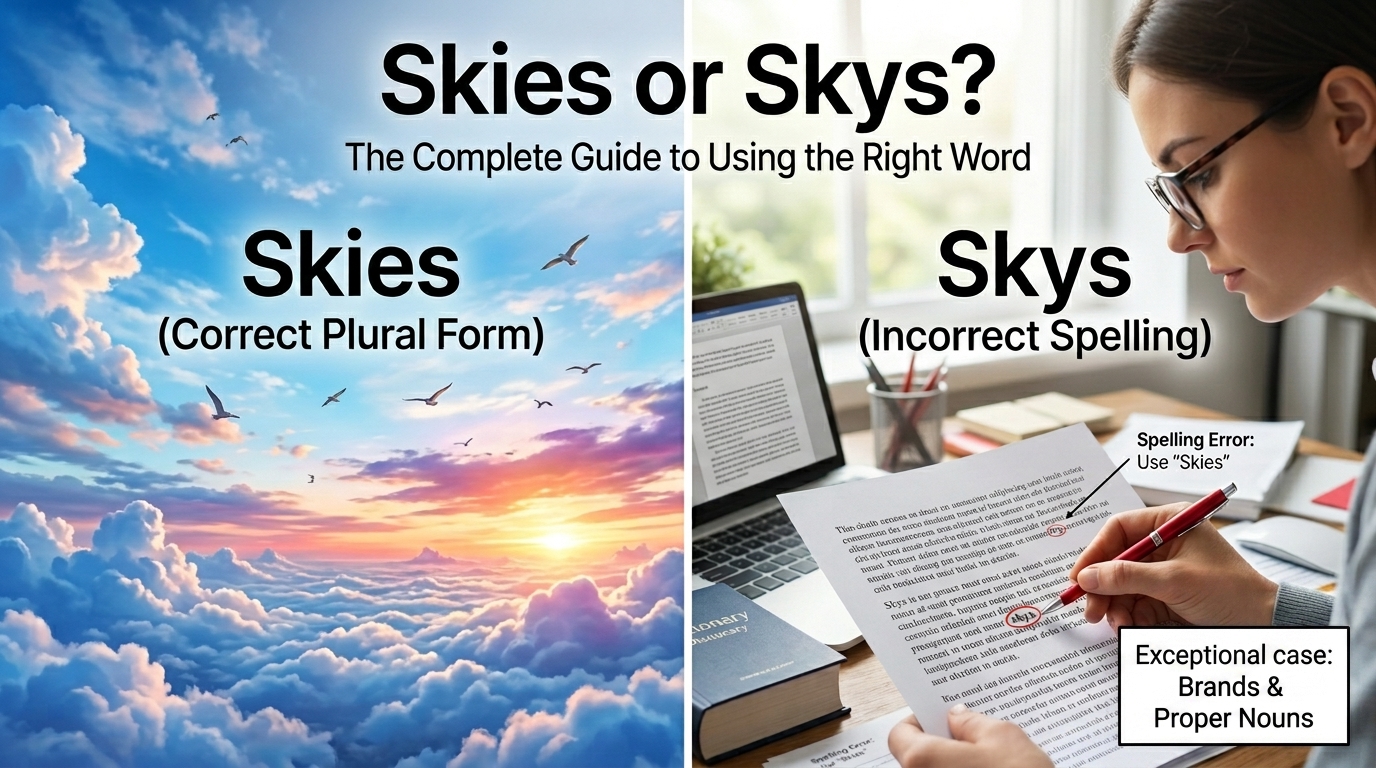
The correct plural of “sky” is skies ,not “skys.” For example: “The skies over the mountains turned pink at sunset.” Use “skys” only in rare cases, like a proper noun or brand name.
I still remember the moment I second-guessed myself mid-sentence.
I was writing a travel blog about Pakistan’s northern valleys. I typed “the skys above Hunza”, then stopped. Something felt off. I deleted it, typed “skies,” then deleted that too.
For a full minute, I stared at the screen.
Here’s the thing: I had been teaching English for over a decade at that point. And I still wasn’t sure.
That’s when I realized ,this tiny word trips up even experienced writers. Native speakers doubt themselves. ESL learners avoid using it altogether. And most grammar guides bury the answer in dense, boring text.
This article fixes that. You’ll learn exactly which spelling is correct, when (and why) “skys” ever appears, and how to use this word confidently in emails, essays, and everything in between.
Let’s settle this once and for all.
Skies or Skys : Quick Answer
“Skies” is always the correct plural form of “sky.”
English follows a rule for words ending in a consonant + “y”: drop the “y” and add “-ies.” So:
- sky → skies ✅
- sky → skys ❌
Simple examples:
- “The skies were clear all week.”
- “We photographed skies across three continents.”
There is no standard context in modern English where “skys” is grammatically correct as a plural noun.
The Origin of “Sky” : Where the Confusion Begins
The word sky comes from the Old Norse word ský, meaning “cloud.” It entered Middle English around the 13th century. Back then, it was used to describe clouds specifically — not the whole atmosphere.
Over time, English borrowed the word and expanded its meaning. It came to represent the entire visible expanse above us: blue, grey, stormy, or starred.
Now, here’s where writers get confused.
Most nouns ending in “-y” simply add “-s” to form plurals: day → days, bay → bays. But those examples end in a vowel + y. Sky ends in a consonant + y (the consonant being “k”). That triggers a different rule entirely drop the “y,” add “-ies.”
Nobody taught this distinction clearly enough. That’s why “skys” feels plausible to so many people. It looks like it should work. It just doesn’t.
Skies vs. Skys : Key Differences Explained
Let’s break this down cleanly.
| Term | Correct? | When It Appears | Region/Context |
| Skies | ✅ Yes | Plural of sky in all standard use | Global English |
| Skys | ❌ No | Misspelling or typo | N/A |
| Skys (proper noun) | ✅ Sometimes | Brand names, surnames | Brand/personal use |
| Sky’s | ✅ Yes | Possessive singular (belonging to the sky) | All contexts |
| Skies’ | ✅ Yes | Possessive plural | Formal/poetic writing |
Note on proper nouns: “Skys” can appear in brand names (like a product called “Skys”) or as someone’s last name. In those cases, the standard grammar rule doesn’t apply.
Which Version Should You Use?
For students and ESL learners: Always write skies. It’s the only correct plural form. Memorize the rule: consonant + y → drop “y,” add “-ies.”
For professional writers and bloggers: Use skies without hesitation in articles, scripts, and content. “Skys” will flag as an error in every spell-checker and signal carelessness to readers.
For creative writers and poets: “Skies” also gives you more flexibility. “Beneath painted skies” sounds natural. “Beneath painted skys” looks wrong and breaks the reader’s flow.
For brand or product naming: If “Skys” is your brand name, own it , but make the intentional choice clear in your branding so readers don’t assume it’s a typo.
The rule to remember:
Words ending in consonant + Y → always “-ies” for the plural. fly → flies, city → cities, sky → skies
Common Mistakes Writers Make
Here are the five errors that come up again and again and how to fix them.
Mistake 1: Writing “skys” as the plural
- ❌ “The skys were beautiful.”
- ✅ “The skies were beautiful.”
- Why it happens: Writers apply the simpler “-s” rule without thinking about the consonant-y exception.
Mistake 2: Confusing “sky’s” with “skies”
- ❌ “The sky’s were cloudy all week.”
- ✅ “The skies were cloudy all week.”
- Why it happens: The apostrophe-s pattern feels natural but signals possession, not plural.
Mistake 3: Over-capitalizing in poetic writing
- ❌ “Under many Skies” (unless it’s a title)
- ✅ “Under many skies”
- Why it happens: Sky feels like a grand, important word. It’s still a common noun.
Mistake 4: Using “skies” as a verb
- ❌ “He skies the ball over the fence.”
- ✅ “He sends the ball over the fence.”
- Why it happens: “Skies” can technically be used as a third-person verb (to sky a ball), but it’s rare and confusing. Avoid it in most writing.
Mistake 5: Forgetting the possessive forms
- ❌ “The skies color changed.”
- ✅ “The sky’s color changed.” (singular possessive)
- ✅ “Beneath the skies’ endless reach” (plural possessive — poetic)
Skies in Real : World Examples
Seeing a word in context cements it. Here are natural uses across four common formats:
Professional email:
“Our drone photography team captured the skies above Dubai during the early morning shoot.”
News headline:
“Wildfire Smoke Darkens Skies Across Western Canada for Third Day”
Social media post:
“No filter needed. The skies here do all the work. 🌅 #TravelPakistan #Hunza”
Formal report:
“Atmospheric monitoring revealed that skies over the region maintained above-average particulate levels throughout the quarter.”
In every example, skies flows naturally. Not once does “skys” fit
Master’s or Masters: Easy Guide to Correct Usage
Skies or Skys : Search Data, Trends & Usage
According to Google Trends data, “skies or skys” and “plural of sky” are consistently searched across English-speaking countries — especially in the UK, India, Pakistan, and the United States.
The search intent is purely informational. People aren’t buying anything. They just want a fast, reliable answer.
Interestingly, most searches spike during travel season and among ESL learners preparing for exams like IELTS and TOEFL. The word appears frequently in descriptive writing prompts , making it a high-frequency grammar concern for test-takers.
The takeaway? This isn’t a rare edge case. Millions of people type this question every year. And most of the top results bury the answer in cluttered, hard-to-scan pages.
Now you have it in 30 seconds flat.
Full Comparison Table
| Term/Variant | Meaning | Region/Context | Best Used When |
| Skies | Plural of sky | Global English | Always — standard plural form |
| Skys | Misspelling | N/A — avoid | Never in standard writing |
| Sky’s | Possessive of sky (singular) | All formal/informal contexts | “The sky’s color,” “sky’s limit” |
| Skies’ | Possessive of skies (plural) | Poetic or literary writing | “Beneath the skies’ vast expanse” |
| Skys (brand) | Proper noun spelling | Product/brand naming only | Only when it’s a named brand |
Frequently Asked Question : Skies or Skys
Q: Is “skies” or “skys” correct? A: “Skies” is always correct as the plural of sky. “Skys” is a misspelling in standard English. The rule is: consonant + y words drop the “y” and add “-ies” in their plural form.
Q: Why do people write “skys” if it’s wrong? A: Because most plural nouns just add “-s,” people apply that habit automatically. The consonant-y exception isn’t always taught clearly especially to ESL learners and casual writers.
Q: Can “skys” ever be correct? A: Only as a proper noun like a brand name or surname. Outside of that, it’s never grammatically correct in standard English writing.
Q: What’s the difference between “skies” and “sky’s”? A: “Skies” is a plural noun (more than one sky). “Sky’s” is a possessive noun : meaning something belonging to the sky, as in “the sky’s changing colors” or “the sky’s the limit.”
Q: Is “skies” used in formal writing? A: Absolutely. “Skies” is appropriate in academic papers, news articles, business reports, and creative writing. It’s a standard word with no register restrictions.
Q: Where does the word “sky” come from? A: It comes from Old Norse ský, originally meaning “cloud.” It entered Middle English in the 13th century and gradually expanded to mean the full visible atmosphere above us.
Q: Can “sky” be used as a verb? A: Rarely, yes. In cricket and some other sports, “to sky” means to hit a ball high into the air. The third-person form would technically be “skies” “he skies the ball.” But this usage is uncommon and context-specific.
Conclusion
Let’s make this easy to remember.
Skies is the only correct plural of sky. No exceptions in standard English. The rule is straightforward: when a word ends in a consonant + “y,” you drop the “y” and add “-ies.”
Here are the four things to take away:
- Always write “skies” never “skys” in any formal or informal writing
- “Sky’s” is the possessive form, not a plural
- “Skys” can appear in brand names, but it’s not a grammar choice ,it’s a branding choice
- This rule applies to dozens of other words: city → cities, fly → flies, party → parties.
Skies or skys explained : correct spelling, meaning, plural rules, and real examples. Learn which version to use and avoid common mistakes.
Families or Family’s: Complete Easy Guide to Meaning & Usage

As an English language enthusiast, I love diving into the tricky details of word differences and spelling variations. My mission is to explain confusing terms and make them accessible to everyone, helping readers to communicate with clarity and confidence.