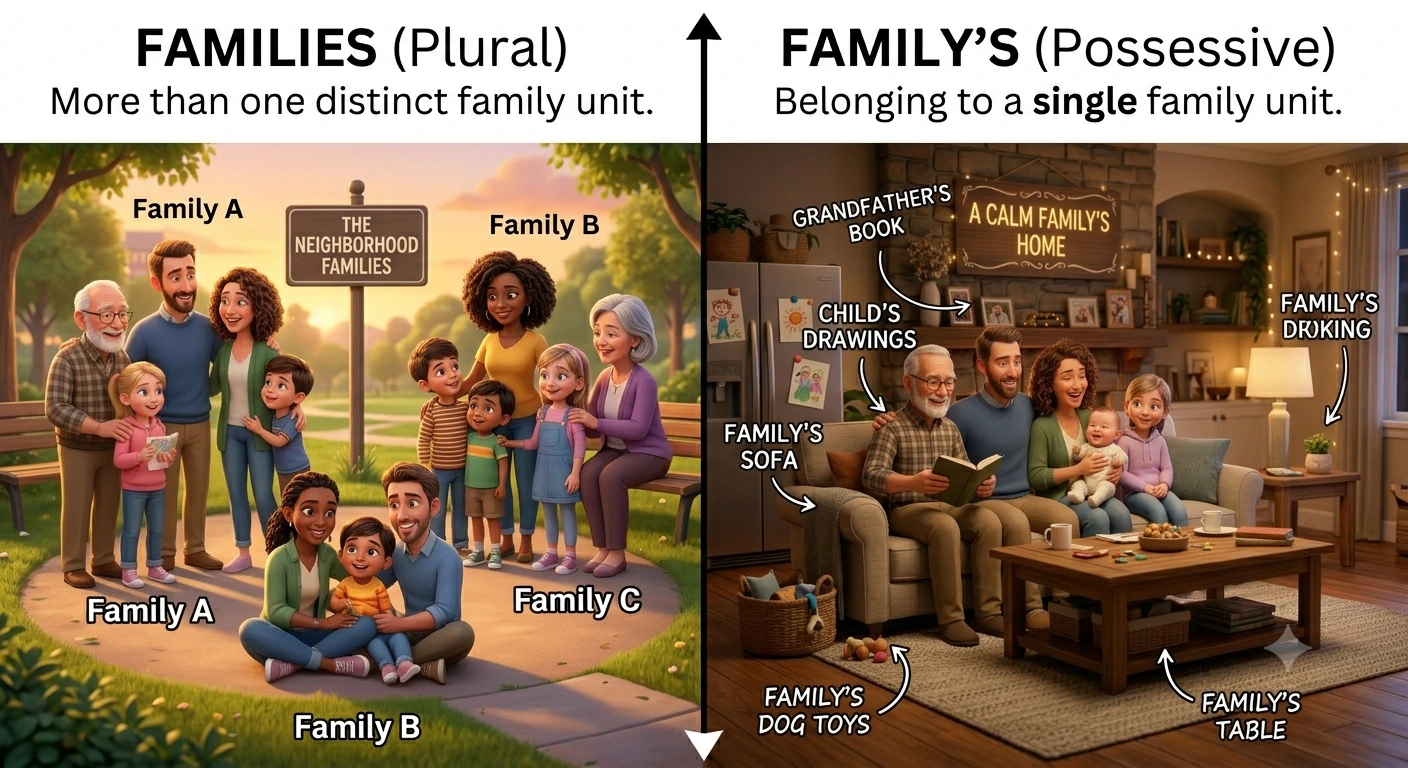
“Families” means more than one family. “Family’s” shows possession and means something belongs to one family. Example: Families gather in parks vs The family’s house is large and warm.
I once marked a student essay where the sentence read: “Many family’s came to the event.” The student looked confident about it. But one small apostrophe changed everything.
That moment is common in classrooms. Even adults make the same mistake in emails, captions, and reports. The words families and family’s look almost identical. But they carry completely different meanings.
This confusion happens because English punctuation rules are not always intuitive. In spoken English, both forms sound exactly the same. But in writing, that tiny apostrophe controls whether you are talking about more than one family or something that belongs to a family.
Understanding this difference is important. It helps you write clearly in school, work, and everyday communication. It also prevents grammar mistakes that can change meaning or reduce clarity.
In this guide, you will learn the full difference between families, family’s, and families’ in the simplest way possible. We will go step by step with examples, tables, mistakes, and real-life usage so you never feel confused again.
Families or Family’s Quick Answer
“Families” means more than one family.
“Family’s” means something belongs to one family.
Simple examples:
- Families enjoy spending time together on weekends.
- The family’s traditions are very old.
So the difference is simple:
- No apostrophe = plural (many families)
- Apostrophe + s = possession (one family owns something)
The Origin / Background of Families or Family’s
The word family comes from the Latin word familia, which meant a household or group of people living together.
As English evolved, grammar rules became more structured:
Key developments:
- Family → singular noun
- Families → plural form (more than one family)
- Family’s → possessive form (belonging to one family)
- Families’ → plural possessive (belonging to multiple families)
The apostrophe was introduced in English much later. Its purpose was to show possession and missing letters in contractions.
However, over time, people started misusing apostrophes for plurals. This created confusion like:
- ❌ familys (wrong plural)
- ❌ family’s (wrong plural usage)
That confusion continues today because spoken English does not show punctuation. Only writing does.
Families or Family’s Explained Key Differences or Variations
Let’s break this into simple parts.
Basic meanings:
- Family → one group
- Families → more than one group
- Family’s → something belonging to one family
- Families’ → something belonging to multiple families
Comparison Table
| Term | Meaning | When to Use | Example |
| Family | One group of people | Singular subject | My family is happy |
| Families | More than one family | Plural subject | Families live here |
| Family’s | Belonging to one family | Possession | The family’s car is new |
| Families’ | Belonging to many families | Shared possession | Families’ homes were damaged |
Easy memory trick:
- No apostrophe = just count (how many?)
- Apostrophe before s = one owner
- Apostrophe after s = many owners
Which Version / Approach Should You Use?
The correct form depends on meaning and context.
For Students
Use families when writing general ideas.
Example:
- Families play an important role in society.
For Personal Writing
Use family’s when showing ownership.
Example:
- My family’s traditions are unique.
For Academic Writing
You will often use all forms:
- families (general group)
- family’s (singular possession)
- families’ (plural possession)
For Professional Writing
Clarity matters most. Always check:
- Who owns it?
- One family or many families?
Simple decision rule:
If you can replace it with “belonging to one group,” use family’s.
If you are just counting groups, use families.
Common Mistakes with Families or Family’s
This is where most learners struggle.
Mistake 1: Using apostrophe for plural
❌ Wrong: Many family’s attended the wedding
✅ Correct: Many families attended the wedding
Why it happens: People think apostrophe = plural. It does not.
Mistake 2: Missing possession apostrophe
❌ Wrong: The families house is big
✅ Correct: The family’s house is big
Why it happens: Learners forget ownership rule.
Mistake 3: Double apostrophe confusion
❌ Wrong: Families’s opinions matter
✅ Correct: Families’ opinions matter
Why it happens: Over-adding punctuation.
Mistake 4: Overusing apostrophes everywhere
❌ Wrong: Family’s are happy here
✅ Correct: Families are happy here
Why it happens: Trying to “sound correct” without understanding grammar.
Mistake 5: Mixing singular and plural possession
❌ Wrong: Family’s opinions are shared by families’
(Confusing structure)
✅ Correct:
- The family’s opinion is important.
- The families’ opinions were collected.
Families or Family’s in Real-World Examples
1. Professional Email
Dear Team,
Several families have registered for the upcoming event.
2. News Headline
Local families receive financial aid after floods
3. Social Media Post
A family’s love is the strongest support system in life.
4. Academic Report
The study analyzed families’ income levels across rural regions.
5. Community Announcement
Families are invited to participate in the health awareness drive.
Families or Family’s Data, Trends & Usage
This topic is widely searched by English learners.
Who searches it?
- School students
- ESL learners
- Teachers
- Content writers
- Exam candidates
Search intent
This is an informational grammar query.
People want:
- Clear difference
- Simple rules
- Real examples
- Usage guidance
Regions with high interest
- Pakistan
- India
- Bangladesh
- UAE
- English learning countries worldwide
Why it matters today
English writing is used everywhere:
- exams
- job applications
- social media
- emails
Even a small mistake like “family’s” instead of “families” can change meaning or reduce credibility.
That’s why this topic stays important.
Standalone Comparison Table
| Term/Variant | Meaning | Region/Context | Best Used When |
| Family | One group | General English | Talking about a single household |
| Families | More than one | Everyday communication | Describing groups |
| Family’s | Belonging to one | Formal/informal writing | Showing ownership |
| Families’ | Belonging to many | Academic writing | Shared ownership context |
FAQ Section
Q: What does families mean?
A: “Families” is the plural of family. It refers to more than one household or group of people.
Q: What does family’s mean?
A: “Family’s” shows possession. It means something belongs to one family, such as “family’s home.”
Q: What is the difference between families and family’s?
A: “Families” is plural, while “family’s” shows ownership. One is quantity, the other is possession.
Q: Is family’s correct English?
A: Yes, but only when showing possession. It is not used for plural form.
Q: Which is correct — families or family’s?
A: Both are correct depending on meaning. Use “families” for plural and “family’s” for possession.
Q: What does families’ mean?
A: “Families’” means something belongs to multiple families. Example: families’ opinions.
Q: Can I use families in essays?
A: Yes. It is commonly used in academic and formal writing when talking about groups.
Conclusion
The difference between families and family’s is small in spelling but very important in meaning.
Here is what you should remember:
- Families = more than one family
- Family’s = belonging to one family
- Families’ = belonging to many families
- Apostrophes show ownership, not plural
- Context decides the correct form
Once you understand this simple rule, your writing becomes clearer and more professional. You will stop guessing and start writing with confidence.
Grammar mistakes like this are common, but they are also easy to fix once you understand the logic behind them.
Keep this guide in mind, and you will never confuse families or family’s again. Try using these forms in your own writing today—you will notice the difference immediately.
Read More:
Wane or Wain: The Complete Guide to Using the Correct Word

📚✨ I’m an English enthusiast and author dedicated to exploring word differences, spelling variations, and common language questions. By drawing on trusted dictionaries, language resources, and practical usage examples, I create clear, reliable content that helps readers learn with confidence and communicate more effectively. ✍️🌍