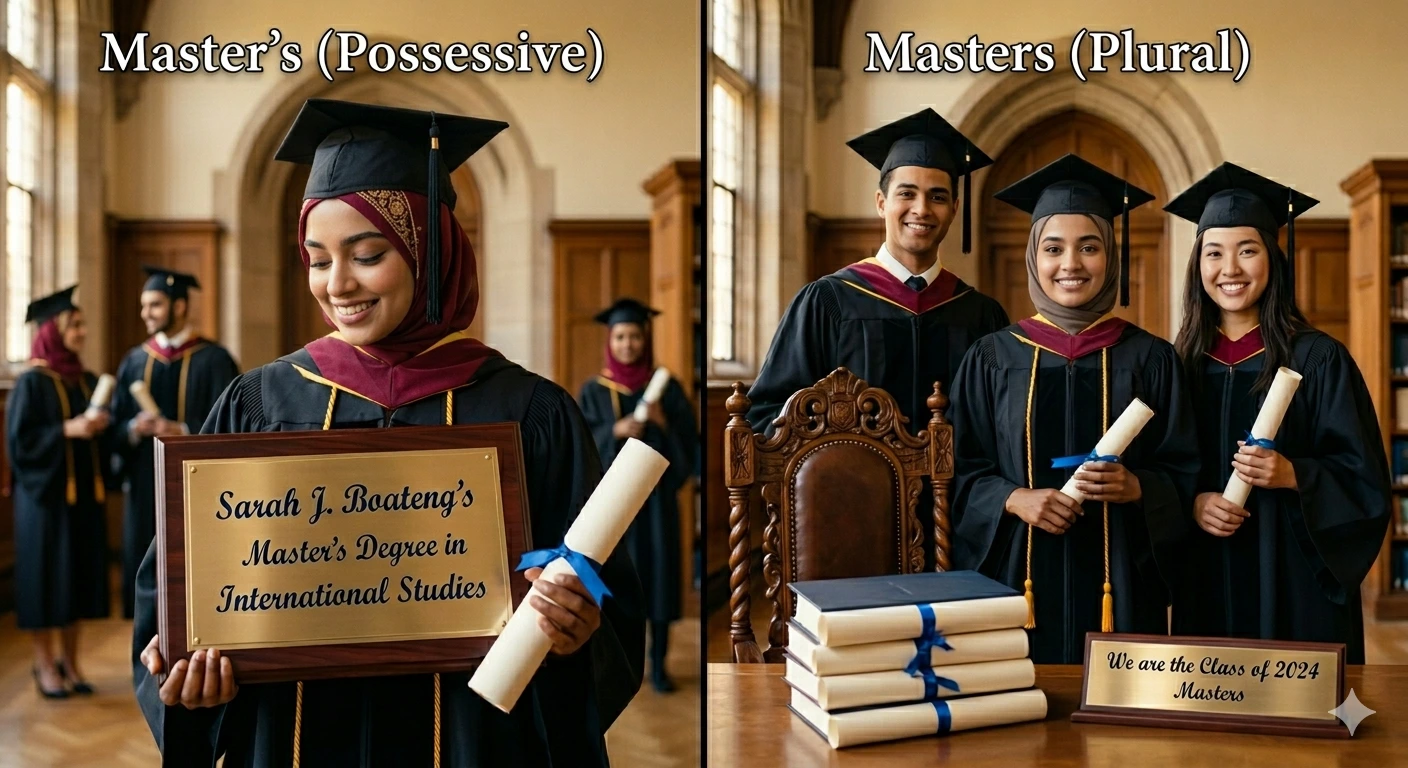
Master’s and masters are both correct, but they mean different things. Use master’s when referring to a degree, such as “a master’s degree,” and use masters as the plural form of “master,” such as “the chess masters competed in the tournament.”
A few years ago, I was proofreading a student’s university application when I noticed something interesting. The student wrote, “I am applying for a masters degree in Education.” It looked right at first glance. Yet something was missing.
That tiny apostrophe.
Many people struggle with master’s or masters because both versions appear online, in emails, on university websites, and even in social media posts. Some writers use them interchangeably. Others are not sure whether the apostrophe matters at all.
The confusion gets worse when you see phrases like “Masters program,” “master’s degree,” and even “Masters student.” Which one is correct? Does it depend on grammar, country, or context?
If you have ever paused while typing this phrase, you are not alone.
This guide will clear up the confusion once and for all. You’ll learn the difference between master’s and masters, discover where the terms came from, see real-world examples, avoid common mistakes, and know exactly which version to use in any situation.
Let’s settle the debate.
Master’s or Masters – Quick Answer
In most academic situations, master’s is the correct form.
Examples:
- I earned a master’s degree in Psychology.
- She is completing her master’s program this year.
- He holds a master’s in Business Administration.
Use masters when referring to more than one master.
Examples:
- Several chess masters attended the event.
- The old painters were true masters of their craft.
The apostrophe in master’s shows possession. Historically, the degree is known as a “degree of a master.”
The Origin / Background of Master’s or Masters
To understand the difference, it helps to look at the history of the word.
The word master comes from the Latin word magister, meaning teacher, chief, or person with authority. During the Middle Ages, universities awarded titles to scholars who had achieved advanced knowledge in a field.
A person who earned this qualification became a master.
Over time, people began referring to the qualification as a master’s degree, meaning a degree belonging to or held by a master.
That possessive form stayed in English.
This is why we write:
- Bachelor’s degree
- Master’s degree
Both use apostrophes because they describe a degree associated with a bachelor or a master.
Confusion arises because many universities shorten the phrase in casual writing. People often say:
- master’s
- Masters
- graduate degree
As these shortened forms became common, many writers stopped noticing the grammatical difference.
Master’s or Masters Explained — Key Differences
The main difference is simple.
TermMeaningWhen to UseRegion/ContextMaster’sPossessive form related to an academic degreeEducation and university writingGlobal academic EnglishMastersPlural form of masterMore than one masterGeneral EnglishMaster’s DegreeGraduate-level academic qualificationFormal education contextsWorldwideMasters TournamentOfficial name of a sporting eventProper nounSports contexts
Examples of Master’s
- She earned a master’s degree in Engineering.
- My master’s program starts next month.
- He completed his master’s thesis.
Examples of Masters
- The art gallery displayed works from several masters.
- Many chess masters participated.
- The old masters influenced modern artists.
Special Case: Masters
Sometimes Masters appears without an apostrophe because it is part of an official name.
Examples:
- The Masters Tournament in golf.
- The Masters Series in sports.
In these cases, the spelling is determined by the official title.
Which Version Should You Use?
The right choice depends on your purpose.
For Students
Use master’s.
Examples:
- master’s degree
- master’s program
- master’s thesis
This is the form universities expect.
For Job Seekers
Use master’s on resumes and applications.
Example:
- Master’s Degree in Computer Science
Employers recognize this as the standard format.
For Academic Writing
Always use master’s when discussing graduate education.
Example:
- She completed her master’s research in 2024.
For General English
Use masters only when talking about multiple masters.
Example:
- The martial arts masters trained together.
For Global Communication
Choose master’s when referring to a graduate degree.
It is widely accepted in both American and British English.
Common Mistakes with Master’s or Masters
Here are the errors people make most often.
MistakeCorrectionI have a masters degree.I have a master’s degree.She is studying for her masters.She is studying for her master’s.The master’s competed in the event.The masters competed in the event.Several master’s attended.Several masters attended.He completed a Masters Degree.He completed a master’s degree.
Why These Mistakes Happen
1. Forgetting the Apostrophe
Many writers type quickly and miss the apostrophe.
Incorrect:
- masters degree
Correct:
- master’s degree
2. Confusing Singular and Plural
People sometimes treat master’s as a plural noun.
Incorrect:
- three master’s attended
Correct:
- three masters attended
3. Copying Informal Usage
Social media often drops punctuation, leading to incorrect forms.
4. Capitalizing Unnecessarily
Unless part of an official title, keep it lowercase.
Correct:
- master’s degree
Incorrect:
- Master’s Degree
Master’s or Masters in Real-World Examples
Professional Email
I recently completed my master’s degree in Data Science and would like to apply for the position.
News Headline
University reports record enrollment in master’s programs this year.
Social Media Post
Finally finished my master’s thesis! Months of hard work paid off.
Formal Report
The survey included 500 participants holding a master’s degree or higher qualification.
Academic Biography
She earned a master’s degree in Public Health before pursuing doctoral studies.
These examples show how commonly the possessive form appears in education-related writing.
Master’s or Masters — Data, Trends & Usage
Search interest in master’s or masters remains high because students constantly prepare:
- University applications
- Graduate school essays
- Academic resumes
- LinkedIn profiles
- Scholarship applications
Who Searches This Topic Most?
Common audiences include:
- College students
- Graduate students
- International students
- Job seekers
- Academic writers
Search Intent
The primary search intent is:
Informational
People want to know:
- Which spelling is correct
- Whether an apostrophe is required
- How universities write it
- What style guides recommend
Why This Matters Today
More people are earning graduate degrees than ever before. As online education grows, millions of students write about their qualifications in applications, resumes, and professional profiles.
A small punctuation mark can affect how polished and professional your writing appears.
Comparison Table: Master’s vs Masters
Term/VariantMeaningRegion/ContextBest Used WhenMaster’sPossessive form linked to an academic degreeAcademic English worldwideReferring to graduate educationMaster’s DegreeFormal graduate qualificationUniversities and employersOfficial writingMaster’s ProgramGraduate course of studyAcademic contextsDiscussing enrollmentMastersPlural of masterGeneral EnglishReferring to multiple mastersMasters TournamentOfficial event nameSportsUsing the event’s titleMasters StudentSometimes used informallyVaries by institutionFollow local style guidelines
Frequently Asked Questions
Q: What does master’s mean?
A: Master’s usually refers to a graduate-level academic qualification. It is short for master’s degree and uses an apostrophe because it is possessive.
Q: How do you use master’s correctly?
A: Use master’s when discussing higher education. Examples include master’s degree, master’s thesis, and master’s program.
Q: Master’s vs masters — what’s the difference?
A: Master’s refers to an academic degree. Masters is simply the plural form of master and refers to multiple people who are masters.
Q: Is master’s acceptable in formal writing?
A: Yes. In fact, master’s degree is the standard form used in formal academic and professional writing.
Q: Which version is correct — master’s or masters?
A: Both can be correct. The right choice depends on meaning. For education, use master’s. For multiple masters, use masters.
Q: Where does master’s come from?
A: It comes from the historical title of master, awarded to advanced scholars. The possessive form evolved into master’s degree.
Q: Can master’s be used on a resume?
A: Absolutely. Employers expect the standard form. Writing master’s degree on a resume is both correct and professional.
Conclusion
The difference between master’s or masters is easier than it first appears.
Remember these key points:
- Master’s is the correct form for academic degrees.
- Masters is the plural form of master.
- The apostrophe matters because master’s degree is a possessive expression.
- Universities, employers, and style guides generally prefer master’s degree in formal writing.
Whenever you are talking about graduate education, choose master’s. That small apostrophe instantly makes your writing look more accurate and professional.
The next time you update a resume, fill out a university application, or write about your education, you’ll know exactly which form to use.
Bookmark this guide so you never second-guess master’s or masters again, and share it with someone who still wonders where that apostrophe belongs.
Read More:
Plain or Plane: Easy Guide to Use the Right Word

📚✨ I’m an English enthusiast and author dedicated to exploring word differences, spelling variations, and common language questions. By drawing on trusted dictionaries, language resources, and practical usage examples, I create clear, reliable content that helps readers learn with confidence and communicate more effectively. ✍️🌍