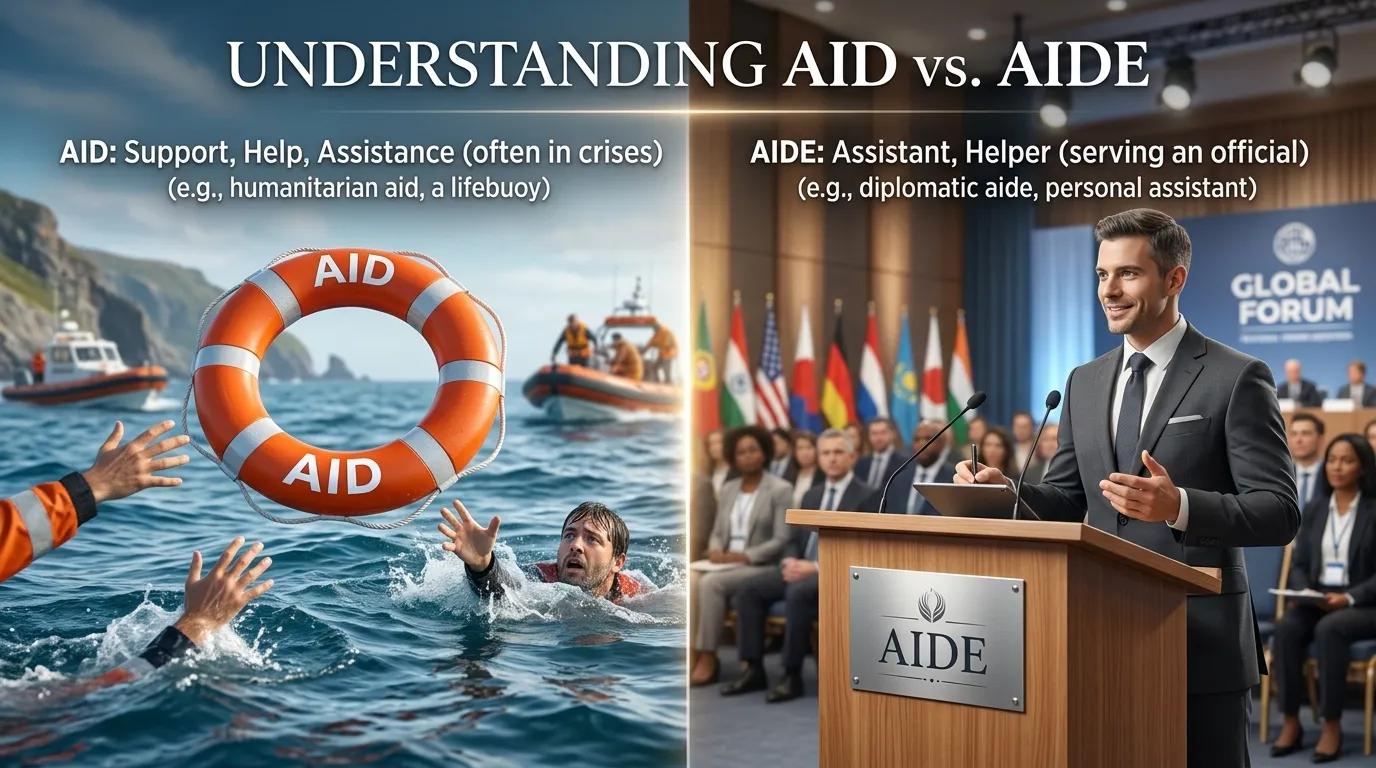
Aid means help, assistance, or a helpful object. Aide refers specifically to a person who acts as an assistant. For example, you can give first aid to an injured person, but a political aide helps a government leader.
Did you ever write a quick message to a colleague and suddenly find your finger frozen over the keyboard? It happened to me a few years ago. I was working as a senior copywriter for a global non-profit group. We were drafting an important press release about emergency relief funds. I typed a line about a dedicated “humanitarian aid.” Then, I paused. Did I need an “e” at the end of that word? If I meant the actual supplies, it was one spelling. If I meant the worker delivering them, it was another.
That single letter can completely alter your sentence. People search for this topic constantly because both words sound identical when spoken aloud. They are homophones. Because they sound the same and both relate to the concept of helping, our brains easily mix them up.
This guide will dismantle that confusion forever. You will discover the distinct histories of both terms. You will see clear, practical charts and real-world examples. By the end of this page, you will know exactly how to choose the right spelling every single time you write.
Aide or Aid: Quick Answer
The word aid without an “e” is mostly used as a verb meaning to help, or as a noun meaning assistance or an object that helps. The word aide with an “e” is always a noun that describes a living person who works as an assistant.
- The visual chart serves as a helpful learning aid.
- The senator asked her chief aide to schedule the meeting.
If you are talking about an object, a concept, or an action, drop the “e.” If you are talking about a human assistant, keep the “e.”
The Origin and Background of Aide or Aid
Both words trace their family tree back to the old Latin word adiutare, which meant to give help. This moved into Old French as the word aide.
When the word first entered the English language around the 1400s, people used aid for everything. Spelling was not standardized yet. People used the short version for both the action of helping and the person doing the helping.
The split happened because of the military. In the 1800s, the British and American military adopted the French phrase aide-de-camp. This term described a general’s personal assistant. Over time, English speakers dropped the “-de-camp” part. They kept the French spelling aide exclusively for people holding an assistant job. The short spelling stayed behind to handle everything else.
Aide or Aid Explained: Key Differences or Variations
Understanding the grammar roles of these words makes it simple to choose between them. One can be multiple parts of speech, while the other has only one job.
| Term | Meaning | When to Use | Region or Context |
| Aid | To help / assistance / a helpful tool | Use for actions, concepts, and physical objects | Universal standard English |
| Aide | A human assistant or helper | Use only when describing a person doing a job | Universal standard English |
Let us look at distinct examples to see how they function:
- Action (Verb): New software will aid the team in tracking expenses.
- Object (Noun): A hearing aid amplifies sound for the wearer.
- Person (Noun): The teacher’s aide graded the spelling quizzes.
Which Version Should You Use?
Choosing the proper term comes down to identifying what kind of help you are writing about. Here is direct advice for your specific writing context:
For Students and Academic Writers
Always check if your sentence refers to a human being. If you are writing about financial support from the government, use student aid. If you are writing about a nurse assistant in a medical study, use a nurse aide.
For Business and Corporate Workers
Stick to aid when describing tools, software, grants, or general team assistance. Use aide when you are writing an official job description or hiring an executive assistant.
For Journalists and Bloggers
Media style guides like the Associated Press (AP) style are very strict about this boundary. News editors will instantly flag a story if you write about a political leader’s “aid” instead of their political aide.
Common Mistakes with Aide or Aid
Even professional writers trip over these two spellings. Here are the most frequent errors and exactly how to fix them.
1. Misspelling first aid
This is a universal health phrase. It refers to the medical treatment, not the person giving it.
- Incorrect: Every office needs a proper first aide kit.
- Correct: Every office needs a proper first aid kit.
2. Stripping the “e” from a person’s job title
When someone’s career is assisting others, they deserve the extra letter.
- Incorrect: The colonel spoke quietly to his military aid.
- Correct: The colonel spoke quietly to his military aide.
3. Mixing up financial assistance terms
Grants and loans are concepts, not people, so they never take the terminal letter.
- Incorrect: She applied for federal financial aide to pay for college.
- Correct: She applied for federal financial aid to pay for college.
Aide or Aid in Real-World Examples
Let us review how these keywords appear in day-to-day writing formats. Notice how the spelling matches the exact type of help being described.
A Professional Email
“Hi Team, please note that our new project management tool is designed to aid communication across departments. If you have questions, please reach out to the director’s administrative aide.”
A News Headline
“Foreign Aid Dispatched to Disaster Zone as Presidential Aide Confirms Logistics Plan”
A Social Media Post
“Shoutout to my amazing graphic design software. It is truly the best creative aid I could ever ask for! 🎨💻”
A Formal Document or Report
“The regional hospital system approved a budget increase to hire fifteen new dietary aides to support the medical staff.”
Aide or Aid: Data, Trends, and Usage
Online search trends show that aid is searched significantly more often than aide. This is because the short version wears many hats. It acts as both a common verb and a noun for huge topics like international business and finance.
This topic falls squarely into the informational search category. Writers search for it mid-sentence when they experience a sudden flash of doubt about spelling rules.
This matters right now because automated speech-to-text tools often make errors with homophones. If you dictate your emails or articles using your phone, software will frequently insert the wrong version. A quick manual check ensures your professional communication stays completely flawless.
Standalone Comparison Table
Keep this clean comparison guide in mind whenever you review your final drafts.
| Term/Variant | Meaning | Region/Context | Best Used When |
| Aid | Help, support, or a helpful tool | Global standard | Writing about finance, tools, medicine, or actions |
| Aide | A professional assistant | Global standard | Writing about staff members, political workers, or military roles |
FAQ Section
Q: What does aid mean? A: It means to provide help or support to someone. As a noun, it can also mean the actual assistance given, or a tool that makes a task easier.
Q: How do you use aide correctly? A: Use it exclusively when you are referring to a person who works as a helper or assistant. For example: “The executive aide managed the calendar.”
Q: Aide vs aid what is the main difference? A: The main difference is that an aide is always a person. Aid can be an action, an abstract concept, or a physical object.
Q: Is aide acceptable in formal writing? A: Yes, it is fully acceptable and correct when describing an assistant. It is the standard spelling in business, politics, and military contexts.
Q: Which version is correct first aid or first aide? A: First aid is the only correct version for emergency medical care. A first aide would incorrectly imply a person named “First.”
Q: Where does the word aide come from? A: It comes from the French military title aide-de-camp, which was shortened over time by English speakers to describe any personal assistant.
Q: Can aid be used as a action verb? A: Yes, it functions perfectly as a verb. An example is: “Regular exercise will aid your overall sleep quality.”
Read More: Geez or Jeez: The Complete Guide to Correct Usage
Conclusion
To sum up, mastering these two tricky words requires remembering three core facts. First, aid is your default word for actions, tools, and abstract concepts like money or relief supplies. Second, aide should be saved strictly for human beings who work in assistant roles. Third, remembering that the word aide ends in “e” just like the word employee can help you connect it to a person
.My final recommendation is to look at your subject before you type. If the helper breathes, add the “e.”
Bookmark this guide so you never second-guess aide or aid again.
Read More: Fulfilment or Fulfillment: Real Guide to Spelling It Right

I am an English language expert dedicated to exploring the nuances of words and their meanings. Through detailed comparisons and practical insights, I help readers understand the finer points of language and use words with accuracy and confidence.