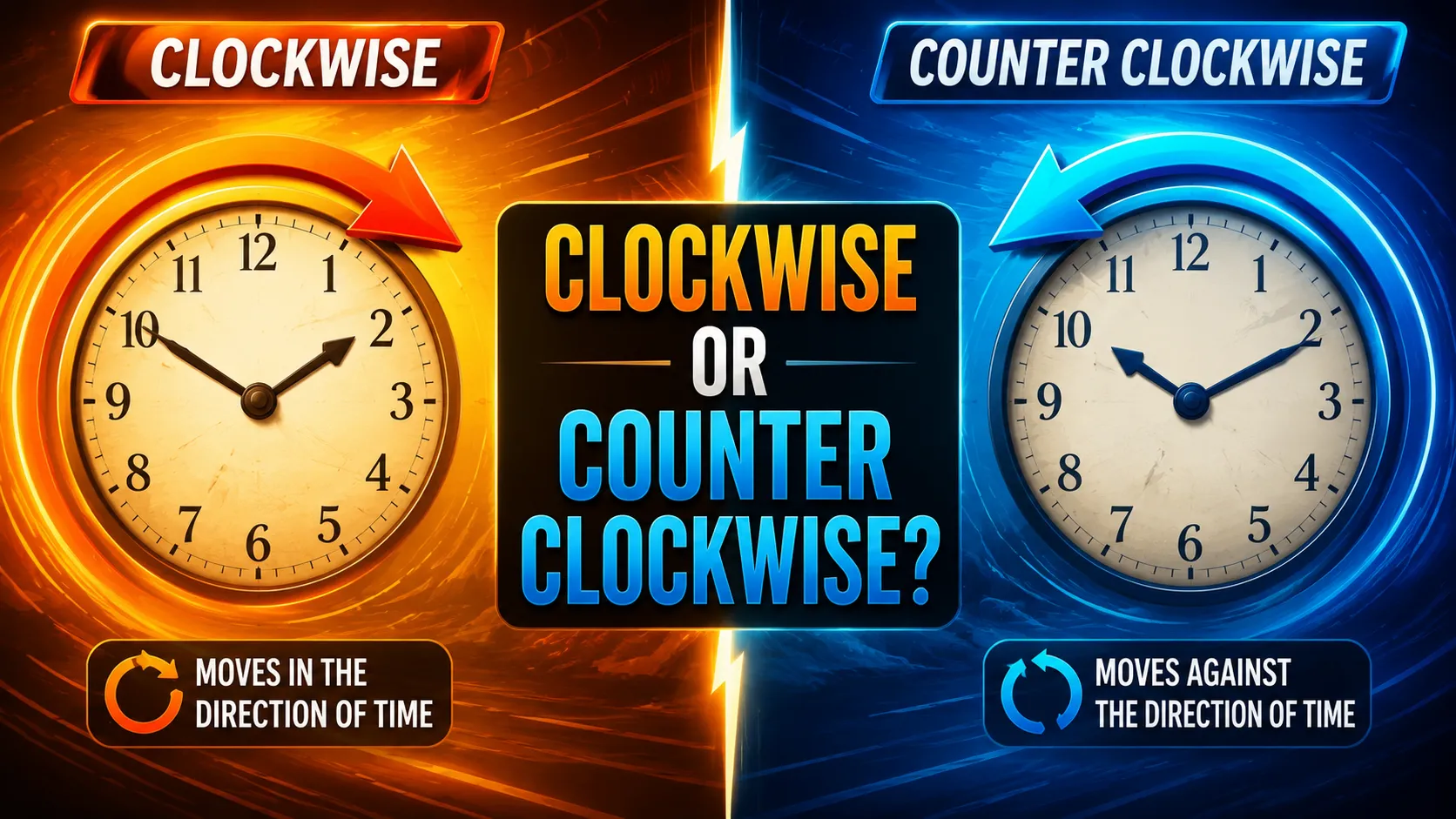
Clockwise or counterclockwise describe the direction of circular movement. Clockwise moves in the same direction as a clock’s hands. Counterclockwise moves in the opposite direction.
I still remember a classroom moment during a geometry lesson. The teacher said, “Rotate the shape clockwise.” Half the class turned it one way. The other half turned it the opposite way. The result? Confusion everywhere.
Someone asked, “Sir, which side is clockwise again?”
That small moment showed me how easily this topic can confuse students. The problem is not intelligence—it’s visualization. People know what a clock looks like, but when they imagine movement, things get mixed up.
I made the same mistake in my early learning days. I rotated a diagram the wrong way in a test and lost marks. After that, I created a simple mental trick that I still use today.
In this guide, you’ll understand clockwise vs counterclockwise in a very simple, visual, and practical way. You’ll learn meanings, memory tricks, real-life uses, math applications, mistakes, and examples so you never get confused again.
Clockwise or Counterclockwise Quick Answer
Clockwise means moving in the same direction as a clock’s hands ⏱️
Counterclockwise means moving in the opposite direction 🔄
Simple examples:
- Turn the key clockwise to lock the door.
- Rotate the wheel counterclockwise to loosen it.
One follows the clock. The other goes against it.
The Origin / Background of Clockwise and Counterclockwise
These terms come directly from the invention of mechanical clocks.
⏱️ Clockwise
When clocks were first designed, the movement of the hands set the standard direction. As the shadow of sundials moved, clock hands were designed to match that motion.
So:
- Clock hand movement → became clockwise
🔄 Counterclockwise
As language evolved, people needed a word for the opposite direction. So they created:
- “Counter” = against
- “Clockwise” = opposite of clock direction
So counterclockwise = against the direction of a clock
In British English, you may also hear:
- Anticlockwise (same meaning)
Clockwise vs Counterclockwise Explained Key Differences
Let’s make it crystal clear.
| Term | Meaning | Direction | Common Use | Region |
| Clockwise | Same direction as clock hands | Rightward circular motion | Everyday instructions, math | Global |
| Counterclockwise | Opposite of clock hands | Leftward circular motion | Science, engineering, math | Global (UK: anticlockwise) |
Easy Visual Trick
Imagine a clock:
- 12 → 3 → 6 → 9 → 12 = clockwise
- 12 → 9 → 6 → 3 → 12 = counterclockwise
Clockwise or Counterclockwise Real Meaning in Simple Words
🕒 Clockwise
Think of:
- Clock hands moving naturally
- Turning a screw to tighten it
- Moving right in a circular path
🔄 Counterclockwise
Think of:
- Undoing something
- Turning left in a circle
- Reversing motion
Which Direction Should You Use?
This depends on context.
For students:
- Clockwise = right turn in circle
- Counterclockwise = left turn in circle
For mechanics or DIY work:
- Clockwise = tighten
- Counterclockwise = loosen
For math and geometry:
- Used in angles and rotation problems
For daily life:
- Door locks, jars, screws, wheels
Memory Trick
- Clockwise = with the clock ⏱️
- Counterclockwise = against the clock 🔄
Simple. No confusion.
Common Mistakes with Clockwise or Counterclockwise
1. Mixing directions
❌ Turn left clockwise
✔️ Turn left counterclockwise
2. Confusing tightening and loosening
❌ Counterclockwise tightens screw
✔️ Clockwise tightens screw
3. Forgetting perspective
❌ Thinking direction changes from person to person
✔️ Direction is fixed from clock view
4. Mixing anticlockwise and counterclockwise
❌ Thinking they are different
✔️ They mean the same thing (UK/US difference)
5. Incorrect rotation in diagrams
❌ Rotating shape opposite to instruction
✔️ Always match clock direction carefully
Clockwise or Counterclockwise in Real-World Examples
📧 Instruction Email
Please rotate the diagram clockwise by 90 degrees.
📰 News or Instruction Manual
Turn the valve counterclockwise to release pressure.
📱 Social Media Post
I always open stubborn jars by turning them counterclockwise 😂
📄 Technical Report
The rotor moves in a clockwise direction during operation.
🏫 Classroom Example
Draw a circle and mark points moving counterclockwise.
Clockwise or Counterclockwise Science & Math Use
This topic is very important in:
📐 Geometry
- Rotation of shapes
- Angles measured in degrees (90°, 180°, 360°)
🧪 Physics
- Rotational motion
- Torque and force direction
⚙️ Engineering
- Machine parts
- Gear rotation
- Screw mechanics
Example:
- Earth rotates counterclockwise (from North Pole view)
Clockwise or Counterclockwise Data, Trends & Usage
Where these terms are most used:
- 📚 Mathematics exams
- ⚙️ Engineering instructions
- 🧪 Physics experiments
- 🏠 Daily life tools (jars, screws, taps)
- 🎮 Games and animations
Search intent behind this topic:
People search this because they want to:
- Understand rotation direction
- Solve math problems
- Fix mechanical items
- Avoid exam mistakes
Why it matters today
Even in modern life, these directions are everywhere:
- Opening bottles
- Using tools
- Reading graphs
- Programming animations
- Understanding maps and rotation systems
So learning this concept improves both academic and practical skills.
Standalone Comparison Table
| Term/Variant | Meaning | Direction | Best Used When |
| Clockwise | Same direction as clock hands | Rightward circular motion | Tightening, standard rotation |
| Counterclockwise | Opposite of clock hands | Leftward circular motion | Loosening, reverse rotation |
FAQs
Q: What is clockwise and counterclockwise?
A: Clockwise moves like a clock’s hands. Counterclockwise moves in the opposite direction.
Q: How do I remember clockwise direction?
A: Think “with the clock.” If it matches clock hands, it is clockwise.
Q: What is counterclockwise also called?
A: It is also called anticlockwise, especially in British English.
Q: Which direction loosens screws?
A: Counterclockwise loosens screws, while clockwise tightens them.
Q: Is counterclockwise left or right?
A: It is generally a leftward circular movement when viewed from the front.
Q: Why do clocks define direction?
A: Because early mechanical clocks set the standard for circular motion direction.
Q: Where is clockwise used in real life?
A: It is used in math, tools, machines, navigation, and everyday instructions.
Conclusion
Understanding clockwise and counterclockwise is simple once you stop overthinking it.
One follows the clock. The other goes against it.
Here’s the final takeaway:
- Clockwise = same direction as clock ⏱️
- Counterclockwise = opposite direction 🔄
- Direction depends on the clock face
- Used in math, science, and daily life
Once you master this, you’ll never get confused in exams, instructions, or real-life tasks again.
Next time someone says “rotate clockwise,” you’ll instantly know exactly what to do.
Read More:
Ionic or Covalent: Complete Guide to Chemical Bonds 🧪

📚✨ I’m an English enthusiast and author dedicated to exploring word differences, spelling variations, and common language questions. By drawing on trusted dictionaries, language resources, and practical usage examples, I create clear, reliable content that helps readers learn with confidence and communicate more effectively. ✍️🌍