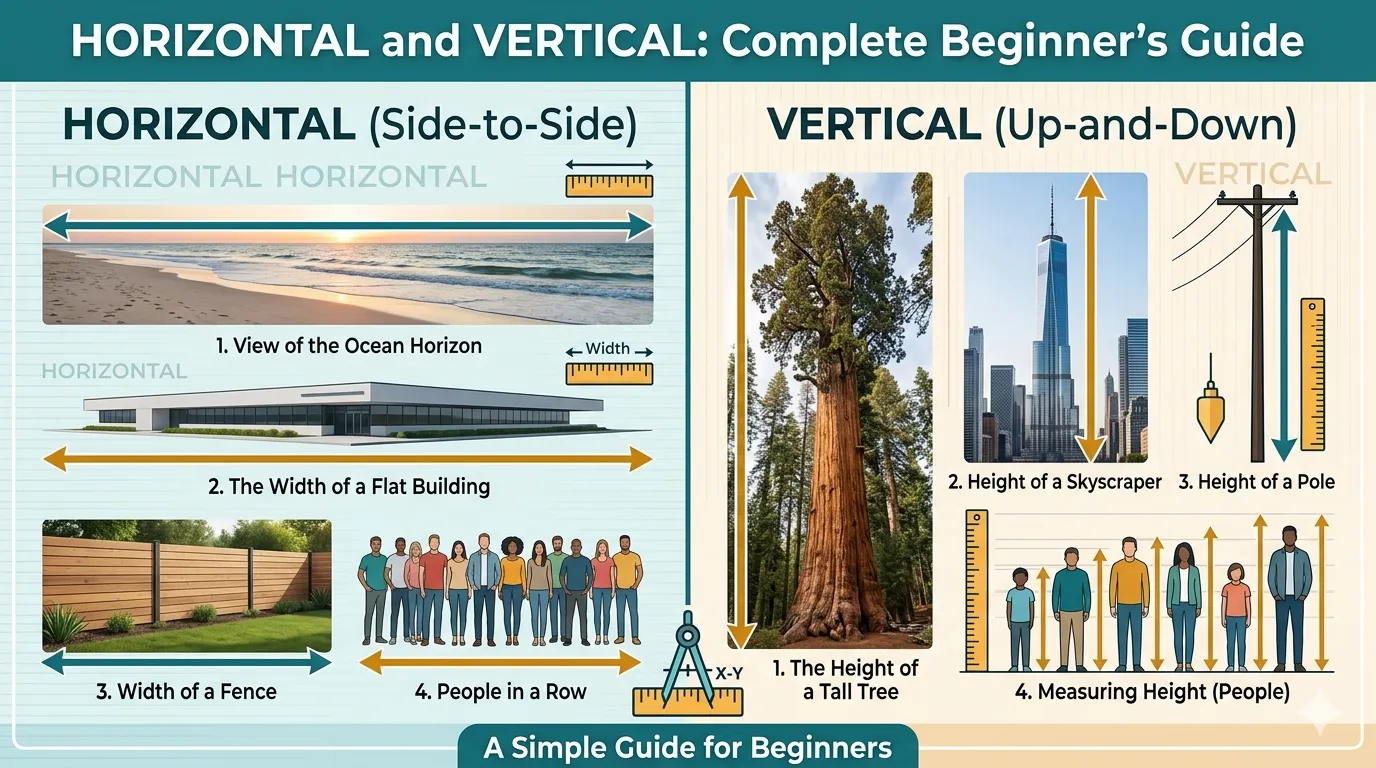
Horizontal means side-to-side, like the horizon. Vertical means up-and-down, like a standing tree or building.
Have you ever looked at a graph, a photo, or a building plan and wondered, “Is this horizontal or vertical?” You’re not alone.
I remember helping a student prepare for a science project. Everything was ready except one thing. The chart labels were mixed up. The student placed the horizontal label on the up-and-down line and the vertical label on the side-to-side line. It seemed like a small mistake, but it changed the meaning of the entire chart.
Many beginners struggle with horizontal and vertical because both terms describe direction. Yet they appear everywhere. You see them in math, geography, photography, architecture, computer screens, business structures, and everyday conversations.
The good news is that understanding the difference is much easier than most people think.
In this guide, you’ll learn what horizontal and vertical mean, where the words came from, how to use them correctly, common mistakes to avoid, and real-world examples that make the concepts stick.
Let’s start with the basics.
Horizontal and Vertical – Quick Answer
A horizontal line runs from left to right or right to left. It stays parallel to the horizon.
A vertical line runs from top to bottom or bottom to top. It stands straight up and down.
Simple Examples
- A road stretching across a flat field is horizontal.
- A flagpole standing upright is vertical.
- A laptop screen in landscape mode is mostly horizontal.
- A smartphone held upright is usually vertical.
Easy Memory Trick
- Horizontal = Horizon
- Vertical = Vertex or Standing Up
If it looks like the horizon, it is horizontal. If it stands upright, it is vertical.
The Origin / Background of Horizontal and Vertical
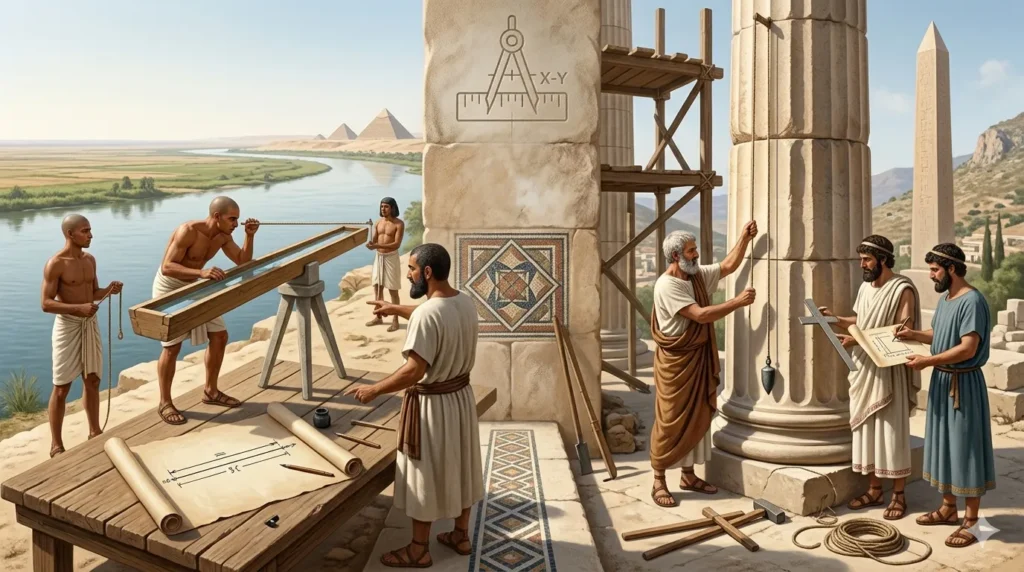
The word horizontal comes from the Greek word horizōn, which means “separating” or “boundary.” It refers to the horizon line where the sky appears to meet the earth.
The word vertical comes from the Latin word verticalis. It relates to the highest point or direction that goes straight upward.
Why People Get Confused
Several reasons cause confusion:
- Both terms describe direction.
- They are often taught together.
- Graphs and charts use both at the same time.
- Phone and computer orientations switch between horizontal and vertical.
Because the words appear in many subjects, beginners often mix them up.
Horizontal and Vertical Explained : Key Differences and Variations
Although the concepts are simple, their uses can change depending on the context.
| Term | Meaning | When to Use | Region/Context |
| Horizontal | Side-to-side direction | Width, rows, landscape layouts | Worldwide |
| Vertical | Up-and-down direction | Height, columns, portrait layouts | Worldwide |
| Landscape | Wider than tall | Photos, screens, documents | Design & Media |
| Portrait | Taller than wide | Mobile viewing, documents | Design & Media |
Horizontal Examples
- A bookshelf stretching across a wall
- A horizon line in nature
- A landscape photograph
- Rows in a spreadsheet
Vertical Examples
- A skyscraper
- A standing pencil
- A portrait photo
- Columns in a spreadsheet
Visual Comparison
Imagine the letter H.
- The middle bar is horizontal.
- The side bars are vertical.
This simple image helps many students remember the difference.
Which Version / Approach Should You Use?
The answer depends on what you’re doing.
For Students
Use horizontal when discussing width or side-to-side movement.
Use vertical when discussing height or up-and-down movement.
For Math Learners
- X-axis = horizontal
- Y-axis = vertical
Remembering this can prevent many graphing mistakes.
For Photographers
- Landscape photos = horizontal
- Portrait photos = vertical
Choose based on the subject you want to capture.
For Business and Organizations
- Horizontal structure = fewer management layers
- Vertical structure = many levels of authority
For Global Communication
Use the standard definitions:
- Horizontal = left to right
- Vertical = top to bottom
These meanings are universally accepted.
Common Mistakes with Horizontal and Vertical
Many beginners make the same errors.
Mistake 1: Confusing Width with Height
| Mistake | Correction |
| Horizontal means height | Horizontal means width |
| Vertical means width | Vertical means height |
Why it happens: People focus on position instead of direction.
Mistake 2: Mixing Up Graph Axes
| Mistake | Correction |
| X-axis is vertical | X-axis is horizontal |
| Y-axis is horizontal | Y-axis is vertical |
Why it happens: Students memorize without visualizing.
Mistake 3: Mislabeling Photos
| Mistake | Correction |
| Tall photo = horizontal | Tall photo = vertical |
| Wide photo = vertical | Wide photo = horizontal |
Why it happens: People confuse orientation terms.
Mistake 4: Using the Words Interchangeably
| Mistake | Correction |
| Horizontal and vertical mean the same thing | They describe opposite directions |
Why it happens: Lack of practical examples.
Mistake 5: Ignoring Context
| Mistake | Correction |
| One definition fits every field | Context changes the application |
Why it happens: Different industries use the terms differently.
Horizontal and Vertical in Real-World Examples
Let’s see how these terms appear naturally.
Professional Email
Please arrange the charts in a horizontal layout so all data can fit on one page
News Headline
New vertical farming project aims to increase food production in urban areas
Social Media Post
Just switched my video from horizontal to vertical format and engagement doubled!
Formal Report
The building includes a vertical transportation system consisting of elevators and emergency staircases.
Classroom Example
Draw a horizontal line across the page and a vertical line through the center.
Horizontal and Vertical : Data, Trends & Usage
The terms horizontal and vertical are searched frequently by students, teachers, graphic designers, photographers, and business professionals.
Most Interested Audiences
- School students
- College learners
- Graphic designers
- Photographers
- Architects
- Business professionals
Common Search Intent
The primary search intent is:
Informational
People want to understand:
- What horizontal means
- What vertical means
- The difference between them
- How to use them correctly
Where Interest Is Highest
These concepts are especially important in:
- Education
- Technology
- Design
- Construction
- Business management
Why It Matters Today
Mobile content has increased the importance of understanding orientation.
Short-form videos often use vertical formats, while presentations, movies, and websites frequently use horizontal layouts.
Knowing the difference helps you communicate clearly and avoid mistakes.
Comparison Table: Horizontal vs Vertical
| Term/Variant | Meaning | Region/Context | Best Used When |
| Horizontal | Side-to-side direction | Universal | Describing width or landscape orientation |
| Vertical | Up-and-down direction | Universal | Describing height or portrait orientation |
| Horizontal Layout | Wider arrangement | Design, Web, Media | Showing content across a page |
| Vertical Layout | Taller arrangement | Mobile, Publishing | Stacking content top to bottom |
| Horizontal Structure | Broad organization | Business | Teams with fewer layers |
| Vertical Structure | Layered organization | Business | Traditional management systems |
Frequently Asked Questions (FAQs)
Q: What does horizontal and vertical mean?
A: Horizontal means side-to-side. Vertical means up-and-down. They describe two opposite directions used in everyday life, education, and professional fields.
Q: How do you use horizontal and vertical correctly?
A: Use horizontal when referring to width or left-to-right movement. Use vertical when referring to height or top-to-bottom movement.
Q: Horizontal vs vertical : what’s the difference?
A: Horizontal runs parallel to the horizon. Vertical stands upright and is perpendicular to the horizon.
Q: Are horizontal and vertical acceptable in formal writing?
A: Yes. Both are standard English terms widely used in academic, professional, and technical writing.
Q: Which version is correct : horizontal or vertical?
A: Both are correct. The right choice depends on the direction being described.
Q: Where do the words horizontal and vertical come from?
A: Horizontal comes from Greek roots connected to the horizon. Vertical comes from Latin roots related to upright direction.
Q: Can horizontal and vertical be used in business?
A: Yes. Businesses use horizontal and vertical to describe organizational structures, communication flow, and market strategies.
Conclusion
Understanding horizontal and vertical is easier once you connect the words to real-world objects.
Remember these key points:
- Horizontal means side-to-side.
- Vertical means up-and-down.
- Horizontal relates to width.
- Vertical relates to height.
- The concepts appear in school, business, design, photography, and technology.
A simple trick can help you remember forever. Think of the horizon. It stretches across the landscape. That’s horizontal. Now think of a tree standing upright. That’s vertical.
Once you understand this difference, reading graphs becomes easier. Taking photos becomes simpler. Even everyday communication becomes clearer.
Now you know exactly how to use horizontal and vertical. Bookmark this guide so you never mix them up again, and share it with someone who has been confused by these terms.
Liter or Litre: Which Spelling Should You Use?

“I am a dedicated and hardworking individual with a passion for learning and personal growth. I am committed to achieving goals and continuously improving my skills.”