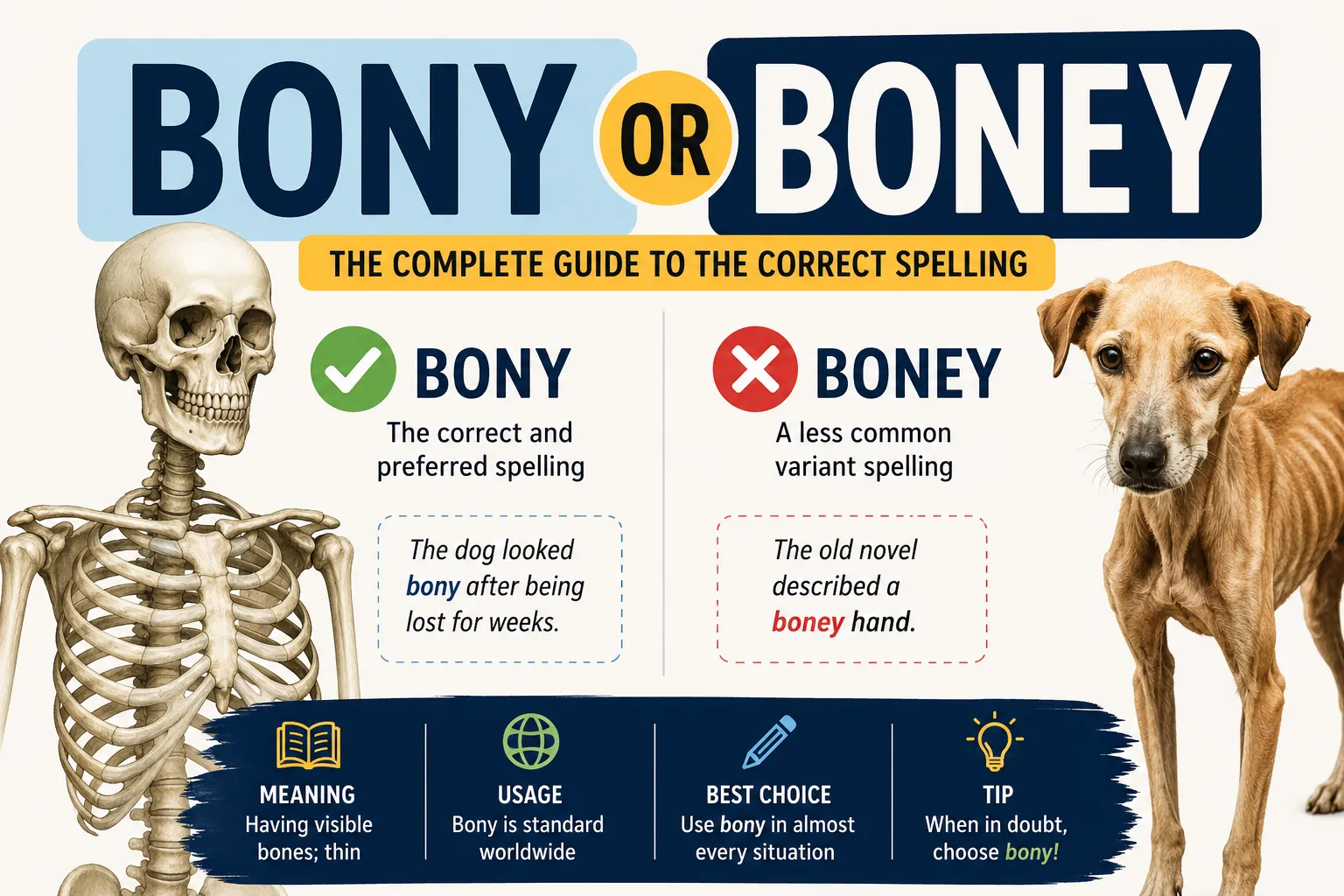
Bony is the standard and preferred spelling in modern English. Boney is a less common variant that appears mainly in older writing, place names, and some proper no
A few years ago, while editing an article about health and body types, I noticed something interesting. One writer described a person as “boney,” while another used “bony.” Both looked correct at first glance. Yet only one was considered the standard spelling by most dictionaries.
This small spelling difference causes confusion for many English learners, students, writers, and even native speakers. After all, English has many words that can be spelled in more than one way. Think of “gray” and “grey” or “color” and “colour.”
So what about bony and boney?
Are they both correct? Is one American and the other British? Should you use one in formal writing and the other in casual conversation?
The answer is simpler than many people expect.
By the end of this guide, you’ll know exactly which spelling to use, why the confusion exists, and how to avoid common mistakes.
Bony or Boney Quick Answer
The correct and preferred spelling is bony.
The word bony describes something that has many bones, shows bones clearly, or is thin enough that the bones are easy to see.
Examples
- The dog looked bony after being lost for weeks.
- Her bony fingers gripped the pencil.
- The fish has a bony structure.
The spelling boney is much less common and is generally considered a variant spelling.
The Origin / Background of Bony or Boney
The word bony comes from the noun bone.
English often adds the suffix -y to nouns to create adjectives.
Examples include:
- Cloud → Cloudy
- Wind → Windy
- Dust → Dusty
- Bone → Bony
Over time, some writers also used boney. This spelling appeared in older texts and regional writing styles.
The extra “e” likely remained because the base word already ended with an “e.” Similar patterns can be found in older English spellings.
Today, however, dictionaries overwhelmingly prefer bony.
That is why most editors, teachers, and publishers recommend using bony in nearly every situation.
Bony or Boney Explained — Key Differences or Variations
Although the words usually mean the same thing, their usage differs.
| Term | Meaning | When to Use | Region/Context |
| Bony | Thin, skeletal, containing bones | Standard writing | Worldwide |
| Boney | Same meaning | Rare or stylistic use | Older texts, names, special contexts |
Example Using Bony
- The rescued cat was extremely bony.
- The bird has bony wings.
Example Using Boney
- The old novel described a “boney hand.”
- Some historical documents use “boney” instead of “bony.”
In modern writing, bony wins almost every time.
Which Version Should You Use?
The best choice depends on your audience, but the answer is usually the same.
For Students
Use bony.
Teachers, exams, and dictionaries prefer this spelling.
For Professional Writers
Use bony.
Editors expect the standard form.
For Business Communication
Use bony.
It looks professional and modern.
For Creative Writers
Use bony most of the time.
You may choose boney only when copying historical speech, creating a specific character voice, or quoting older texts.
For Global Audiences
Use bony.
Readers everywhere recognize it instantly.
Recommendation
If you are unsure, always choose bony.
Common Mistakes with Bony or Boney
Many people make the same errors.
Mistake 1
❌ He looked boney after the illness.
✅ He looked bony after the illness.
Why? Modern English prefers bony.
Mistake 2
❌ The report described the animal as very boney.
✅ The report described the animal as very bony.
Why? Professional writing favors the standard spelling.
Mistake 3
❌ Using both spellings in the same document.
✅ Choose one spelling and stay consistent.
Why? Consistency improves readability.
Mistake 4
❌ Assuming boney is British English.
✅ Both American and British English mainly use bony.
Why? The difference is not based on region.
Mistake 5
❌ Thinking boney and bony have different meanings.
✅ They generally mean the same thing.
Why? The distinction is mainly spelling preference.
Bony or Boney in Real-World Examples
Professional Email
The veterinarian reported that the rescued puppy appeared unusually bony and required immediate nutritional support.
News Headline
Scientists Discover Rare Fish With Unusual Bony Structure
Social Media Post
Just adopted a very bony rescue dog. Time to give him lots of love and care!
Formal Report
Examination revealed prominent bony features along the shoulder and rib area.
These examples show how bony naturally appears in modern communication.
Bony or Boney — Data, Trends & Usage
Search Intent
Most searches for bony or boney are informational.
People want to know:
- Which spelling is correct
- Whether both versions are acceptable
- Which word should be used in writing
Who Searches for This Topic?
Common audiences include:
- Students
- English learners
- Bloggers
- Copywriters
- Teachers
- Editors
Usage Trend
Modern dictionaries, style guides, publishers, and educational resources strongly favor bony.
The spelling boney appears far less often and continues to decline in everyday use.
Why This Matters Today
Clear writing builds trust.
Using the standard spelling helps your writing look polished, professional, and accurate.
Comparison Table
| Term/Variant | Meaning | Region/Context | Best Used When |
| Bony | Having visible bones or containing bones | Standard English worldwide | Almost always |
| Boney | Alternative spelling of bony | Older texts, special stylistic use | Rare situations |
| Skeletal | Very thin, bone-like appearance | Medical or descriptive writing | Formal descriptions |
| Thin | Not fat or wide | Everyday conversation | General use |
Frequently Asked Questions
Q: What does bony mean?
A: Bony means having many bones, containing bones, or showing bones clearly because someone or something is very thin.
Q: How do you use bony correctly?
A: Use bony as an adjective. For example, “The dog looked bony after its long journey.”
Q: Bony vs boney — what’s the difference?
A: The meaning is usually the same. The difference is that bony is the standard modern spelling, while boney is a less common variant.
Q: Is bony acceptable in formal writing?
A: Yes. Bony is the preferred spelling for academic, business, and professional writing.
Q: Which version is correct — bony or boney?
A: Bony is the correct and widely accepted spelling in modern English.
Q: Where does the word bony come from?
A: It comes from the noun bone with the adjective-forming suffix -y, creating the word bony.
Q: Can bony be used in medical contexts?
A: Yes. Doctors, researchers, and health writers often use bony when describing anatomy, body structure, or visible bones.
Conclusion
The debate between bony and boney is much easier than many spelling questions in English. Both forms have existed, but bony is the clear winner in modern usage.
Remember these key points:
- Bony is the standard spelling.
- Boney is an uncommon variant.
- Professional and academic writing should use bony.
- Both words generally share the same meaning.
- Using the standard form makes your writing clearer and more trustworthy.
Whenever you describe a thin person, a skeletal animal, or a structure made of bone, choose bony with confidence.
Now you know exactly how to use bony correctly. Bookmark this guide so you never second-guess bony or boney again, and share it with anyone who has ever wondered which spelling is right.
Mat or Matt: Complete Guide to Using the Right Word

I am passionate about helping readers understand subtle differences between English words.
My articles focus on practical language usage and modern writing trends.
I enjoy turning complex grammar topics into easy-to-read guides.