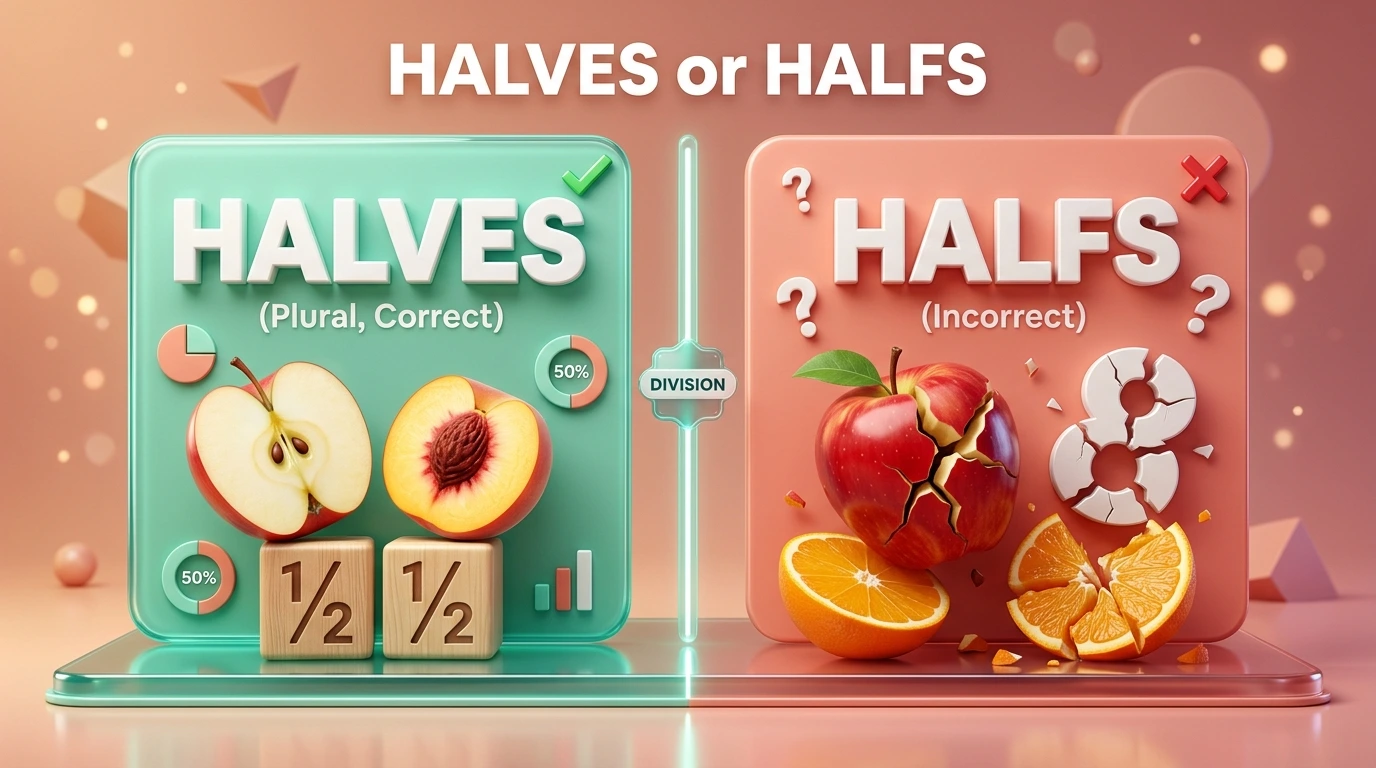
Halves is the correct plural form of half. Halfs is almost always incorrect. For example, “Cut the apple into two halves” is correct.
A few years ago, I was proofreading a student’s essay when I came across a sentence that read, “The cake was divided into two halfs.” At first, it looked harmless. After all, many English words simply add -s to become plural. But something felt off.
That small mistake sparked a discussion that lasted longer than expected. The student asked a question I hear all the time: “Why isn’t it halfs?”
If you’ve ever paused while writing and wondered whether to use halfs or halves, you’re not alone. English has many words that break the usual plural rules. Some follow patterns. Others seem to create their own.
The good news is that this confusion is easy to solve once you understand the rule behind it. In this guide, you’ll learn which form is correct, why it works that way, common mistakes to avoid, and how to use the word confidently in everyday writing.
Halves or Halfs: Quick Answer
The correct plural form of half is halves.
When the noun half becomes plural, the f changes to v, and -es is added.
Correct Examples
- One half → Two halves
- The pizza was cut into halves.
- Both halves of the team played well.
Incorrect Examples
- Two halfs ❌
- Several halfs ❌
In modern English, halfs is considered incorrect in nearly all situations.
The Origin: Background of Halves or Halfs
The word half comes from Old English. It has existed for hundreds of years and belongs to a group of nouns that change spelling when they become plural.
This pattern is not unique.
Other examples include:
| Singular | Plural |
| Leaf | Leaves |
| Wolf | Wolves |
| Knife | Knives |
| Life | Lives |
| Half | Halves |
Long ago, English pronunciation influenced spelling changes. The f sound often softened into a v sound when pluralized. Over time, the spelling changed to match the pronunciation.
That’s why we write halves instead of halfs today.
Many learners expect a simple -s ending because that works for most nouns. Unfortunately, half belongs to the exception group.
Halves or Halfs Explained: Key Differences or Variations
The difference is simple but important.
| Term | Meaning | When to Use | Region/Context |
| Half | One of two equal parts | Singular | Worldwide |
| Halves | More than one half | Plural | Worldwide |
| Halfs | Incorrect plural form | Avoid | Not standard English |
Examples of Half
- I ate half the sandwich.
- Only half the class attended.
Halves
- The orange was split into two halves.
- Both halves of the football match were exciting.
Halfs
- The pie was divided into two halfs. ❌
- Both halfs were equal. ❌
The correct choice is always halves when referring to more than one half.
Nobodies or Nobody’s: Easy Guide to Correct Usage
Which Version Should You Use?
The answer depends on whether you’re using the singular or plural form.
For Students
Use half when referring to one part and halves when referring to two or more parts.
For Teachers and Academic Writers
Always use halves in formal writing. Dictionaries, textbooks, and style guides recognize it as the correct plural.
For Business Professionals
Reports, emails, and presentations should use halves whenever the plural form is needed.
For Global Audiences
The rule is the same in American English, British English, Canadian English, Australian English, and other major varieties.
There is no accepted regional preference for halfs.
Common Mistakes with Halves or Halfs
Many errors happen because people apply the normal plural rule.
Mistake 1
Wrong: Two halfs of the cake
Correct: Two halves of the cake
Why: Half changes from f to v before adding -es.
Mistake 2
Wrong: The halfs were equal.
Correct: The halves were equal.
Why: The plural form must be halves.
Mistake 3
Wrong: Several halfs remained.
Correct: Several halves remained.
Why: Standard English does not use halfs.
Mistake 4
Wrong: Cut it into four halfs.
Correct: Cut it into four halves.
Why: The plural spelling remains halves regardless of quantity.
Mistake 5
Wrong: Both halfs played well.
Correct: Both halves played well.
Why: Sports and other contexts follow the same grammar rule.
Halves or Halfs in Real-World Examples
Professional Email
“The report has been divided into two halves for easier review.”
News Headline
“Strong Second Half Helps Team Win After Even First and Second Halves“
Social Media Post
“We shared the sandwich and each took one of the halves.”
Formal Report
“The study compared the performance of both halves of the sample population.”
These examples show how naturally halves appears in everyday and professional writing.
Halves or Halfs: Data, Trends & Usage
Searches for halves or halfs are primarily informational.
People often search this topic because:
- They are writing essays.
- They are learning English.
- A spell checker flagged “halfs.”
- They want to improve grammar accuracy.
The topic is especially popular among:
- Students
- Teachers
- ESL learners
- Content writers
- Editors
An interesting trend is that grammar-related searches continue to grow because more communication now happens online. Small spelling mistakes are easier to notice and easier to question.
The search intent behind this keyword is educational and language-focused.
Standalone Comparison Table
| Term/Variant | Meaning | Region/Context | Best Used When |
| Half | One of two equal parts | Standard English | Singular form |
| Halves | More than one half | Standard English worldwide | Plural form |
| Halfs | Nonstandard spelling | Usually considered incorrect | Avoid in writing |
| Part | A section of something | General English | When not referring specifically to halves |
Frequently Asked Questions
Q: What does halves mean?
A: Halves is the plural form of half. It refers to two or more equal parts of something.
Q: Is halfs a real word?
A: While you may occasionally see it online, halfs is generally considered incorrect in modern standard English. Dictionaries and style guides prefer halves.
Q: How do you use halves correctly?
A: Use halves whenever you need the plural form of half. Example: “The apple was cut into two halves.”
Q: Why does half become halves?
A: English has a group of words where the final f changes to v before adding -es. Half follows that pattern.
Q: Is halves acceptable in formal writing?
A: Yes. Halves is the correct form in academic, professional, and everyday writing.
Q: Which version is correct: halves or halfs?
A: Halves is correct. Halfs is considered a spelling mistake in standard English.
Q: Can halves be used in sports?
A: Absolutely. People commonly refer to the first half and second half of a game as the two halves of a match.
Buoy or Bouy: The Complete Guide to the Correct Spelling
Conclusion
The debate between halves and halfs is much easier than it first appears. Once you know the rule, the answer becomes clear.
Remember these key points:
- Half is singular.
- Halves is the correct plural form.
- Halfs is generally incorrect.
- The rule applies in all major English-speaking regions.
- The spelling follows the same pattern as words like leaves, wolves, and knives.
English can sometimes feel unpredictable, but this is one grammar rule worth remembering. The next time you’re writing about two equal parts, you’ll know exactly which spelling belongs on the page.
Now you know exactly how to use halves correctly. Bookmark this guide so you never second-guess halves or halfs again, and share it with someone who might be confused too.
Halves or halfs explained with meanings, examples, grammar rules and usage tips to help avoid common mistakes today

As an English language enthusiast, I love diving into the tricky details of word differences and spelling variations. My mission is to explain confusing terms and make them accessible to everyone, helping readers to communicate with clarity and confidence.