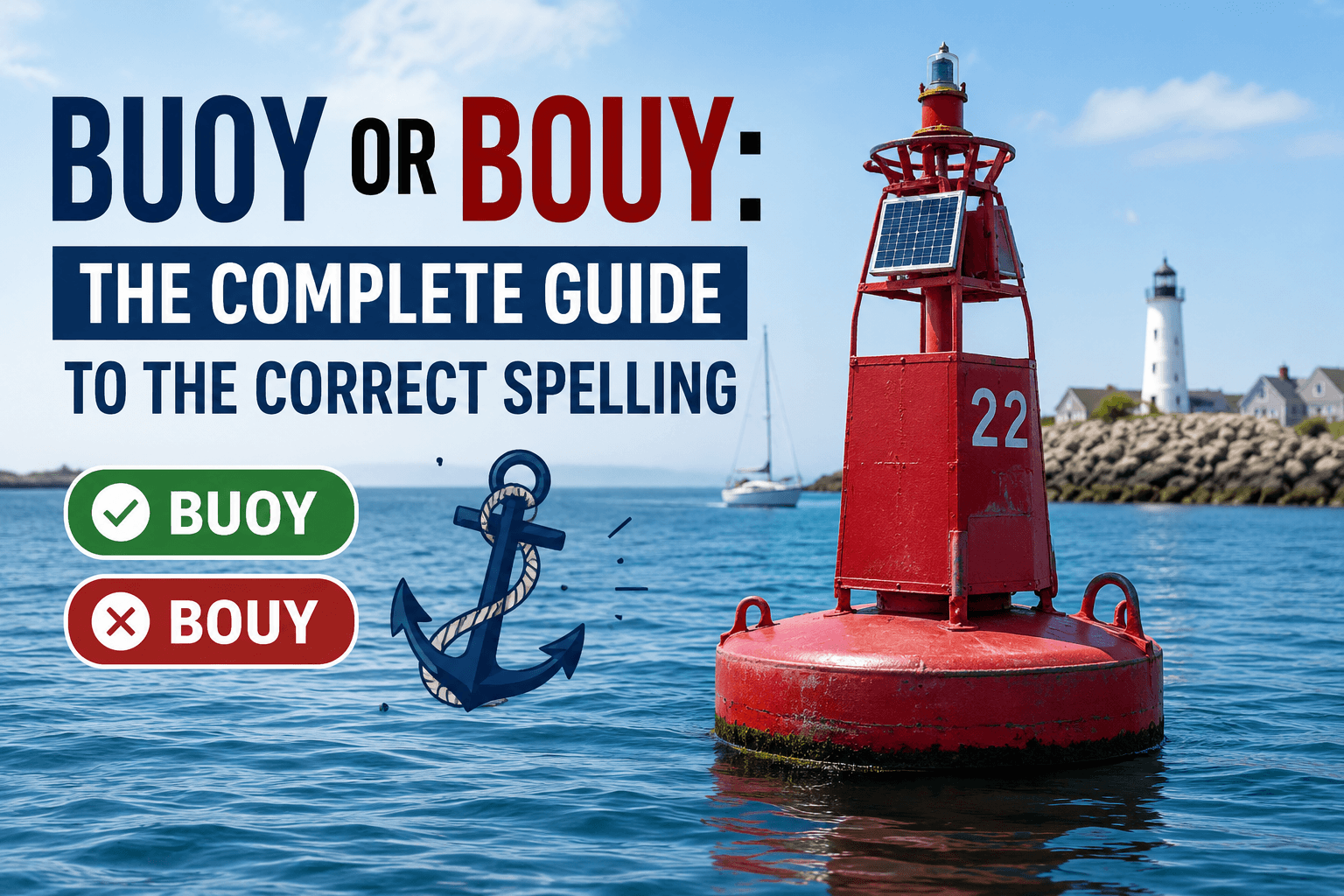
Buoy is the correct spelling. Bouy is a common misspelling and is not accepted in standard English. For example, a buoy floats in the water to mark a safe route for boats.
A few summers ago, I was helping a student edit a travel article about sailing. Everything looked good until I spotted the word “bouy.” It appeared several times throughout the piece.
The student was surprised.
“I’ve seen that spelling online before,” she said. “Isn’t it correct?”
That question highlights a mistake many people make. The words buoy and bouy look very similar. The letters are simply reversed. Because of that, many writers type the wrong version without noticing.
Search engines receive thousands of spelling-related questions every year. People want to know whether bouy is an accepted alternative or simply an error.
The answer is simple, but understanding why the confusion happens can help you avoid it forever.
In this guide, you’ll learn the difference between buoy and bouy, where the word comes from, how to use it correctly, common mistakes to avoid, and real-world examples that make the spelling easy to remember.
Let’s clear up the confusion once and for all.
Buoy or Bouy: Quick Answer

The correct word is buoy.
The spelling bouy is incorrect in standard English.
A buoy is a floating object placed in water to mark locations, warn of hazards, or guide boats.
Examples
- The red buoy marked the entrance to the harbor.
- Fishermen tied their nets near the buoy.
If you write bouy, most editors and spell-checkers will flag it as an error.
The Origin; Background of Buoy or Bouy
The word buoy has an interesting history.
It entered English from older European languages connected to navigation and maritime trade. For centuries, sailors used buoys to mark safe passages and dangerous areas in rivers, lakes, and oceans.
Over time, the word became a standard nautical term.
The confusion with bouy happens because the letters “u” and “o” are easy to reverse when typing. The mistake is common enough that many people search for it online.
Unlike some English words that have regional spelling differences, buoy has only one accepted spelling.
That means:
- Buoy = Correct
- Bouy = Incorrect
There is no British-versus-American difference here.
Buoy or Bouy Explained: Key Differences
The difference is straightforward.
| Term | Meaning | When to Use | Region/Context |
| Buoy | Floating marker in water; also means to support or uplift | Always | Worldwide |
| Bouy | Misspelling of buoy | Never | Incorrect spelling |
Buoy as a Noun
A buoy is an object that floats on water.
Example:
- The yellow buoy warned sailors about shallow water.
Buoy as a Verb
The word can also mean to support, encourage, or keep afloat.
Example:
- Good news helped buoy her confidence.
Bouy
The spelling bouy has no accepted meaning in standard English dictionaries.
It is simply a spelling mistake.
Which Version Should You Use?
The answer is easy.
For Students
Always use buoy.
Teachers and exams will mark bouy as incorrect.
For Bloggers and Writers
Use buoy in all articles, reports, and content.
For Business Professionals
Use buoy in emails, presentations, and documents.
For Global Audiences
Choose buoy every time.
There is no situation where bouy is preferred.
Flavor or Flavour: Which Spelling Should You Use?
Common Mistakes with Buoy or Bouy
Here are the mistakes people make most often.
Mistake 1
❌ The fishing boat stopped near the bouy.
✅ The fishing boat stopped near the buoy.
Why?
Buoy is the correct spelling.
Mistake 2
❌ Bouy is the British spelling.
✅ Buoy is used in both British and American English.
Why?
There is no regional spelling variation.
Mistake 3
❌ The positive review bouyed her confidence.
✅ The positive review buoyed her confidence.
Why?
The verb form comes from buoy.
Mistake 4
❌ The bouy floated in the harbor.
✅ The buoy floated in the harbor.
Why?
The letter order matters.
Mistake 5
❌ Buoy and bouy are interchangeable.
✅ Only buoy is correct.
Why?
Dictionaries recognize only one spelling.
Buoy in Real-World Examples
Professional Email
“The maintenance team will inspect each buoy before the boating season begins.”
News Headline
“Coast Guard Replaces Damaged Buoy Near Harbor Entrance”
Social Media Post
“Just spotted a bright red buoy while kayaking today!”
Formal Report
“The navigation buoy remained visible throughout the survey period.”
These examples show how the word appears in different settings.
Buoy or Bouy: Data, Trends & Usage
Many searches for bouy come from typing mistakes.
Search Intent
The primary search intent is:
Informational
People want to know:
- Which spelling is correct?
- Is bouy a real word?
- How do I use buoy correctly?
Popular Audiences
This topic is commonly searched by:
- Students
- English learners
- Writers
- Editors
- Bloggers
Regional Interest
Searches come from:
- United States
- United Kingdom
- Canada
- Australia
- India
Why This Matters Today
Online writing tools catch many spelling errors, but not everyone uses them. Knowing the correct spelling helps you write confidently and professionally.
Buoy vs Bouy Comparison Table
| Term/Variant | Meaning | Region/Context | Best Used When |
| Buoy | Floating marker in water; also means support or uplift | Worldwide | Always |
| Bouy | Misspelling of buoy | None | Never |
Frequently Asked Questions

Q: What does buoy mean?
A: A buoy is a floating object placed in water to mark locations, channels, or hazards. It can also mean to support emotionally or physically.
Q: How do you use buoy correctly?
A: Use buoy when referring to a floating marker or when using the verb meaning “to support” or “lift.”
Q: Buoy vs bouy; what’s the difference?
A: Buoy is the correct spelling. Bouy is a common spelling error.
Q: Is buoy acceptable in formal writing?
A: Yes. Buoy is the standard spelling used in academic, professional, and technical writing.
Q: Which version is correct; buoy or bouy?
A: Buoy is correct. Bouy is incorrect.
Q: Where does buoy come from?
A: The word developed through maritime languages and became a standard English term used in navigation.
Q: Can buoy be used as a verb?
A: Yes. It can mean to support, encourage, or keep something afloat.
Example: “The strong sales figures buoyed investor confidence.”
Conclusion
The debate between buoy and bouy is actually very simple.
Only buoy is correct.
Remember these key points:
- Buoy is the accepted spelling.
- Bouy is a common mistake.
- Buoy can be both a noun and a verb.
- The spelling stays the same in American and British English.
If you remember the letter order in buoy, you’ll avoid one of the most common spelling errors related to this word.
Buoy or bouy explained: Learn correct spelling, meaning, usage, examples, and avoid common mistakes when writing confidently.
Tonnes or Tons: The Easy Guide to Knowing the Difference

As an English language enthusiast, I love diving into the tricky details of word differences and spelling variations. My mission is to explain confusing terms and make them accessible to everyone, helping readers to communicate with clarity and confidence.