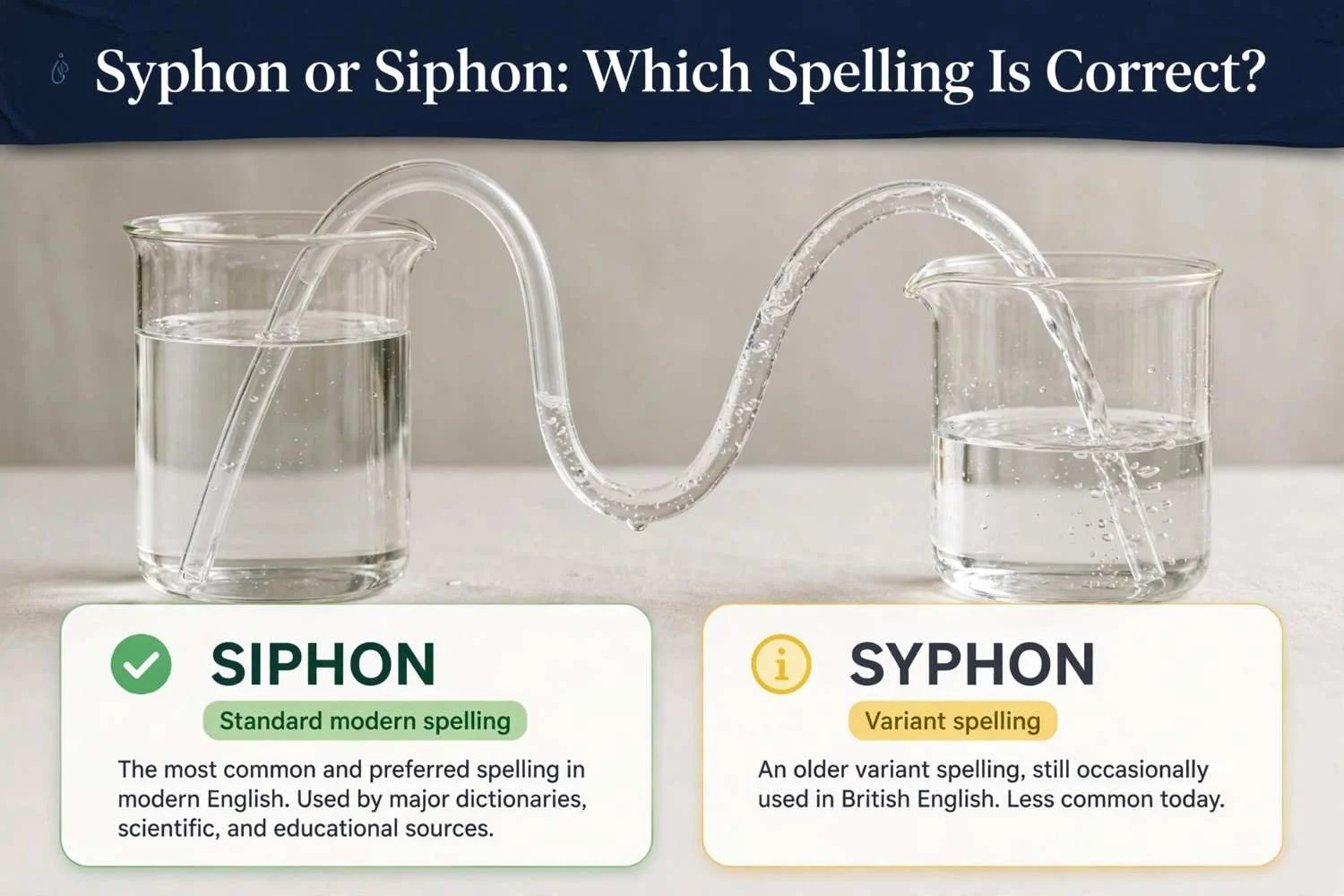
Siphon is the standard and preferred spelling in modern English, while syphon is an accepted but less common variant. For professional, academic, and general writing, siphon is the safest choice.
Have you ever stopped while writing syphon or siphon because both spellings looked right? You are not alone. Both forms appear in books, product names, plumbing guides, coffee equipment, and online posts. This makes it hard to know which spelling is best.
The quick answer is simple: siphon is the standard modern spelling. Syphon is an accepted variant, but it is much less common. Major dictionaries list siphon as the main form. Some British dictionaries also show syphon as another spelling.
The word can name a tube that moves liquid from one place to another. It can also be a verb. For example, you may siphon water from a tank. In a figurative sense, someone may siphon money from a business.
This guide explains the difference between syphon or siphon, their history, regional use, common errors, and the safest spelling for professional writing.
Syphon or Siphon – Quick Answer
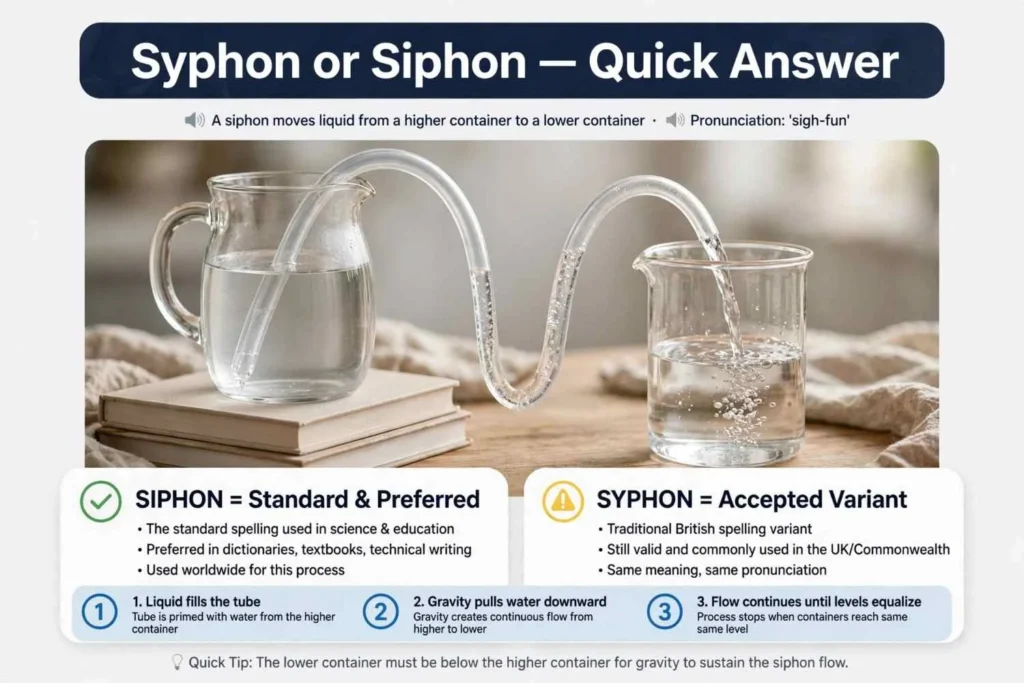
Siphon is the standard and preferred spelling.
Syphon is also a real spelling, but it is less common. Merriam-Webster calls it a less common form, while Oxford lists it as an alternative spelling.
Use siphon in most modern writing.
Correct examples
- We used a tube to siphon water from the tank.
- The worker siphoned fuel into a safe container.
- The report claims that money was siphoned off.
- She bought a new coffee siphon.
Less common but accepted
- We used a syphon to empty the tank.
- The water was syphoned into another container.
Both spellings have the same meaning. They are also said in the same way: sigh-fun.
The safest rule is:
Use siphon unless a brand name, house style, or quoted text uses syphon.
The Origin of Syphon or Siphon
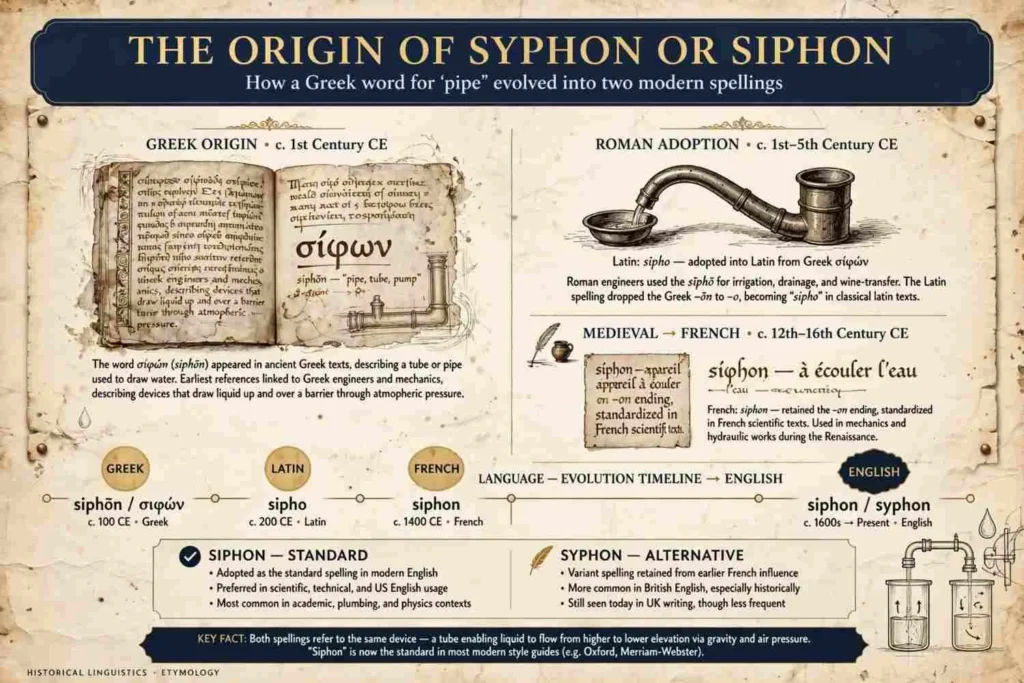
The word siphon comes from the Greek word siphōn, meaning a pipe or tube. It later passed through Latin and French before entering English. Oxford dates the noun to late Middle English and the verb to the middle of the nineteenth century.
The spelling with i follows the older Greek and Latin forms more closely. This is one reason siphon became the main dictionary spelling.
The form syphon developed as an alternative English spelling. Writers sometimes replaced the letter i with y because both forms produced the same sound. English spelling was less fixed in older periods, so several forms of one word could exist at the same time.
Over the years, dictionaries and publishers began to favour siphon. However, syphon did not disappear. It can still be found in older books, British writing, product names, and specialist terms.
Today, both forms are understood, but they are not used equally. Siphon is the clear modern standard.
British English vs American English Spelling
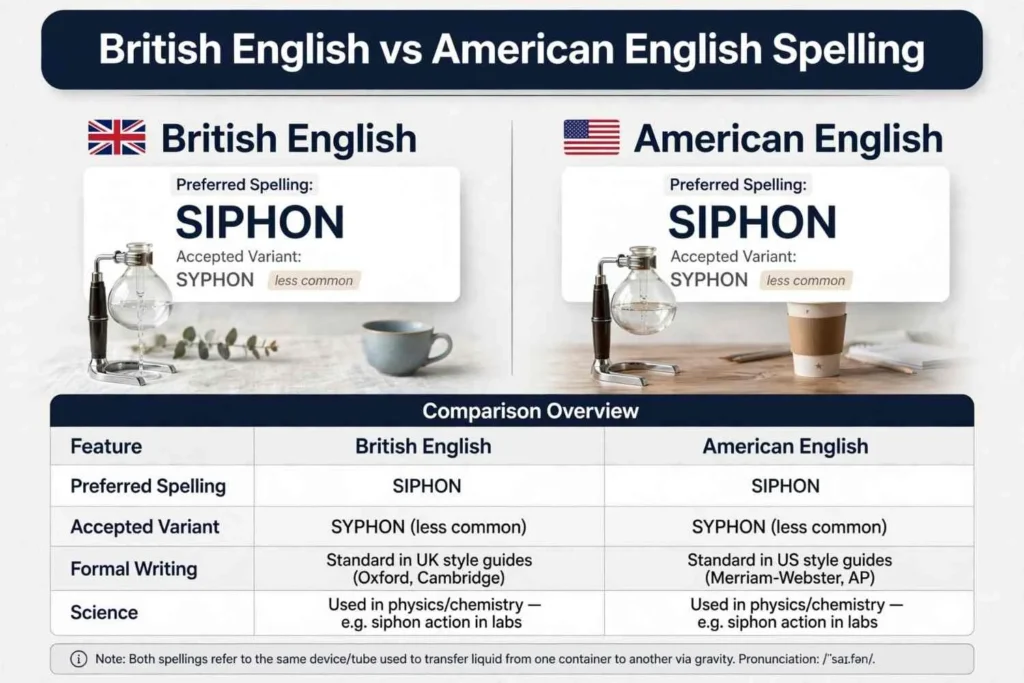
The choice between syphon or siphon is not a strict British-versus-American rule.
Both British and American English use siphon. It is the main spelling in major dictionaries from both regions. Oxford lists syphon as an alternative, and Collins describes it as a variant spelling. Merriam-Webster marks it as less common.
The form syphon may appear more often in British and Commonwealth writing. However, British writers can still use siphon, and it is often the better choice.
British and American comparison
| Feature | British English | American English |
| Preferred spelling | Siphon | Siphon |
| Accepted variant | Syphon | Syphon, but uncommon |
| Common in formal writing | Siphon | Siphon |
| Common in science | Siphon | Siphon |
| Common in older texts | Both forms | Both forms |
| Best choice for general readers | Siphon | Siphon |
This case is different from words such as colour/color or centre/center. You do not need to change the spelling based only on your country.
Which Spelling Should You Use?
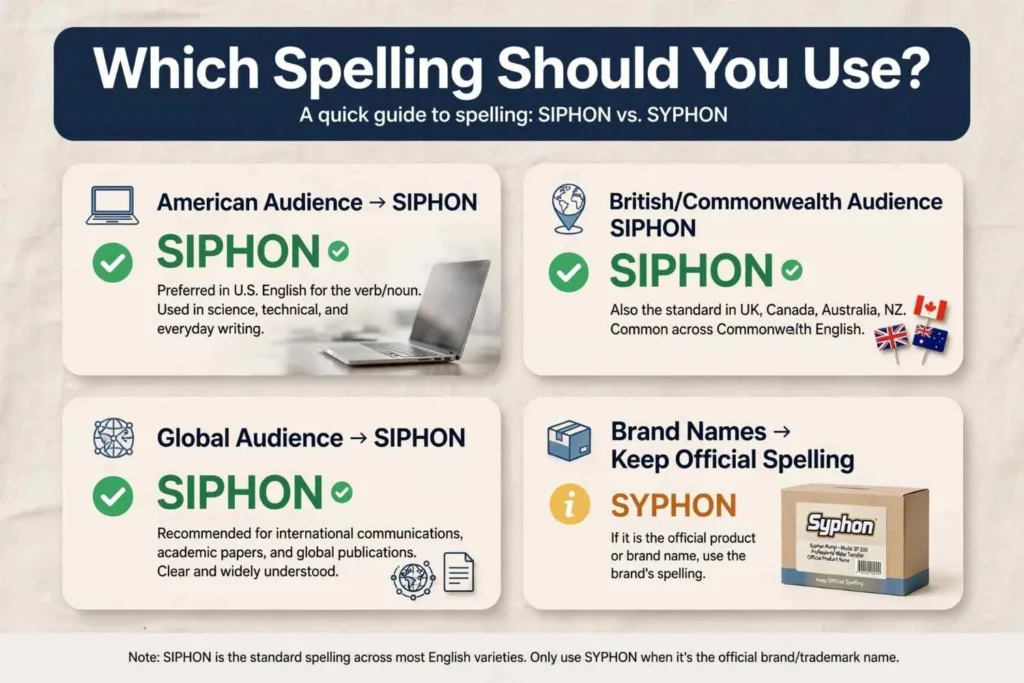
Your best choice depends on your audience and type of writing.
For an American audience
Use siphon.
It is the standard form in American dictionaries, news writing, education, science, and business communication.
Example:
The machine can siphon water from the lower chamber.
For a British or Commonwealth audience
Use siphon as your default choice.
Syphon is accepted and may appear in the United Kingdom, Australia, New Zealand, Pakistan, and other Commonwealth countries. However, siphon is more widely recognised and looks more modern.
For a global audience
Always prefer siphon.
It is easier to recognise and works well in international articles, product pages, manuals, and academic work.
For brand names and product titles
Keep the official spelling used by the company.
For example, a coffee maker may include Syphon in its official product name. Do not change a registered or printed name simply to follow the standard spelling.
For quoted or historical text
Keep the original spelling when quoting a source.
Outside the quotation, return to siphon for consistency.
Common Mistakes with Syphon or Siphon
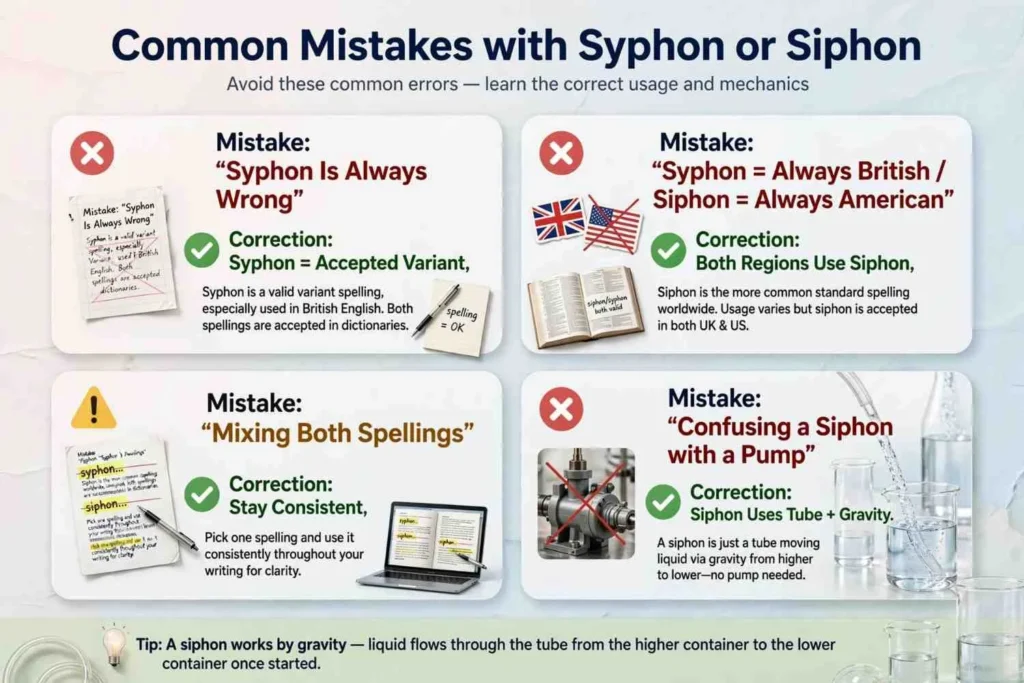
Although both forms exist, writers often make small errors when using them.
Mistake 1: Thinking syphon is always wrong
Syphon is not a spelling error. It is an accepted but less common variant.
Better advice: Use siphon in modern writing, but do not mark every use of syphon as incorrect.
Mistake 2: Treating it like a UK-US spelling rule
Some people think syphon is always British and siphon is always American.
That rule is too simple. British dictionaries also use siphon as the main form.
Mistake 3: Mixing both spellings
Do not write siphon in one paragraph and syphon in the next.
Choose one form and use it throughout your text.
Mistake 4: Using the wrong verb ending
Correct forms include:
- Siphon
- Siphons
- Siphoned
- Siphoning
The less common variant forms are:
- Syphon
- Syphons
- Syphoned
- Syphoning
Mistake 5: Confusing a siphon with a pump
A pump uses mechanical force to move liquid. A siphon usually uses a tube, gravity, and a difference in height.
The words may describe similar tasks, but they are not always equal.
Mistake 6: Forgetting the figurative meaning
Siphon off can mean secretly moving money or resources.
Correct: The manager was accused of siphoning off company funds.
Read More: Kindergarden or Kindergarten? The Correct Spelling Explained
Syphon or Siphon in Everyday Examples
The word appears in many types of communication.
In an email
Please use the hose to siphon the remaining water from the tank before the repair begins.
This spelling is clear and professional.
In a news report
Investigators believe the group siphoned money from public projects.
Here, the word does not describe liquid. It means that money was moved or taken, often in a dishonest way. Dictionaries recognise this figurative use.
On social media
I finally learned how to use a siphon to clean my fish tank.
The standard spelling works best, even in casual writing.
In formal writing
The liquid was siphoned into a separate container for testing.
This form is suitable for reports, instructions, and academic work.
In a product description
This aquarium siphon removes dirt, waste, and old water from the tank.
Clear product pages should normally use siphon because customers are more likely to recognise it.
In coffee writing
A glass siphon coffee maker uses two chambers to brew coffee.
Some coffee brands use syphon in official product names. In normal descriptions, either form may appear, but siphon remains the safer general choice.
Syphon or Siphon – Google Trends & Usage Data

Google Trends measures relative search interest. It uses a scale from 0 to 100 rather than showing exact search totals. Results can change by country, date range, category, and search type.
A comparison of syphon or siphon will normally support this broad pattern:
- Siphon is the stronger modern search term.
- Syphon has lower and more regional interest.
- Searches for siphon often relate to plumbing, aquariums, fuel, science, and coffee.
- Searches for syphon may relate to older spelling habits or product names.
- British and Commonwealth users may search both forms.
- American users are more likely to search for siphon.
The exact scores should not be treated as permanent facts. Google Trends data changes over time, especially for words with low search volume.
For professional content, use siphon as the main keyword. You may include syphon once or twice to answer the spelling question and catch variant searches. Do not repeat both forms in every paragraph.
Syphon or Siphon Comparison Table
| Variation | Meaning | Status | Best Use |
| Siphon | A tube or method used to move liquid | Standard spelling | All modern writing |
| Syphon | Same meaning as siphon | Accepted variant | Older text, regional use, brand names |
| Siphons | Third-person verb or plural noun | Standard | “The machine siphons water” |
| Siphoned | Past tense | Standard | “They siphoned the fuel” |
| Siphoning | Present participle | Standard | “The pump is siphoning water” |
| Siphon off | Move or remove something | Standard phrase | Money, funds, energy, or resources |
| Syphoned off | Same figurative meaning | Less common | Text using the syphon style |
Frequently Asked Questions
1. Is it syphon or siphon?
Both spellings exist, but siphon is the standard and preferred form. Use it in most modern writing.
2. Is syphon a correct word?
Yes. Syphon is an accepted variant spelling. However, it is much less common than siphon.
3. Is syphon the British spelling?
Not exactly. British English accepts syphon, but major British dictionaries also use siphon as the main form.
4. What does siphon mean?
As a noun, a siphon is a tube or device used to move liquid. As a verb, it means to move liquid through such a tube.
5. What does siphon off mean?
Siphon off means to remove or move something. It often refers to money or resources taken from their proper place.
Example: Someone had siphoned off part of the project budget.
6. How do you spell siphoned?
The standard spelling is siphoned.
Example: The water was siphoned out of the pool.
7. Should I use syphon in formal writing?
You can, but siphon is the better choice. It is more common, more widely recognised, and preferred in professional work.
8. Do siphon and syphon have different meanings?
No. They have the same meaning and pronunciation. The only difference is the spelling and how common each form is.
Conclusion
The choice between syphon or siphon is easier than it first appears. Both forms are real, and both have the same meaning. They can name a tube used to move liquid or describe the act of moving liquid. They can also appear in the phrase siphon off, which means moving money, energy, or other resources.
Still, the two spellings are not equally common. Siphon is the standard modern form in American, British, and international English. It is the best option for articles, emails, schoolwork, reports, manuals, and product descriptions. Syphon remains an accepted variant, but it is more likely to appear in older writing, regional use, or official product names.
For clear and professional writing, follow one easy rule: choose siphon and use it throughout your content. Keep syphon only when you are quoting an original source, following a brand name, or discussing the spelling difference itself.

Hi, I’m Shafqat Rehman. I write easy-to-follow guides about spelling differences, grammar, commonly confused words, comparison keywords, and British and American English variations. I enjoy breaking down confusing language topics and explaining them with clear examples. My aim is to help readers understand English differences and use the right words naturally and confidently.