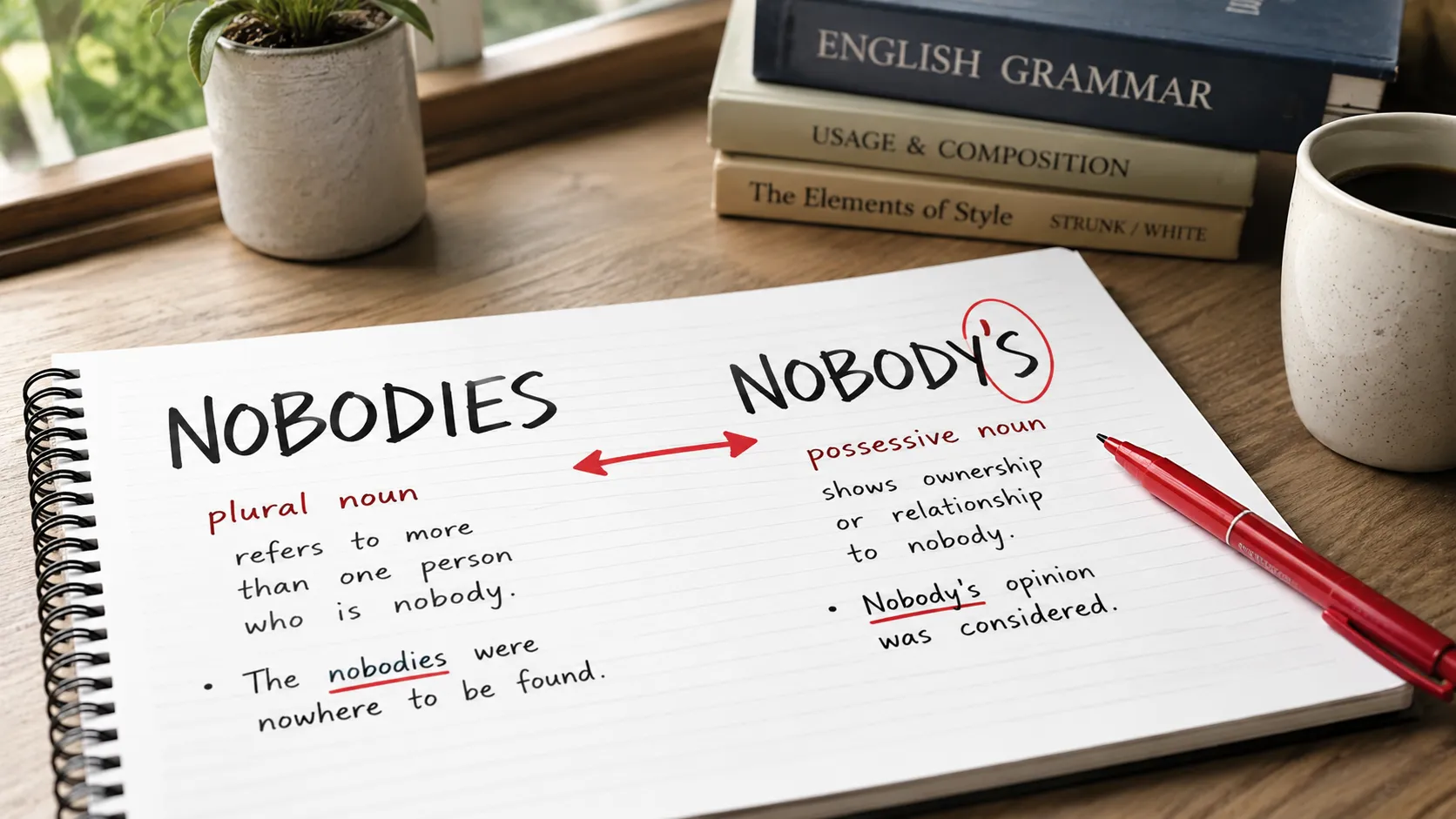
Nobodies” is the plural form of nobody and means more than one unimportant or unknown person. “Nobody’s” is a contraction meaning nobody is or nobody has, or a possessive form meaning something belongs to nobody. Example: “They were treated like nobodies” vs. “Nobody’s coming to the meeting.”
A few years ago, while editing articles for a language-learning website, I noticed the same mistake appearing again and again. Writers would type “nobody’s” when they meant “nobodies”, or use “nobodies” when they really meant “nobody’s.” Even experienced writers got confused.
Why does this happen?
The answer is simple. Both words look almost identical. The only difference is a tiny apostrophe. Yet that small mark completely changes the meaning.
You may have searched for “nobodies or nobody’s” because you saw one of these words in a book, social media post, email, or school assignment. Perhaps you want to know which version is correct. Or maybe you’re worried about making a grammar mistake.
The good news is that this confusion is easy to fix once you understand the rule. In this guide, you’ll learn the meaning of each word, when to use it, common mistakes to avoid, and real-world examples that make everything clear.
Let’s break it down step by step.
Nobodies or Nobody’s :Quick Answer
The correct choice depends on what you want to say.
- Nobodies = more than one nobody
- Nobody’s = nobody is, nobody has, or belonging to nobody
Examples
✅ Those actors were once nobodies.
✅ Nobody’s ready for the test.
✅ Nobody’s idea was accepted.
A quick trick:
- Need a plural? Use nobodies.
- Need “is” or “has”? Use nobody’s.
- Need possession? Use nobody’s.
The Origin / Background of Nobodies or Nobody’s

The word nobody has been part of English for centuries. It comes from combining two simple words:
- No
- Body (meaning person)
Originally, it simply meant “no person.”
Over time, English speakers also began using nobody as a noun describing someone with little importance, fame, or influence.
For example:
“Before becoming famous, they were nobodies.”
The confusion appeared later because English often adds ‘s to create:
- Contractions
- Possessive forms
As a result:
- Nobody’s can mean nobody is
- Nobody’s can mean nobody has
- Nobody’s can show possession
Meanwhile, nobodies is simply the plural noun.
That tiny apostrophe creates a big difference.
Nobodies or Nobody’s Explained :Key Differences
Understanding the difference is easier when you see the words side by side.
| Term | Meaning | When to Use | Region/Context |
| Nobodies | More than one nobody | Plural noun | All English varieties |
| Nobody’s | Nobody is | Contraction | All English varieties |
| Nobody’s | Nobody has | Contraction | All English varieties |
| Nobody’s | Belonging to nobody | Possessive | Less common |
Nobodies
Use nobodies when talking about multiple people considered unknown or unimportant.
Examples:
- They were once nobodies.
- The magazine ignored the nobodies in the industry.
Nobody’s = Nobody Is
Examples:
- Nobody’s perfect.
- Nobody’s available right now.
Expanded form:
- Nobody is perfect.
- Nobody is available right now.
Nobody’s = Nobody Has
Examples:
- Nobody’s finished the project.
- Nobody’s called me today.
Expanded form:
- Nobody has finished the project.
- Nobody has called me today.
Nobody’s = Possessive
Examples:
- It was nobody’s fault.
- The abandoned bag was nobody’s property.
This use is correct but less common.
Which Version Should You Use?
The best choice depends on your sentence.
For Students
Use nobodies when discussing multiple people.
Example:
The characters started as nobodies.
For Business Writers
Use nobody’s when shortening nobody is or nobody has.
Example:
Nobody’s available to approve the request.
For Academic Writing
You may prefer the full form.
Example:
Nobody is responsible for the error.
This sounds slightly more formal.
For Global and Neutral Use
Follow this simple rule:
- More than one person → nobodies
- Nobody is/has → nobody’s
- Possession → nobody’s
This works in American, British, Canadian, and Australian English.
Common Mistakes with Nobodies or Nobody’s
Many writers make the same errors.
Mistake #1
❌ Those singers were nobody’s before the show.
✅ Those singers were nobodies before the show.
Why?
You need a plural noun, not a contraction.
Mistake #2
❌ Nobodies coming to the event.
✅ Nobody’s coming to the event.
Why?
The sentence means nobody is coming.
Mistake #3
❌ The idea was nobodies fault.
✅ The idea was nobody’s fault.
Why?
This sentence shows possession.
Mistake #4
❌ The nobodies car was abandoned.
✅ The nobody’s car was abandoned.
Why?
The car belongs to nobody.
Mistake #5
❌ Nobodys understand the rule.
✅ Nobody’s understanding the rule.
or
✅ Nobody understands the rule.
Why?
The apostrophe is required in the contraction.
Nobodies or Nobody’s in Real-World Examples
Here is how each form appears in everyday writing.
Professional Email
Many applicants feel like nobodies when applying for jobs, but every candidate deserves consideration.
News Headline
Local Entrepreneurs Go From Nobodies to Industry Leaders
Social Media Post
Nobody’s talking about this amazing book and that’s surprising!
Formal Report
After investigation, it was determined that the incident was nobody’s fault.
Workplace Conversation
Nobody’s available this afternoon.
Entertainment Article
Ten years ago, these musicians were complete nobodies.
Nobodies or Nobody’s :Data, Trends & Usage
Grammar questions involving apostrophes remain among the most searched English-language topics online.
Search Intent
The keyword “nobodies or nobody’s” is mainly:
- Informational
- Educational
- Grammar-focused
Who Searches for It?
Common audiences include:
- Students
- ESL learners
- Bloggers
- Content writers
- Teachers
- Business professionals
Regions With Strong Interest
Interest is highest in:
- English-speaking countries
- Areas with large English-learning populations
- Academic and professional writing communities
Why It Matters Now
Online communication moves fast. People write emails, posts, articles, and messages every day. A small apostrophe mistake can affect credibility. Knowing the difference helps your writing look polished and professional.
Comparison Table
| Term/Variant | Meaning | Region/Context | Best Used When |
| Nobodies | Multiple unknown or unimportant people | Universal English | Referring to more than one person |
| Nobody’s | Nobody is | Universal English | Replacing “nobody is” |
| Nobody’s | Nobody has | Universal English | Replacing “nobody has” |
| Nobody’s | Belonging to nobody | Universal English | Showing possession |
| Nobody | No person | Universal English | Referring to a single unspecified person |
Frequently Asked Questions
Q: What does nobodies or nobody’s mean?
A: Nobodies means multiple unknown or unimportant people. Nobody’s means nobody is, nobody has, or something belongs to nobody.
Q: How do you use nobodies correctly?
A: Use nobodies as a plural noun. Example: “The band members were nobodies before their first hit song.”
Q: Nobodies vs nobody’s : what’s the difference?
A: Nobodies is plural. Nobody’s is a contraction or possessive form. The apostrophe changes the meaning completely.
Q: Is nobody’s acceptable in formal writing?
A: Yes. However, many formal documents prefer the expanded forms nobody is or nobody has for extra clarity.
Q: Which version is correct : nobodies or nobody’s?
A: Both are correct. The right choice depends on the sentence. Use nobodies for a plural noun and nobody’s for contractions or possession.
Q: Where does the word nobody come from?
A: It developed from combining the words no and body, meaning “no person.” It has been used in English for hundreds of years.
Q: Can nobody’s be used to show possession?
A: Yes. Example: “The mistake was nobody’s fault.” Here, the word shows ownership or association.
Conclusion
The difference between nobodies and nobody’s is small on the page but important in meaning. Remember the three key rules:
- Nobodies is the plural form of nobody.
- Nobody’s can mean nobody is.
- Nobody’s can mean nobody has or show possession.
When you’re unsure, try expanding nobody’s into nobody is or nobody has. If the sentence still makes sense, you’ve chosen the correct form. If you’re talking about multiple people, use nobodies instead.
Mastering this grammar point will make your writing clearer and more professional. Small details often create the strongest impression.
Now you know exactly how to use nobodies or nobody’s: go try it in your next piece of writing. Bookmark this guide so you never second-guess the difference again.
Mitosis or Meiosis: Complete Easy Guide for Students

“I am a dedicated and hardworking individual with a passion for learning and personal growth. I am committed to achieving goals and continuously improving my skills.”