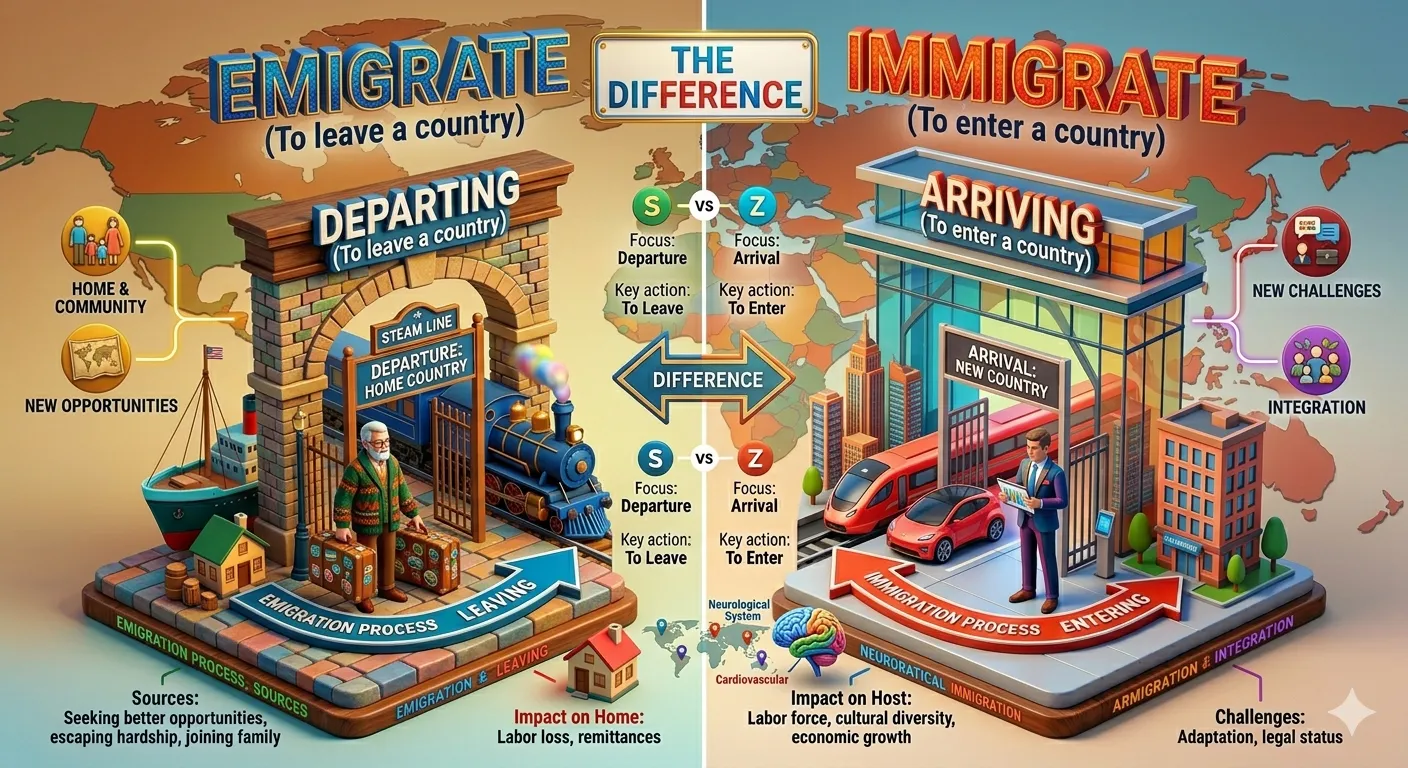
Emigrate or immigrate refers to moving between countries. Emigrate means leaving your country. Immigrate means entering another country to live.
I still remember a classroom moment that made this topic stick in my mind forever. A student raised his hand and asked, “Sir, my cousin moved to Canada. Did he emigrate or immigrate?”
The whole class went quiet. Even a few strong students looked unsure.
That confusion is very common. I faced the same problem when I started teaching English. I once wrote, “He immigrated from Pakistan,” and my mentor corrected me immediately. That small mistake changed the meaning completely.
The truth is simple, but the wording feels tricky. Both words talk about movement between countries. But they look at it from two different sides. One focuses on leaving. The other focuses on entering.
In this guide, you’ll learn emigrate vs immigrate in the easiest way possible. You’ll see meanings, real examples, memory tricks, mistakes, grammar forms, and real-world usage. By the end, you’ll never mix them up again.
Emigrate or Immigrate Quick Answer
Emigrate means to leave your country and live somewhere else.
Immigrate means to enter a new country and live there.
Simple examples:
- She emigrated from Pakistan to Canada.
- She immigrated to Canada from Pakistan.
Same journey. Two perspectives.
The Origin / Background of Emigrate and Immigrate
The words emigrate and immigrate share the same Latin root but developed different meanings based on direction.
- Emigrate comes from the Latin word emigrare, meaning “to move away” or “to depart from a place.” It combines the prefix e- (meaning “out of” or “away from”) with migrare (“to move”).
- Immigrate comes from the Latin word immigrare, meaning “to move into” or “to settle in a place.” It combines the prefix im- (meaning “into”) with migrare (“to move”).
Both words entered English in the 18th century and became especially common during periods of large-scale international migration. While they describe the same movement of people, emigrate emphasizes leaving a country, whereas immigrate emphasizes entering a new one.
Word Origins at a Glance
| Word | Latin Origin | Literal Meaning |
| Emigrate | emigrare | To move out of or away from |
| Immigrate | immigrare | To move into or settle in |
| Migrate | migrare | To move from one place to another |
Understanding these Latin prefixes makes the difference easy to remember:
- E- = out of → Emigrate
- Im- = into → Immigrate
Emigrate or Immigrate: Key Differences
| Aspect | Emigrate | Immigrate |
| Meaning | To leave your home country to live elsewhere | To enter a new country to live there permanently |
| Focus | The country being left | The country being entered |
| Perspective | Departure | Arrival |
| Common Preposition | From | To |
| Memory Trick | Emigrate = Exit a country | Immigrate = Into a country |
| Example | She emigrated from India. | She immigrated to Canada. |
| Question Answered | “Where did you leave?” | “Where did you move to?” |
| Viewpoint | Home country’s perspective | Destination country’s perspective |
Quick Example
If Ali moves from Pakistan to Canada:
- Ali emigrated from Pakistan.
- Ali immigrated to Canada.
Both statements describe the same move but from different perspectives.
Real-Life Example
A family moves from Pakistan to the UK:
- Pakistan says: “They emigrated from Pakistan.”
- UK says: “They immigrated to the UK.”
Same people. Same journey. Different angle.
Easy Memory Trick
- E = Exit → Emigrate
- I = Into → Immigrate
This trick works every time.
Emigrate vs Immigrate Grammar Forms You Should Know
These words are not only verbs. They also change form.
Verb Forms
- Emigrate → emigrated / emigrating
- Immigrate → immigrated / immigrating
Noun Forms
- Emigrant → a person who leaves a country
- Immigrant → a person who enters a country
Example:
- He is an emigrant from Syria.
- He is an immigrant in Germany.
This small detail is very important in exams and formal writing.
Emigrate or Immigrate Explained Key Variations
Sometimes learners also confuse these related words:
- Migrate → general movement (no direction focus)
- Emigrate → leave a country
- Immigrate → enter a country
Simple Breakdown
- Birds migrate in winter.
- People emigrate from their country.
- People immigrate into another country.
Which Version Should You Use?
Choosing the right word depends on context.
- For students and beginners → use the memory rule:
- Exit = Emigrate
- Into = Immigrate
- For IELTS / academic writing:
- Be precise
- Use both words when explaining movement
- For news or formal reports:
- Use immigrate when focusing on destination
- Use emigrate when focusing on origin
Example Sentence (Best Practice)
He emigrated from Pakistan in 2020 and immigrated to Canada the same year.
Clear. Correct. Professional.
Common Mistakes with Emigrate or Immigrate
Let’s fix the most common errors.
1. Wrong direction
❌ She immigrated from Pakistan
✔️ She emigrated from Pakistan
2. Wrong preposition
❌ He emigrated to Canada
✔️ He immigrated to Canada
3. Mixing both incorrectly
❌ He immigrated from India to Canada
✔️ He emigrated from India and immigrated to Canada
4. Using migrate for everything
❌ He migrate to Canada
✔️ He immigrated to Canada
5. Forgetting perspective
❌ Using one word for both sides
✔️ Always think: leaving or entering
Emigrate or Immigrate in Real-World Examples
📧 Professional Email
Dear Sir,
I would like to inform you that my brother has emigrated from Pakistan for employment purposes.
📰 News Headline
Skilled workers immigrate to Europe in record numbers each year.
📱 Social Media Post
Big move! I just immigrated to Australia. New life, new goals!
📄 Formal Report
Data shows that many professionals emigrate from developing countries due to economic opportunities abroad.
🏫 Academic Essay Example
Migration patterns show that people often emigrate from rural regions and immigrate into urbanized nations.
Emigrate or Immigrate Data, Trends & Usage
Emigrate or Immigrate: Data, Trends & Usage
The words emigrate and immigrate are closely related and frequently appear in discussions about international migration, citizenship, visas, and population movement. While both terms describe relocating to another country, their usage depends on perspective: emigrate focuses on leaving a country, while immigrate focuses on entering a new one.
Usage Trends
In modern English, immigrate and its related forms (immigrant, immigration) are generally used more often than emigrate and its related forms. This is because news reports, government policies, and public discussions typically focus on people arriving in a country rather than those leaving it.
Common contexts include:
- Immigration laws and policies
- Citizenship and residency applications
- International migration statistics
- Economic and workforce migration
- Refugee and asylum discussions
Search Interest
People often search for “emigrate vs immigrate” because the two words are easy to confuse. Popular search queries include:
- What is the difference between emigrate and immigrate?
- Emigrate vs immigrate examples
- Emigrate meaning
- Immigrate meaning
- Emigrate from or immigrate to?
- Emigration and immigration explained
Usage in Real-World Writing
| Context | More Common Term |
| Government policies | Immigrate |
| Visa and residency discussions | Immigrate |
| Historical population movements | Both |
| Personal relocation stories | Both |
| News reporting | Immigrate |
| Academic migration studies | Both |
Example of Usage
When a person moves from Pakistan to Canada:
- From Pakistan’s perspective, they emigrate from Pakistan.
- From Canada’s perspective, they immigrate to Canada.
This dual perspective explains why both words often appear together in educational materials and migration-related content.
Modern Relevance
With globalization, international education, remote work opportunities, and skilled-worker programs becoming more common, the concepts of emigration and immigration remain highly relevant. Governments, businesses, researchers, and individuals frequently use these terms when discussing cross-border movement and demographic trends.
Key Takeaway
Although immigrate tends to appear more frequently in modern media and public discussions, both words remain essential. The distinction is simple:
- Emigrate = leave a country
- Immigrate = enter a country
Understanding this difference helps readers interpret migration-related information accurately and use both terms correctly in writing and conversation.
Standalone Comparison Table
| Term/Variant | Meaning | Region/Context | Best Used When |
| Emigrate | Leave a country | Source country focus | Talking about departure |
| Immigrate | Enter a country | Destination country focus | Talking about arrival |
| Migrate | General movement | Global use | Birds, animals, or general movement |
FAQs
Q: What does emigrate or immigrate mean?
A: Emigrate means leaving your country. Immigrate means entering another country. They describe the same movement from different perspectives.
Q: How do I use emigrate and immigrate correctly?
A: Use emigrate when focusing on leaving a country and immigrate when focusing on entering a new country.
Q: What is the main difference between emigrate and immigrate?
A: The difference is direction. Emigrate is exit-based. Immigrate is entry-based.
Q: Is immigrate used in formal English?
A: Yes, immigrate is widely used in formal writing, news, and legal documents.
Q: Which is correct: emigrate or immigrate?
A: Both are correct. The situation decides which one to use.
Q: Can I use migrate instead of emigrate or immigrate?
A: Yes, but only in general contexts. Migrate does not show direction clearly.
Q: What is the noun form of immigrate and emigrate?
A: Immigrant (one who enters) and emigrant (one who leaves).
Conclusion
Understanding emigrate vs immigrate becomes easy once you focus on direction. One word is about leaving. The other is about entering.
You also learned their origin, grammar forms, common mistakes, real examples, and how they are used in real life. This makes your English more accurate and professional.
Final key points:
- Emigrate = leave a country
- Immigrate = enter a country
- Perspective decides the word
- Migrate is general movement
Now you can confidently use these words in writing, exams, emails, and conversations without hesitation.
Go ahead and practice them in your next sentence. That’s how they become permanent in your memory.
Read More:
Ionic or Covalent: Complete Guide to Chemical Bonds 🧪

📚✨ I’m an English enthusiast and author dedicated to exploring word differences, spelling variations, and common language questions. By drawing on trusted dictionaries, language resources, and practical usage examples, I create clear, reliable content that helps readers learn with confidence and communicate more effectively. ✍️🌍