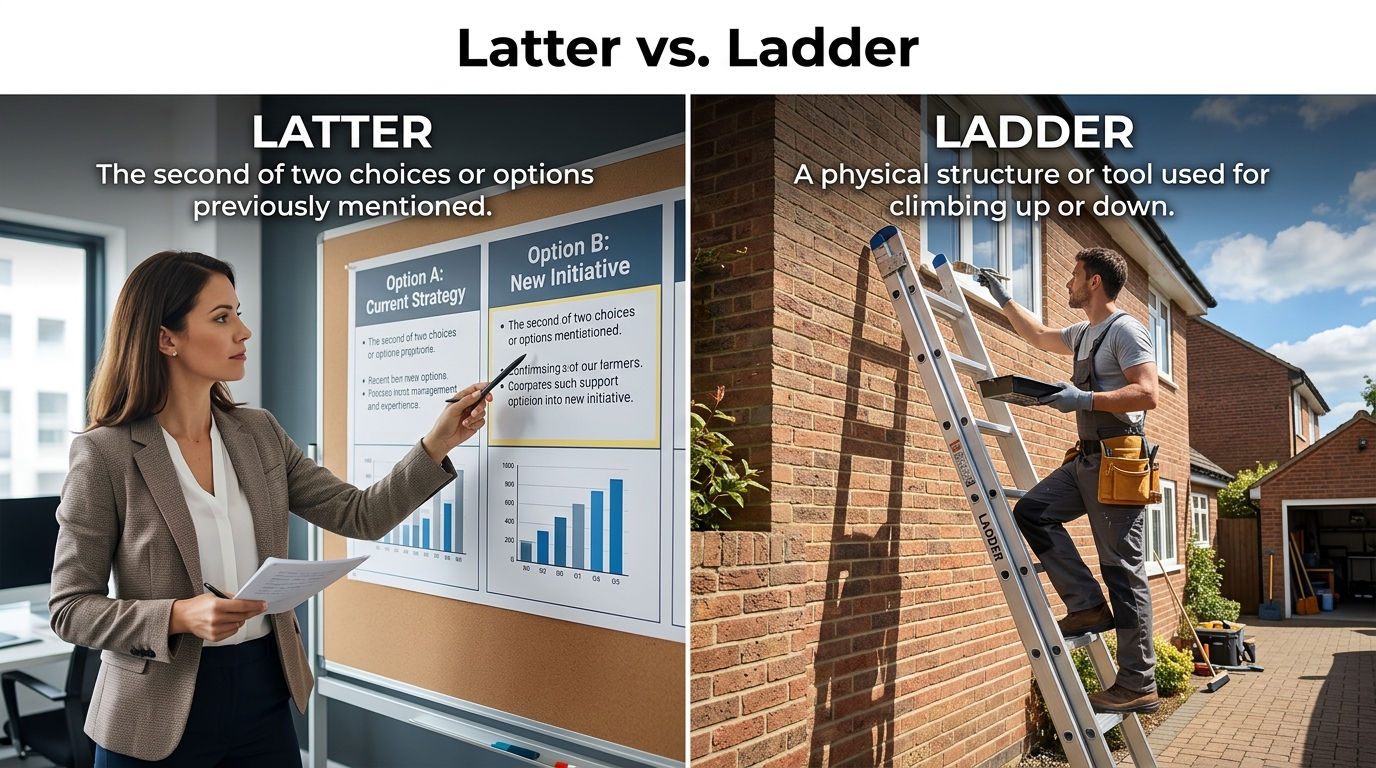
Latter refers to the second of two things mentioned, while ladder is a tool used for climbing. For example, “Between tea and coffee, I prefer the latter” is correct, while “He climbed the ladder to fix the roof” uses ladder correctly.
A few years ago, while reviewing a student’s essay, I noticed a sentence that read, “Of the two options, I chose the ladder.” The writer meant latter, not ladder. It was a small spelling mistake, but it completely changed the meaning of the sentence.
This confusion is common. The words latter and ladder sound similar in many accents. Because of this, people often mix them up when writing emails, essays, reports, and social media posts.
The problem is that these words have very different meanings. One is an English grammar term. The other is a physical object used for climbing. Using the wrong one can make your writing look careless and confuse your readers.
In this guide, you’ll learn the exact difference between latter and ladder, where each word came from, when to use them, common mistakes to avoid, and practical examples you can follow with confidence.
Latter or Ladder :Quick Answer

The correct word depends entirely on what you want to say.
- Latter = the second item in a pair.
- Ladder = a climbing tool with steps or rungs.
Examples
✅ Between pizza and pasta, I prefer the latter.
✅ She used a ladder to clean the windows.
❌ Between pizza and pasta, I prefer the ladder.
The first sentence talks about choices. The second talks about equipment.
The Origin / Background of Latter or Ladder
Understanding where these words come from makes them easier to remember.
Origin of Latter
The word latter comes from Old English lætra, meaning “later” or “second.” Over time, it developed the meaning of referring to the second of two mentioned items.
Example:
- Cats and dogs are popular pets. I prefer the latter.
Here, latter refers to dogs because they were mentioned second.
Origin of Ladder
The word ladder comes from Old English hlæder. It has always referred to a structure used for climbing.
Examples include:
- Step ladder
- Rope ladder
- Extension ladder
Although the words sound somewhat alike, their histories and meanings are completely different.
Gritty or Giddy: Complete Guide to Meaning and Difference
Latter or Ladder Explained :Key Differences

The biggest difference is simple.
Latter is used in language and writing.
Ladder is a physical object.
| Term | Meaning | When to Use | Region/Context |
| Latter | The second of two items mentioned | Writing, speaking, comparisons | Worldwide English |
| Ladder | A climbing device with rungs | Construction, home use, safety | Worldwide English |
Example of Latter
“I considered studying medicine or law. I chose the latter.”
The latter means law because law was mentioned second.
Example of Ladder
“The firefighter climbed a ladder to reach the window.”
The word refers to actual equipment.
Which Version Should You Use?
For Students
Use latter when comparing two ideas, people, places, or objects.
Example:
- Between science and history, I enjoy the latter.
For Professionals
Use latter in reports, presentations, and business writing when referring back to the second item mentioned.
Example:
- We considered two proposals. The latter offered lower costs.
For Homeowners and Tradespeople
Use ladder when talking about climbing equipment.
Example:
- Bring a ladder to paint the ceiling.
For Global Audiences
Both words are standard in British English and American English. The meanings never change.
Common Mistakes with Latter or Ladder

Here are mistakes people make most often.
| Mistake | Correction |
| I prefer the ladder option. | I prefer the latter option. |
| The latter was leaning against the wall. | The ladder was leaning against the wall. |
| He climbed the latter. | He climbed the ladder. |
| We chose the ladder proposal. | We chose the latter proposal. |
| The ladder of the two choices was cheaper. | The latter of the two choices was cheaper. |
Why These Errors Happen
- The words sound similar.
- Spell-check may not catch the mistake.
- Writers type quickly without checking context.
- English learners often memorize pronunciation before meaning.
A quick test helps:
Can you climb it?
- Yes → ladder
- No → latter
Latter or Ladder in Real-World Examples
Professional Email
“We reviewed both marketing plans. The latter provides better long-term value.”
News Headline
“Workers Rescued After Ladder Collapse at Construction Site”
Social Media Post
“Between beach vacations and mountain trips, I choose the latter every time.”
Formal Report
“Two strategies were evaluated. The latter demonstrated stronger performance metrics.”
Everyday Conversation
“Can you grab the ladder from the garage?”
These examples show how different the meanings are despite the similar pronunciation.
Latter or Ladder :Data, Trends & Usage
Search Intent
This keyword is primarily informational.
People search it because they want to:
- Improve grammar
- Avoid spelling mistakes
- Write professionally
- Understand confusing word pairs
Who Searches Most?
Common audiences include:
- Students
- ESL learners
- Teachers
- Writers
- Content creators
- Job seekers
Why Interest Remains High
English learners frequently encounter similar-sounding words. Search interest stays strong because accurate communication matters in school, work, and everyday life.
Current Trend
More people rely on autocorrect tools. Ironically, that creates new mistakes because software may not recognize context. Learning the difference remains valuable.
Standalone Comparison Table
| Term/Variant | Meaning | Region/Context | Best Used When |
| Latter | Second of two mentioned items | Grammar and writing | Referring to the second choice |
| Ladder | Climbing equipment with rungs | Physical object | Discussing climbing or access |
| Former | First of two mentioned items | Grammar and writing | Referring to the first choice |
| Step Ladder | Folding climbing device | Home and construction | Indoor climbing tasks |
Frequently Asked Questions
Q: What does latter mean?
A: Latter refers to the second of two things mentioned. It helps avoid repeating words in writing.
Q: What does ladder mean?
A: A ladder is a structure with rungs or steps used for climbing up or down.
Q: How do you use latter correctly?
A: Use it when discussing two options and referring to the second one. Example: “Of tea and coffee, I prefer the latter.”
Q: How do you use ladder correctly?
A: Use it when talking about climbing equipment. Example: “The painter stood on a ladder.”
Q: Which version is correct: latter or ladder?
A: Both are correct words. The correct choice depends on the meaning you intend.
Q: Is latter acceptable in formal writing?
A: Yes. It is widely used in academic papers, business reports, legal documents, and professional communication.
Q: How can I remember the difference?
A: Think of ladder as having steps you can climb. Think of latter as referring to the later or second item mentioned.
Conclusion
The difference between latter and ladder is easy once you know what each word means.
Remember these key points:
- Latter refers to the second of two things.
- Ladder is equipment used for climbing.
- Both words are correct but serve completely different purposes.
- Checking the context will usually reveal which one belongs in your sentence.
Whenever you’re comparing two choices, you’ll likely need latter. Whenever you’re talking about climbing, repairs, construction, or reaching high places, you’ll need ladder.
A simple spelling mistake can change your meaning instantly. Learning the distinction helps your writing look more professional and clear.
Now you know exactly how to use latter and ladder—go try it in your next piece of writing. Bookmark this guide so you never second-guess these words again, and share it with someone who has mixed them up before.
Latter or ladder explained clearly with meanings, usage, examples, and mistakes. Learn the correct word for every situation.
Plain or Plane: Easy Guide to Use the Right Word

As an English language enthusiast, I love diving into the tricky details of word differences and spelling variations. My mission is to explain confusing terms and make them accessible to everyone, helping readers to communicate with clarity and confidence.