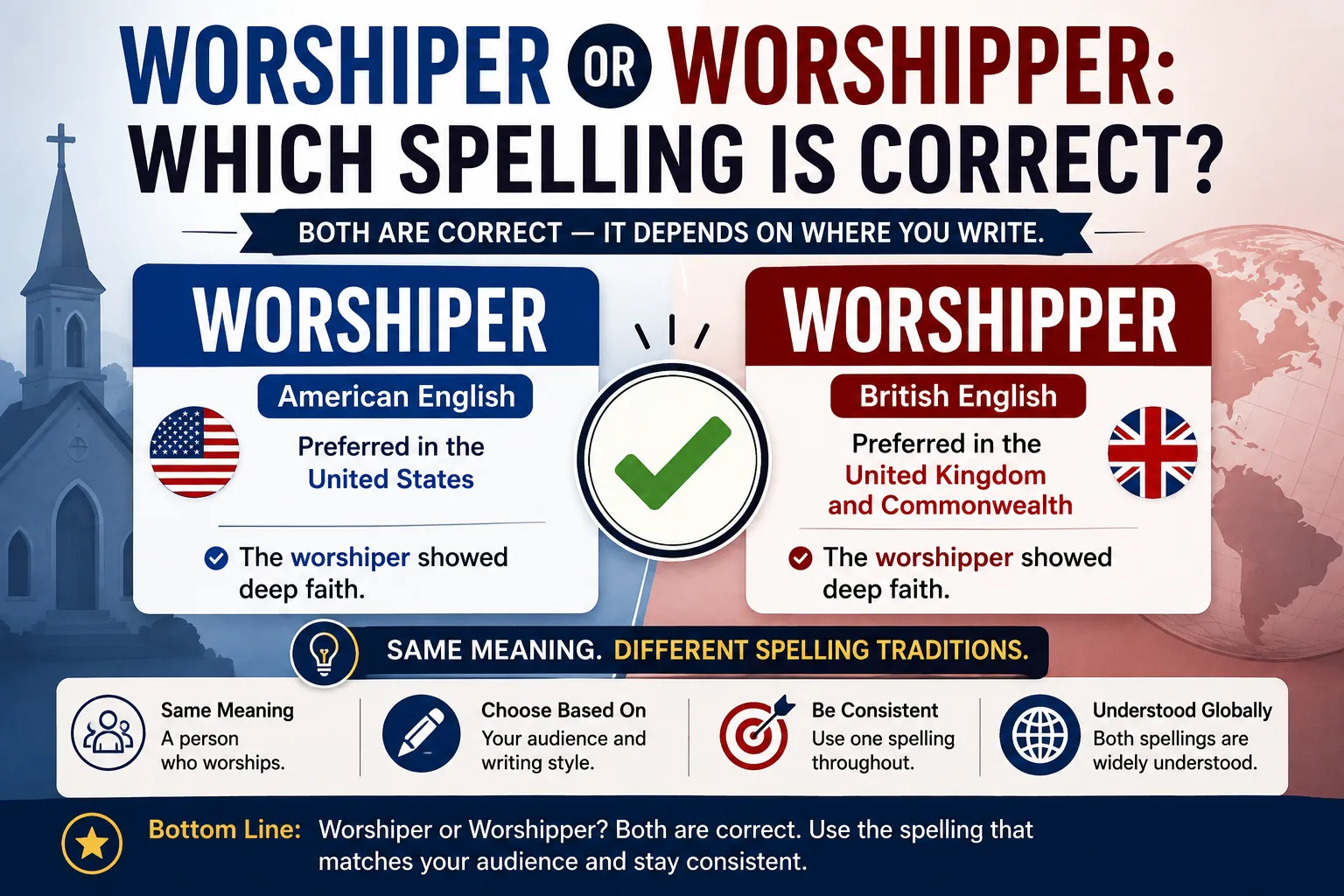
If you have ever typed “worshiper or worshipper” and stopped to wonder which spelling looks right, you are not alone. Both forms appear in dictionaries, books, websites, and everyday writing. The main difference comes from American and British English spelling rules.
So, is it worshiper or worshipper? The answer depends on the variety of English you use. Worshiper is more common in American English, while worshipper is preferred in British English and many other varieties.
This spelling difference can be confusing because both words have the same meaning. They refer to a person who worships or shows devotion to a god, religion, or object of deep respect. The extra p does not change the pronunciation or meaning.
In this guide, you will learn the difference between worshiper and worshipper, where each spelling comes from, which countries prefer each form, and how to choose the right spelling for your writing. You will also see simple examples, common mistakes, and practical advice for school, work, websites, and formal writing.
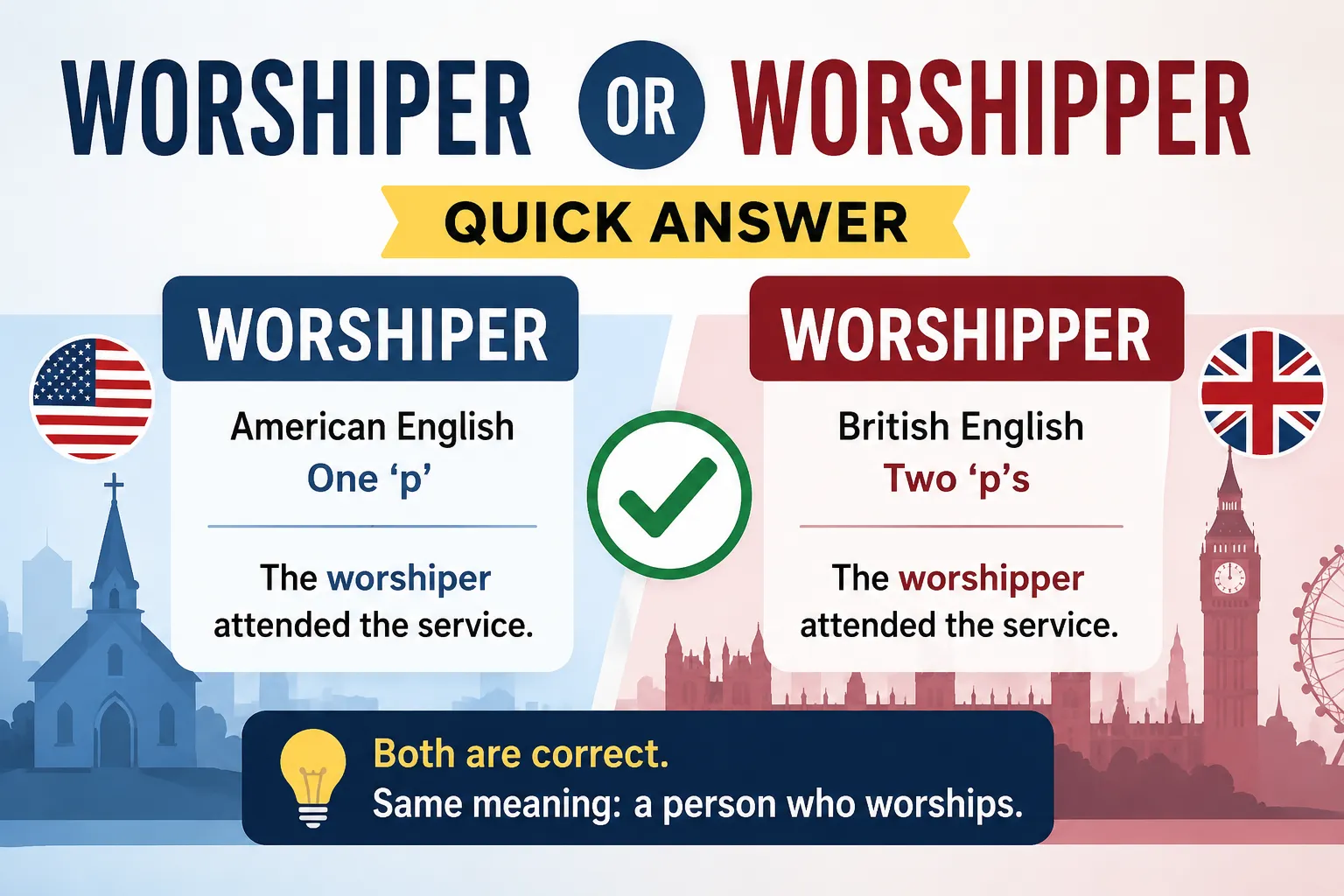
Both worshiper and worshipper are correct spellings.
The main difference is regional:
- Worshiper → more common in American English
- Worshipper → more common in British English
- Both mean a person who worships
Examples
American English:
The worshiper entered the church quietly.
British English:
The worshipper entered the church quietly.
The meaning stays the same. Only the spelling changes.
Quick comparison
| Spelling | Main Usage | Example |
|---|---|---|
| Worshiper | American English | The worshiper prayed quietly. |
| Worshipper | British English | The worshipper prayed quietly. |
If you are writing for an American audience, worshiper is usually the better choice. For a British audience, worshipper is usually preferred.
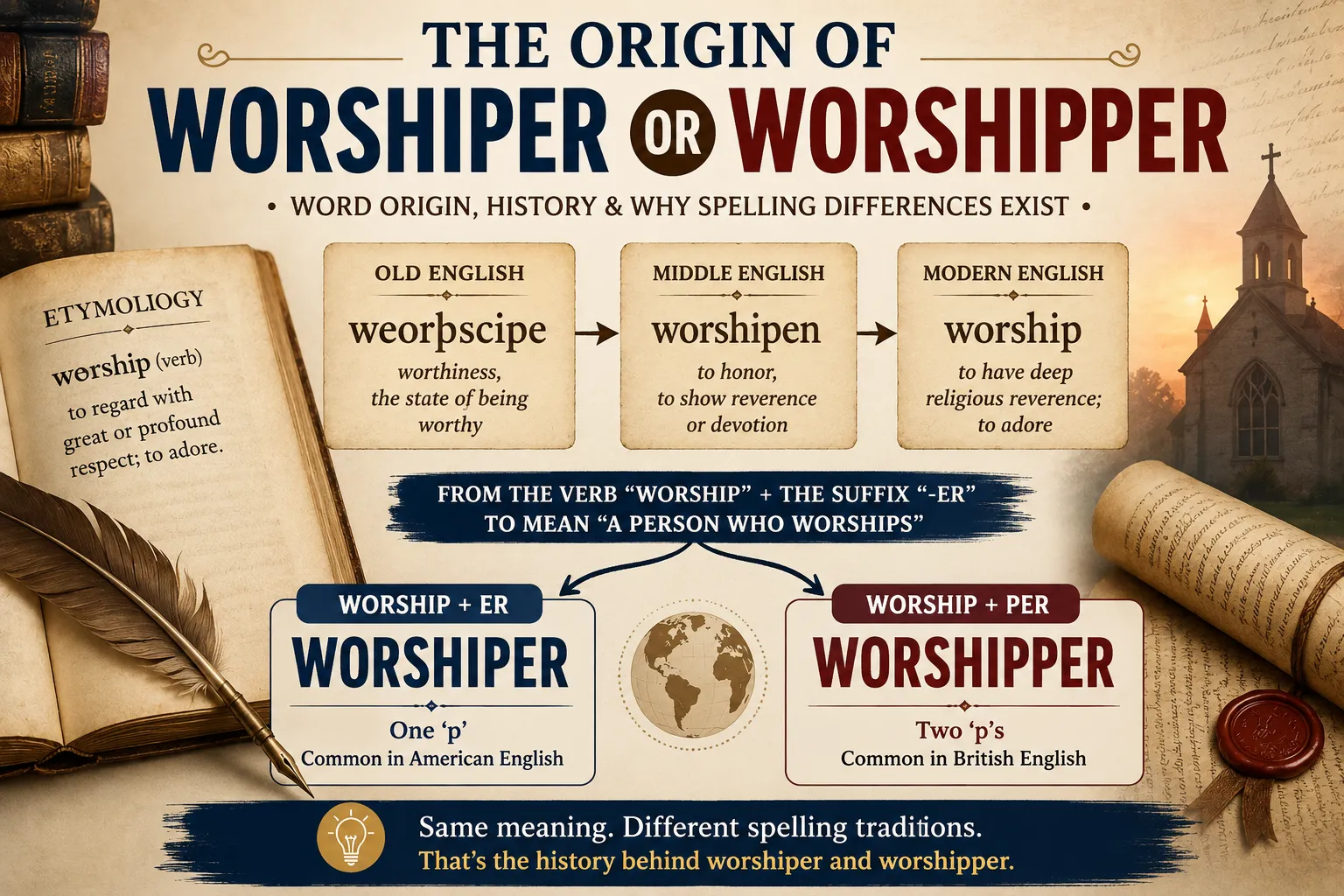
The word worship has a long history in English.
It comes from the Old English word weorþscipe, which meant something like “worthiness” or “the condition of being worthy.” Over time, the word developed its religious meaning.
The suffix -er is used to form a noun for a person who performs an action.
For example:
- teach → teacher
- work → worker
- farm → farmer
- worship → worshiper
The spelling worshipper developed under a spelling pattern in which the final consonant is doubled before adding -er.
This creates the two modern forms:
- worship + er → worshiper
- worship + per → worshipper
The difference is mainly a matter of spelling convention. It does not represent two different words or meanings.
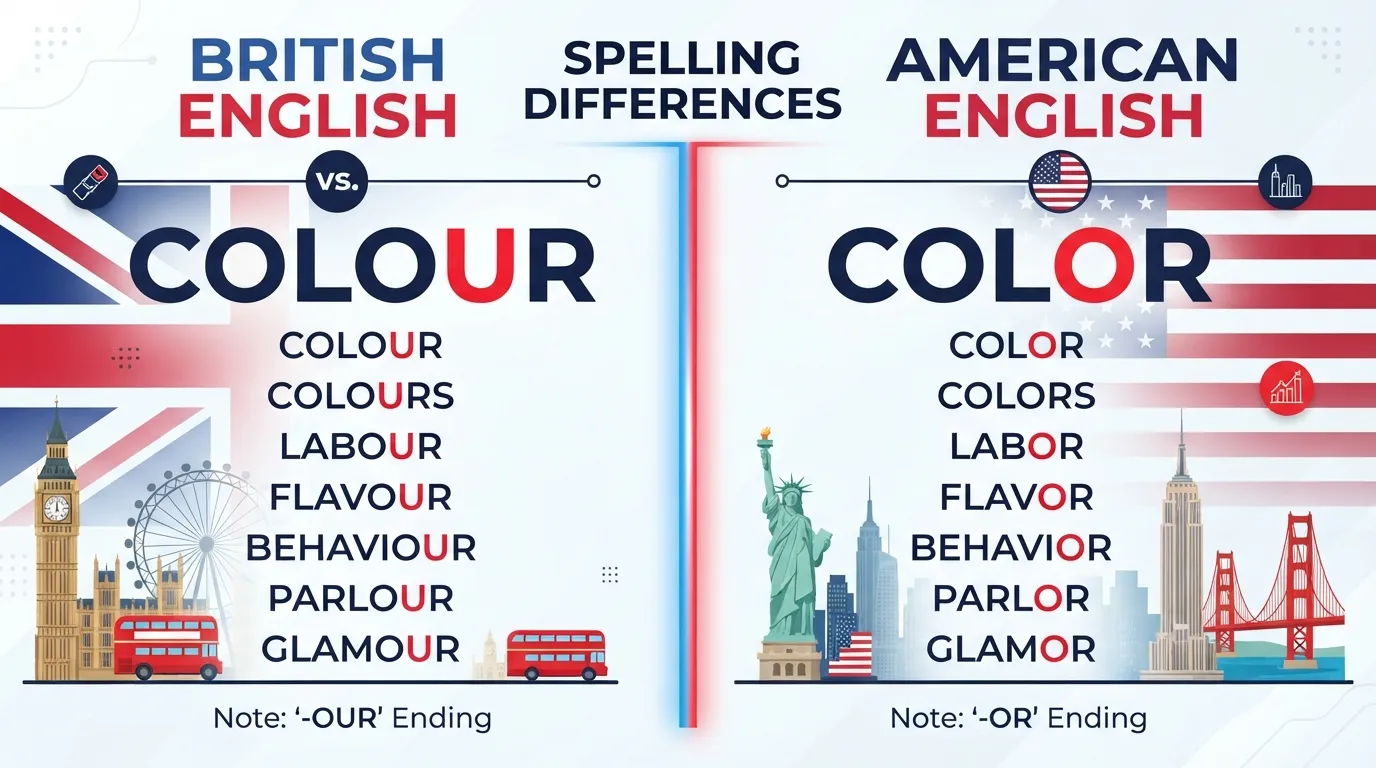
The biggest difference between worshiper and worshipper is regional spelling.
American English often uses a single consonant in words formed from verbs ending in a consonant, while British English often doubles the consonant in certain forms.
For example:
| Word | American English | British English |
|---|---|---|
| Worship | worship | worship |
| Person who worships | worshiper | worshipper |
| Travel | traveler | traveller |
| Label | labeled | labelled |
| Cancel | canceled | cancelled |
However, spelling rules are not always identical across all words. That is why it is best to check the spelling used by your target audience.
Worshiper in American English
American English generally prefers:
worshiper
Example:
The worshiper attended the religious service.
Worshipper in British English
British English generally prefers:
worshipper
Example:
The worshipper attended the religious service.
Both forms are understood in English-speaking countries.
Which Spelling Should You Use?
The best spelling depends on your audience.
For American English
Use worshiper.
This is the safer choice for:
- American websites
- U.S. school assignments
- American newspapers
- U.S. business writing
- American academic writing
Example:
The worshiper joined the morning service.
For British English
Use worshipper.
This spelling is suitable for:
- British publications
- UK schoolwork
- British websites
- Formal writing in the UK
Example:
The worshipper joined the morning service.
For Global English
Either spelling can work. The most important rule is consistency.
If the rest of your article uses American spelling, use worshiper. If it uses British spelling, use worshipper.
Do not switch between the two forms without a reason.
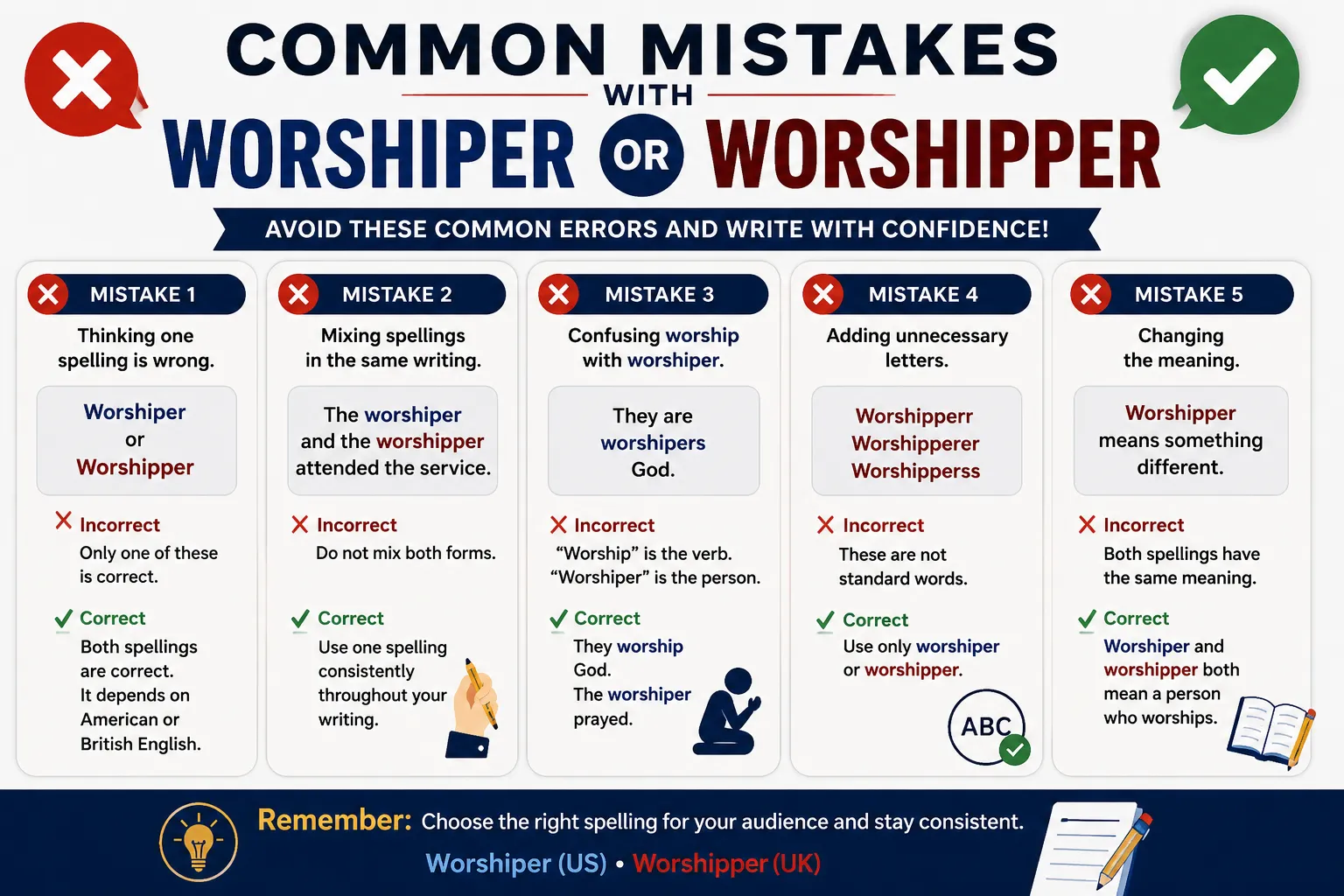
Several mistakes can happen when people are unsure about this word.
Mistake 1: Thinking one spelling is always wrong
Some writers believe worshiper or worshipper is incorrect.
That is not true.
Both spellings are accepted, with regional preferences.
Mistake 2: Mixing spelling styles
A writer may use worshiper in one paragraph and worshipper in another.
Better:
Choose one spelling and use it consistently throughout the document.
Mistake 3: Confusing worship with worshiper
Worship can be a noun or verb.
They worship every Sunday.
Worshiper/worshipper refers to the person.
The worshiper attended the service.
Mistake 4: Adding unnecessary letters
Some writers create forms such as worshipperr or worshipperer.
These are incorrect.
The standard forms are:
- worshiper
- worshipper
Mistake 5: Changing the meaning
The extra p does not create a different meaning.
Worshiper and worshipper both refer to someone who worships.
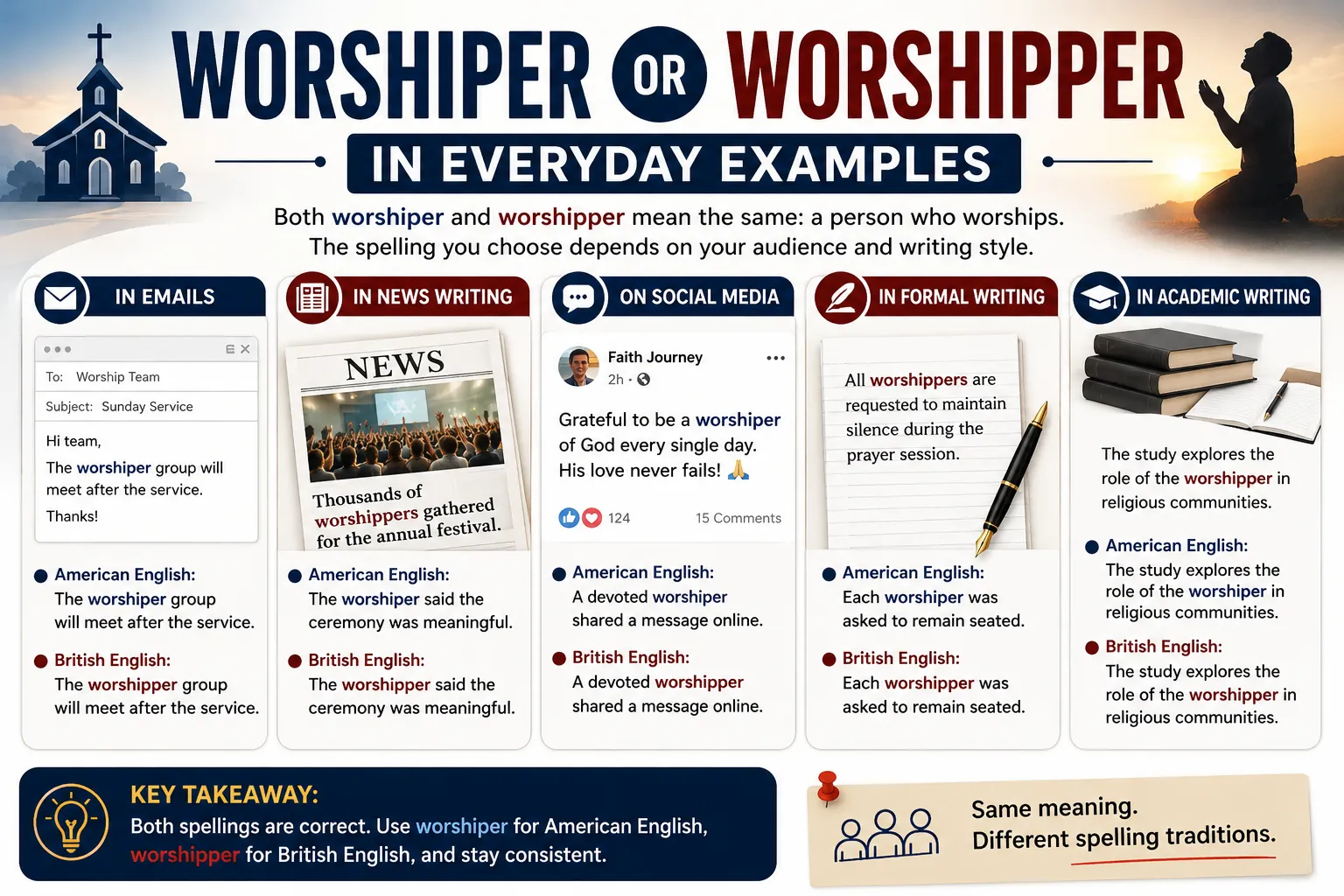
You can see both spellings in many types of writing.
In emails
American English:
The worshiper group will meet after the service.
British English:
The worshipper group will meet after the service.
In news writing
American:
The worshiper said the ceremony was meaningful.
British:
The worshipper said the ceremony was meaningful.
On social media
People may write:
A devoted worshiper shared a message online.
Or:
A devoted worshipper shared a message online.
Both are clear to readers.
In formal writing
For formal documents, choose the spelling that matches your organization’s style guide.
American style:
Each worshiper was asked to remain seated.
British style:
Each worshipper was asked to remain seated.
In academic writing
Consistency is especially important in academic work. Follow the spelling system used by your institution or publication.
Worshiper or Worshipper – Google Trends & Usage Data
Search interest can vary by country and over time. In general, worshiper tends to align more closely with American English, while worshipper is more closely associated with British English.
Google search results can also be affected by:
- Population size
- Religious topics
- News coverage
- Regional spelling
- Search habits
- Website publishing trends
It is important to remember that Google Trends shows relative search interest, not a complete count of every word used in writing.
For SEO, both spellings can be useful. If your website targets readers in the United States, worshiper may be the stronger primary keyword. If your audience is mainly in the UK, worshipper may be more suitable.
For a global website, you can naturally mention both forms.
Worshiper vs Worshipper: Comparison Table
| Feature | Worshiper | Worshipper |
|---|---|---|
| Meaning | Person who worships | Person who worships |
| Spelling | One p before -er | Two p’s before -er |
| American English | Preferred | Less common |
| British English | Less common | Preferred |
| Pronunciation | Same | Same |
| Meaning difference | None | None |
| Best for U.S. audience | Yes | Usually no |
| Best for UK audience | Usually no | Yes |
| Correct spelling | Yes | Yes |
FAQs About Worshiper or Worshipper
1. Is worshiper or worshipper correct?
Both worshiper and worshipper are correct. Worshiper is more common in American English, while worshipper is more common in British English.
2. Is worshipper British English?
Yes. Worshipper is the preferred spelling in British English and is also used in other varieties influenced by British spelling.
3. Is worshiper American English?
Yes. Worshiper is generally the preferred form in American English.
4. Does worshiper mean the same as worshipper?
Yes. Both words have the same meaning: a person who worships or shows religious devotion.
5. Which spelling should I use in the United States?
Use worshiper for most American English writing.
6. Which spelling should I use in the United Kingdom?
Use worshipper for most British English writing.
7. Can I use both spellings on my website?
Yes, but use them carefully. Choose the form that matches your main audience and mention the alternative naturally when useful.
Conclusion: Worshiper or Worshipper?
So, worshiper or worshipper? The good news is that you do not have to choose between a correct and an incorrect word. Both spellings are correct. The difference is mainly based on regional English.
Worshiper is the form most commonly associated with American English, while worshipper is preferred in British English. Both words have the same meaning and pronunciation. They describe a person who worships or shows devotion.
If you are writing for readers in the United States, choose worshiper. If your audience is in the United Kingdom or another region that follows British spelling, choose worshipper. For international websites, either form can work, but consistency matters.
The most important lesson is simple: match your spelling to your audience and stay consistent. Once you know this regional difference, choosing between worshiper and worshipper
you can also read about scarred or scared by clicking this link
👇👇👇
https://versuswords.com/scarred-or-scared/

My name is iqbal hussain, and I am an article writer passionate about creating clear, engaging, and informative content. I specialize in SEO-friendly articles and blog posts. I enjoy researching different topics and turning complex information into simple, useful content that informs readers and provides real value.