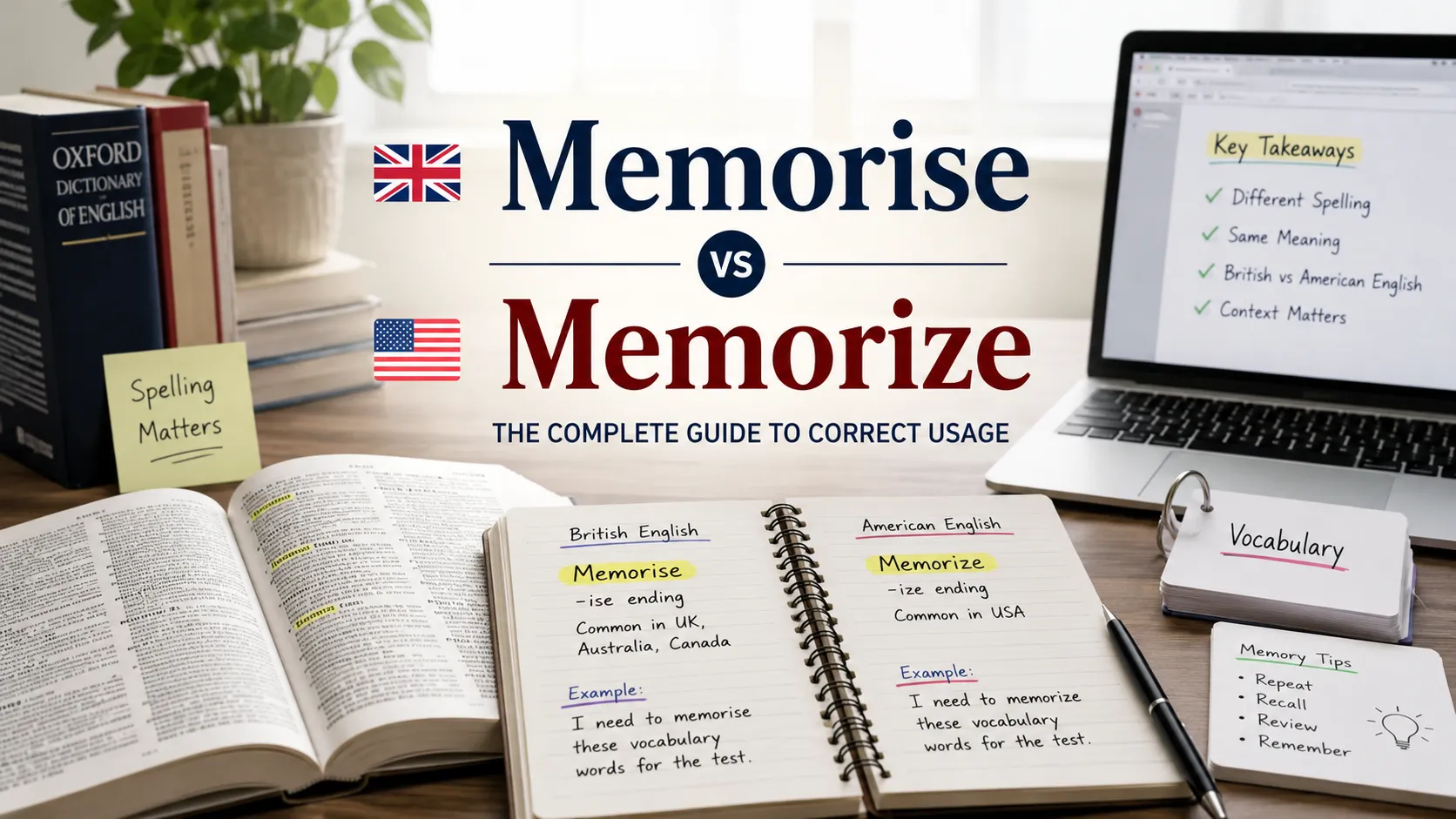
Memorise and memorize mean the same thing: to learn something so well that you can remember it without looking. Memorise is the British spelling, while memorize is the American spelling.
A few years ago, I was editing an article for an international website when I noticed something strange. One writer used memorise, while another used memorize. At first, it looked like a mistake. Then I realized both spellings were correct.
This small difference confuses many students, writers, and English learners. You may see memorize in American books and websites. Then you open a British textbook and find memorise instead. That can make you wonder which spelling is right.
The good news is that both words have the same meaning. The only real difference is the region where they are commonly used.
If you have ever paused while writing and asked yourself, “Should I use memorise or memorize?” you are not alone. This guide will clear up the confusion. You will learn the difference, discover the history behind both spellings, see real examples, and find out which version is best for your audience.
Let’s begin with the simple answer.
Memorise or Memorize – Quick Answer
Both memorise and memorize mean:
To learn something by heart so you can recall it from memory.
The spelling you choose depends on the type of English you are using.
- Memorise = British English
- Memorize = American English
Example 1
- British English: I need to memorise my speech before tomorrow.
- American English: I need to memorize my speech before tomorrow.
Example 2
- Students often memorise poems in UK schools.
- Students often memorize poems in US schools.
The meaning stays exactly the same.
The Origin / Background of Memorise or Memorize
The word comes from the Latin word memoria, which means “memory.”
Over time, English borrowed the word and created the verb memorize. Different English-speaking regions later developed different spelling preferences.
In American English, many words use the ending -ize:
- Organize
- Realize
- Recognize
- Memorize
In British English, many publishers and schools prefer -ise endings:
- Organise
- Realise
- Recognise
- Memorise
This spelling difference is one reason English learners often get confused.
Interestingly, some British dictionaries still accept memorize, although memorise is more common in everyday UK writing.
Memorise or Memorize Explained : Key Differences
The meanings are identical. Only the spelling changes.
| Term | Meaning | When to Use | Region/Context |
| Memorise | Learn by heart | British writing | UK, Australia, New Zealand |
| Memorize | Learn by heart | American writing | United States |
| Memorise | Remember exactly | British academic content | Schools and universities |
| Memorize | Remember exactly | American academic content | Schools and universities |
Why Does the Difference Exist?
The difference comes from spelling traditions rather than meaning.
British English often prefers -ise endings.
American English generally prefers -ize endings.
Because the internet connects people worldwide, you may see both spellings used online.
Example Sentences
Memorise
- You should memorise the formula before the exam.
- Actors often memorise their lines.
Memorize
- Try to memorize these vocabulary words.
- She worked hard to memorize the presentation.
Which Version Should You Use?
The best choice depends on your audience.
For Students in the UK
Use memorise because it matches British spelling rules and school standards.
For Students in the US
Use memorize because it follows American English conventions.
For International Businesses
Choose one style and stay consistent throughout your content.
For Bloggers and Website Owners
Match the spelling to your target audience.
- UK audience → memorise
- US audience → memorize
- Global audience → either is acceptable, but stay consistent
For Academic Writing
Always follow your institution’s style guide.
Consistency matters more than the specific spelling.
Common Mistakes with Memorise or Memorize
Many writers make simple errors when using these words.
| Mistake | Correction | Why It Happens |
| Mixing memorize and memorise in one article | Use one style consistently | Different sources were used |
| Using memorize in British coursework | Use memorise | Regional spelling preference |
| Using memorise in American coursework | Use memorize | Regional spelling preference |
| Thinking one spelling is wrong | Both are correct | Lack of awareness |
| Switching spellings in professional documents | Keep one version | Consistency improves credibility |
Common Error 1
❌ I need to memorize this poem and memorise the speech.
✅ I need to memorize this poem and memorize the speech.
Common Error 2
❌ The company uses memorize in one paragraph and memorise in another.
✅ The company uses one spelling throughout the document.
Common Error 3
❌ Memorise is incorrect.
✅ Memorise is correct in British English.
Memorise or Memorize in Real-World Examples
Professional Email
British English
“Please memorise the safety procedures before the training session.”
American English
“Please memorize the safety procedures before the training session.”
News Headline
“Students memorize historical facts for national exams.”
“Students memorise historical facts for national exams.”
Social Media Post
“I finally memorized all my presentation notes!”
“I finally memorised all my presentation notes!”
Formal Report
“Employees were asked to memorize emergency procedures.”
“Employees were asked to memorise emergency procedures.”
Both versions sound natural when used in the correct regional context.
Memorise or Memorize : Data, Trends & Usage
Search interest for this topic remains high because English learners often encounter both spellings.
Who Searches for It Most?
- Students
- ESL learners
- Teachers
- Academic writers
- Content creators
- Bloggers
Regions Most Interested
Memorise
- United Kingdom
- Australia
- New Zealand
- Ireland
Memorize
- United States
- American educational institutions
Search Intent
The search intent is primarily informational.
People want to know:
- Which spelling is correct
- Whether there is a meaning difference
- Which version they should use
Why It Matters Today
Global communication is growing. Many people write for audiences in different countries. Understanding spelling variations helps create professional and trustworthy content.
Standalone Comparison Table
| Term/Variant | Meaning | Region/Context | Best Used When |
| Memorise | Learn by heart | British English | Writing for UK readers |
| Memorize | Learn by heart | American English | Writing for US readers |
| Memorise | Commit information to memory | British schools and media | Following UK spelling rules |
| Memorize | Commit information to memory | American schools and media | Following US spelling rules |
Frequently Asked Questions
Q: What does memorise or memorize mean?
A: Both words mean to learn something so well that you can recall it from memory without looking at it.
Q: How do you use memorise or memorize correctly?
A: Choose the spelling that matches your audience. Use memorise for British English and memorize for American English.
Q: Memorise vs memorize what’s the difference?
A: The only difference is spelling. Their meaning, pronunciation, and usage are the same.
Q: Is memorise acceptable in formal writing?
A: Yes. It is completely acceptable in British English and many international publications.
Q: Which version is correct , memorise or memorize?
A: Both are correct. The choice depends on whether you are following British or American English conventions.
Q: Where does the word come from?
A: It comes from the Latin word memoria, meaning memory or remembrance.
Q: Can memorise or memorize be used in academic writing?
A: Yes. Both spellings are accepted when they match the required style guide or regional standard.
Conclusion
The debate between memorise and memorize is much simpler than many people think. Both words mean exactly the same thing. Neither spelling is more correct than the other.
The key difference is location. Memorise is preferred in British English, while memorize is the standard form in American English. Once you know your audience, choosing the right spelling becomes easy.
Remember these main points:
- Both spellings are correct.
- The meaning never changes.
- British English prefers memorise.
- American English prefers memorize.
- Consistency is more important than the spelling itself.
Whether you are writing an essay, blog post, email, or report, use the version that matches your readers and stick with it throughout your work.
Now you know exactly how to use memorise or memorize. Bookmark this guide so you never second-guess the spelling again, and share it with someone who is still confused.
Fulfilment or Fulfillment: Real Guide to Spelling It Right

I am an English language enthusiast who enjoys exploring word differences and spelling variations.
My work focuses on making confusing English terms easier to understand for everyday readers.
I believe clear language helps people communicate with confidence.