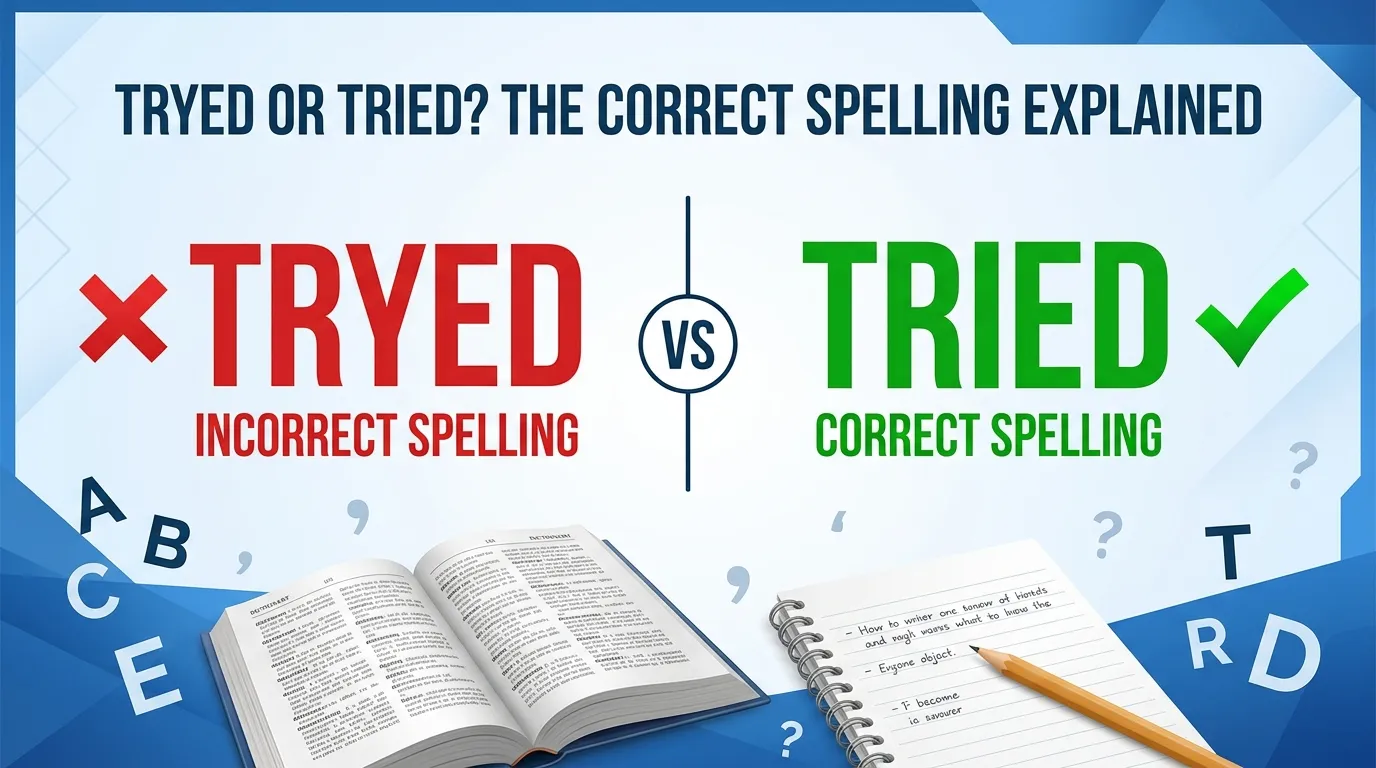
Tried is the correct spelling of the past tense of try.
Tryed is incorrect and should not be used.
Have you ever written “tryed” and wondered if it is correct? You are not alone. Many English learners, students, and writers confuse “tryed” and “tried” because the word try changes when we add -ed.
The correct spelling is tried. Tryed is not correct in standard English.
For example:
- Correct: I tried to call you yesterday.
- Incorrect: I tryed to call you yesterday.
The confusion comes from a simple spelling rule. When a verb ends in a consonant + y, we usually change the y to i before adding -ed. So try + ed becomes tried.
In this guide, you will learn why tried is correct, where the word comes from, how British and American English use it, and how to avoid common spelling mistakes. You will also see simple examples from everyday writing, emails, social media, and formal English.
By the end, you will know exactly when to use tried and why tryed should be avoided.
Tryed or Tried: Quick Answer
Tried is the correct spelling.
Tryed is incorrect in standard English.
The word tried is the past tense and past participle of try.
Examples
- I tried to help him.
- She tried a new recipe.
- We tried to finish the work.
- He has tried many times.
The spelling rule is simple:
try + ed → tried
When a verb ends in a consonant followed by y, change y to i and add -ed.
Other examples include:
- cry → cried
- carry → carried
- study → studied
- worry → worried
So, remember:
Tryed ❌ Tried ✅
The Origin of Tryed or Tried
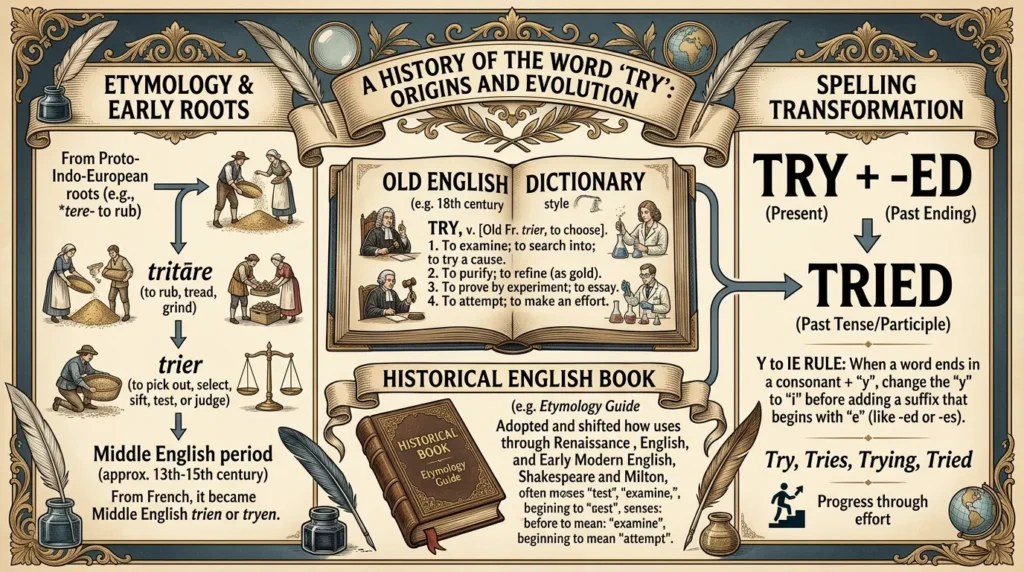
The word try has a long history in English. It comes from French and is linked to the idea of testing or checking something.
The word has been used for many years with meanings such as to test, attempt, or make an effort.
The past form became tried because of English spelling rules.
When English verbs end in consonant + y, the y usually changes to i before -ed.
For example:
| Base Verb | Past Tense |
| try | tried |
| cry | cried |
| study | studied |
| carry | carried |
| worry | worried |
This is why tryed is not the standard spelling.
There is one important difference to remember. If a verb ends in a vowel + y, the y usually stays.
For example:
- play → played
- enjoy → enjoyed
- stay → stayed
- obey → obeyed
So:
consonant + y → change y to i
vowel + y → keep y
British English vs American English Spelling
British and American English both use tried.
There is no spelling difference between British and American English for this word.
For example:
- British English: I tried to help.
- American English: I tried to help.
Both are correct.
The same spelling rule is used in both forms of English.
| Verb | British English | American English |
| try | tried | tried |
| cry | cried | cried |
| study | studied | studied |
| carry | carried | carried |
| worry | worried | worried |
Some British and American spellings differ in other words, such as colour/color or centre/center. However, tried is spelled the same in both varieties.
Why Do People Write “Tryed”?
People often write tryed because they apply a simple rule incorrectly:
try + ed = tryed
This looks logical, but English spelling has a special rule for verbs ending in consonant + y.
The correct form is:
try → tried
Which Spelling Should You Use?
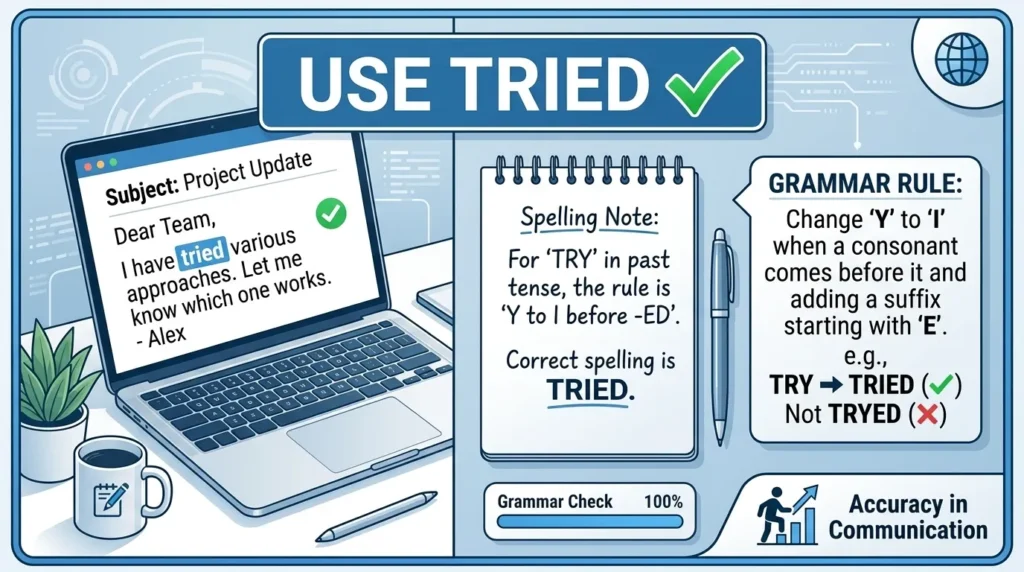
You should always use tried in standard English.
For American English
Use:
I tried to contact you.
For British English
Use:
I tried to contact you.
For Commonwealth English
Countries such as Canada, Australia, and New Zealand also use tried.
For Global English
If you are writing for an international audience, tried is the only standard choice.
Avoid tryed in:
- School assignments
- Emails
- Business writing
- Blog posts
- News articles
- Academic writing
- Social media posts
- Professional documents
Using tried will make your writing look correct and professional.
Common Mistakes with Tryed or Tried
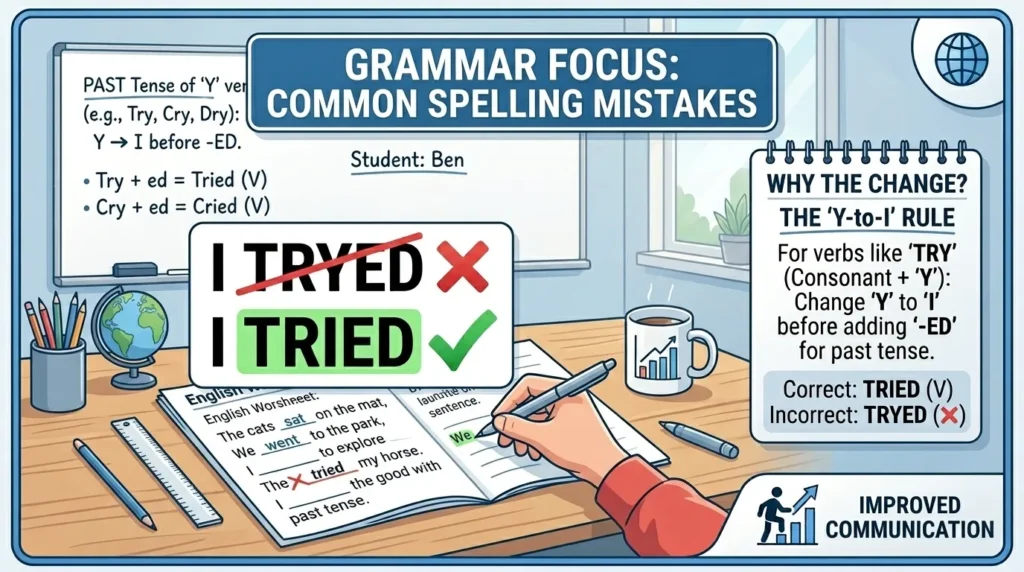
Here are some common mistakes and their corrections.
Mistake 1: Tryed
❌ I tryed to call you.
✅ I tried to call you.
Mistake 2: Tryed Again
❌ She tryed again.
✅ She tried again.
Mistake 3: Has Tryed
❌ He has tryed many times.
✅ He has tried many times.
Mistake 4: Had Tryed
❌ They had tryed to fix it.
✅ They had tried to fix it.
Mistake 5: Confusing Try and Tried
❌ Yesterday, I try to help him.
✅ Yesterday, I tried to help him.
Use try for the present:
I try to exercise every day.
Use tried for the past:
I tried to exercise yesterday.
Tryed or Tried in Everyday Examples
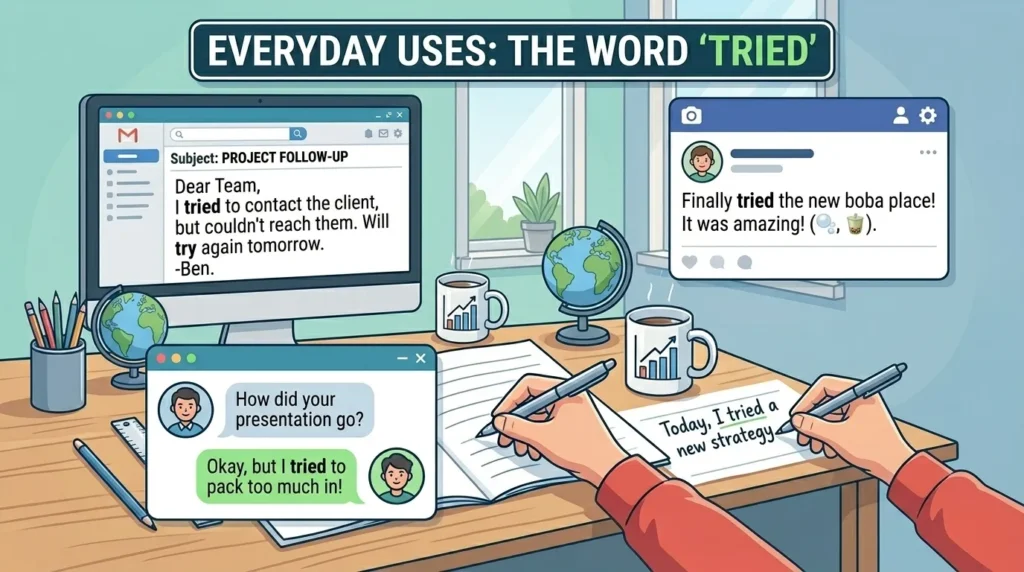
The word tried is common in many types of writing.
In Emails
I tried to contact you yesterday, but I could not reach you.
We tried to solve the problem.
In News Writing
The team tried to improve its performance during the second half.
On Social Media
I tried this new recipe today. It was great!
I tried my best, but I still made a mistake.
In Formal Writing
The researchers tried to find a simple solution.
The company tried to improve customer service.
In Everyday Conversation
I tried calling him.
Have you tried this restaurant?
She tried to open the door.
These examples show why tried is an important word in everyday English.
Tryed or Tried: Google Trends & Usage Data
People search for “tryed or tried” because tryed looks like it should be the past form of try.
Search interest can vary by country and language-learning audience. The question is especially common among people learning English spelling and grammar.
The correct form, tried, is used widely in:
- Everyday English
- Schools
- Business writing
- Online articles
- News
- Books
- Academic writing
The incorrect form tryed may appear in searches because people are checking whether the spelling is correct. Search volume for a spelling mistake does not mean that the spelling is accepted.
A useful rule is more important than search popularity:
try → tried
If you want to check current Google Trends data, compare “tried” and “tryed” by country and time period. The results can change over time.
Tryed vs Tried: Comparison Table
| Word | Correct? | Meaning | Example |
| tried | ✅ Yes | Past form of try | I tried to help. |
| tryed | ❌ No | Incorrect spelling | I tryed to help. |
| try | ✅ Yes | Present/base form | I try to help. |
| trying | ✅ Yes | -ing form | I am trying to help. |
| tries | ✅ Yes | Present form with he/she/it | She tries to help. |
Simple Rule to Remember
Remember this easy pattern:
Consonant + y → change y to i + ed
Examples:
- try → tried
- cry → cried
- study → studied
- copy → copied
- hurry → hurried
But:
Vowel + y → keep y + ed
Examples:
- play → played
- stay → stayed
- enjoy → enjoyed
- annoy → annoyed
This rule makes the spelling much easier.
See Also: Sempai or Senpai? Which Spelling Is Correct?
FAQs About Tryed or Tried
1. Is “tryed” a correct word?
No. Tryed is not the standard spelling. The correct word is tried.
2. Is “tried” the past tense of “try”?
Yes. Tried is both the simple past tense and past participle of try.
Example:
I tried to help.
3. Why is “tryed” wrong?
Because verbs ending in consonant + y usually change the y to i before adding -ed.
So:
try → tried
4. Is “tried” used in British English?
Yes. Tried is correct in British English.
5. Is “tried” used in American English?
Yes. American English also uses tried.
6. Can I use “tryed” in formal writing?
No. Avoid tryed in formal and professional writing. Use tried.
7. What are examples of words like “tried”?
Similar examples include:
- cried
- studied
- carried
- worried
- copied
- hurried
Conclusion
The difference between tryed or tried is easy once you know the spelling rule. Tried is the correct spelling, while tryed is incorrect in standard English.
The reason is simple. The verb try ends in a consonant followed by y. When we add -ed, the y changes to i. Therefore:
try + ed = tried
This rule also works with words such as cry → cried, study → studied, and carry → carried.
British and American English both use “tried.” The spelling is the same in both. Use “tried” in emails, school work, blogs, social media, and formal writing.
A quick memory tip is: try → tried, never tryed.
Once you remember this small spelling rule, you can avoid one of the most common mistakes in English writing.

Ali Hassan is an English language writer and educator who specializes in grammar, spelling, and commonly confused words. He creates simple and easy-to-understand content to help students, writers, and English learners improve their English with confidence.