
Alum is the common and informal term for a former student or graduate.
Alumn is rarely used, so alum is usually the better choice.
Have you ever wondered whether “alumn” or “alum” is the correct word? You are not alone. These two terms are often used when talking about someone who studied at a school, college, or university. The confusion happens because alumn is a formal word, while alum is a shorter and more common form.
Both words can be correct, but they are not used in exactly the same way. Alumn is a singular, gender-neutral term for one former student. Alum is also a singular term, but it is a shortened and more informal form of alumnus or alumna.
People often search for “alumn or alum” because they want to choose the right word for an email, resume, school website, social media post, or formal document. Knowing the difference can help you write with confidence.
In this guide, you will learn the meaning, history, spelling, usage, common mistakes, and practical examples of alumn or alum.
Alumn or Alum: Quick Answer
The short answer is:
- Alumn = a singular, gender-neutral word for a former student.
- Alum = a shorter, informal word for a former student.
- Alumnus = traditionally used for one male former student.
- Alumna = traditionally used for one female former student.
- Alumni = traditionally the plural form of alumnus.
- Alumnae = traditionally the plural form of alumna.
Examples
- He is an alumnus of Harvard University.
- She is an alumna of the university.
- Alex is an alumn of the school.
- Alex is an alum of the school.
- Many alumni attended the event.
For modern, inclusive English, alumn can be useful when you want a gender-neutral term. Alum is often more natural in casual American English.
The Origin of Alumn or Alum
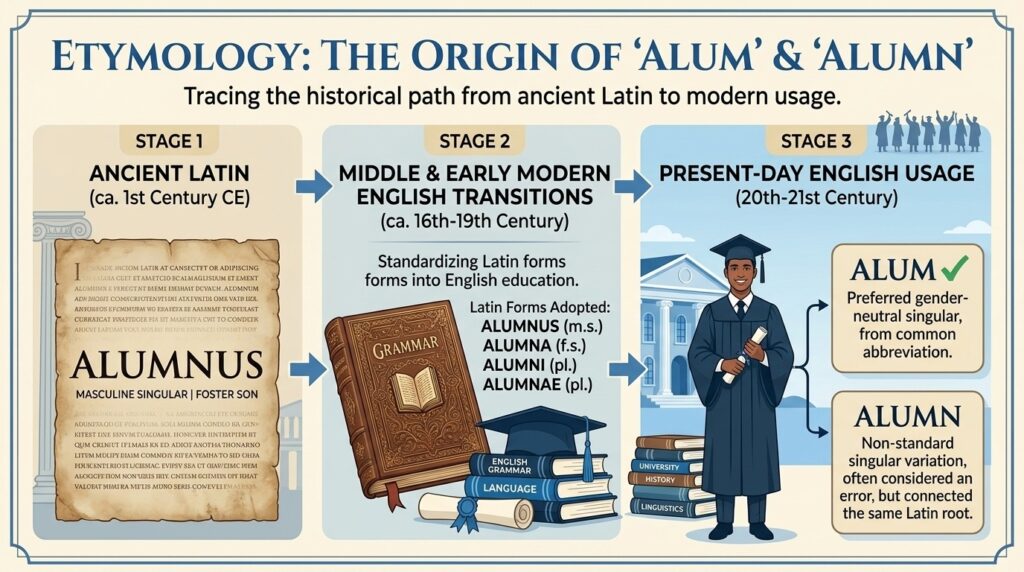
The word alumn comes from the Latin word alumnus, which means a pupil, student, or foster child. The related Latin word alumna refers to a female pupil or student.
English later adopted these Latin-based terms to describe people who had studied at a school or university.
Over time, English speakers created shorter forms. Alum became a common shortened form of alumnus and alumna. It is easy to say and works for both men and women.
The word alumn is a newer gender-neutral form. It avoids choosing between alumnus and alumna.
This gives English several choices:
| Word | Meaning | Typical Use |
| Alumnus | One male former student | Formal or traditional |
| Alumna | One female former student | Formal or traditional |
| Alumn | One former student of any gender | Gender-neutral |
| Alum | One former student of any gender | Short and informal |
| Alumni | Former students | Common plural |
| Alumnae | Female former students | Traditional plural |
British English vs American English Spelling
The basic spelling of alumn, alum, alumnus, and alumna does not change between British and American English.
However, usage and frequency can differ.
American English commonly uses alum as a short, friendly term. For example:
She is a proud Stanford alum.
British English often prefers more traditional terms such as alumnus, alumna, or former student, especially in formal writing.
The word alumn is less common in everyday speech than alum, but it can be useful when gender-neutral language is needed.
British vs American Usage
| Word | American English | British English | Formality |
| Alum | Very common | Less common | Informal |
| Alumn | Used, but less common | Less common | Neutral |
| Alumnus | Common in formal writing | Common in formal writing | Formal |
| Alumna | Common in formal writing | Common in formal writing | Formal |
| Alumni | Very common | Very common | Neutral/Formal |
| Former student | Common | Very common | Neutral |
So, there is no major British-versus-American spelling rule here. The main difference is how often each word is used and how formal it sounds.
Which Spelling Should You Use?
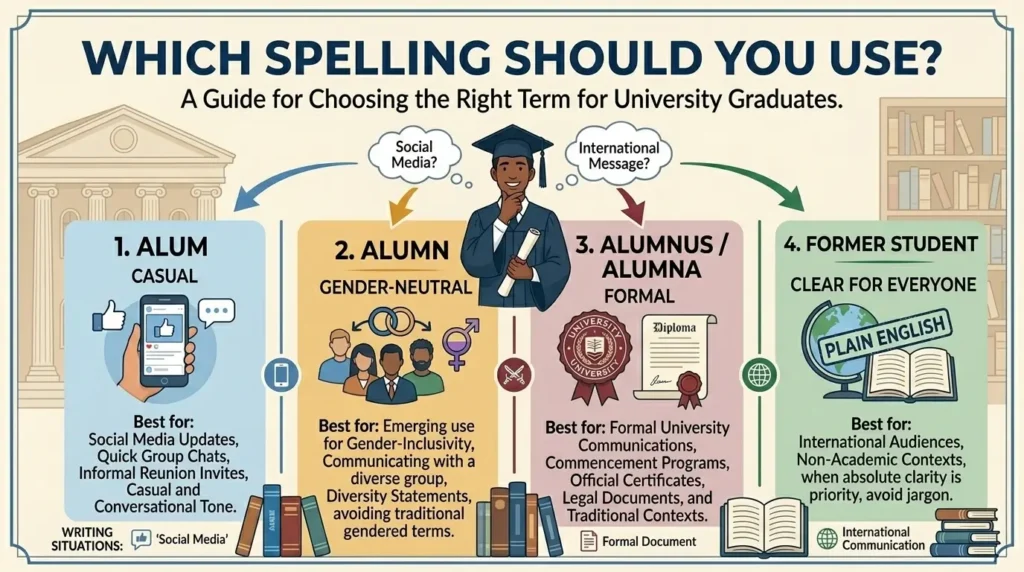
Your best choice depends on your audience and the type of writing.
Use “Alum” for Casual Writing
Use alum when writing social media posts, casual emails, or friendly messages.
Example:
I am a proud alum of the university.
It is short, clear, and easy to understand.
Use “Alumn” for Gender-Neutral Writing
Use alumn when you want a singular, gender-neutral term.
Example:
Each alumn will receive an invitation.
This can be useful when the person’s gender is unknown or when inclusive language is important.
Use “Alumnus” or “Alumna” for Formal Writing
Traditional formal writing may use:
He is an alumnus of the college.
or:
She is an alumna of the college.
Use “Former Student” for Maximum Clarity
If your audience may not know the word alum, simply use former student.
For example:
She is a former student of the university.
This is clear and works well in international English.
Common Mistakes with Alumn or Alum
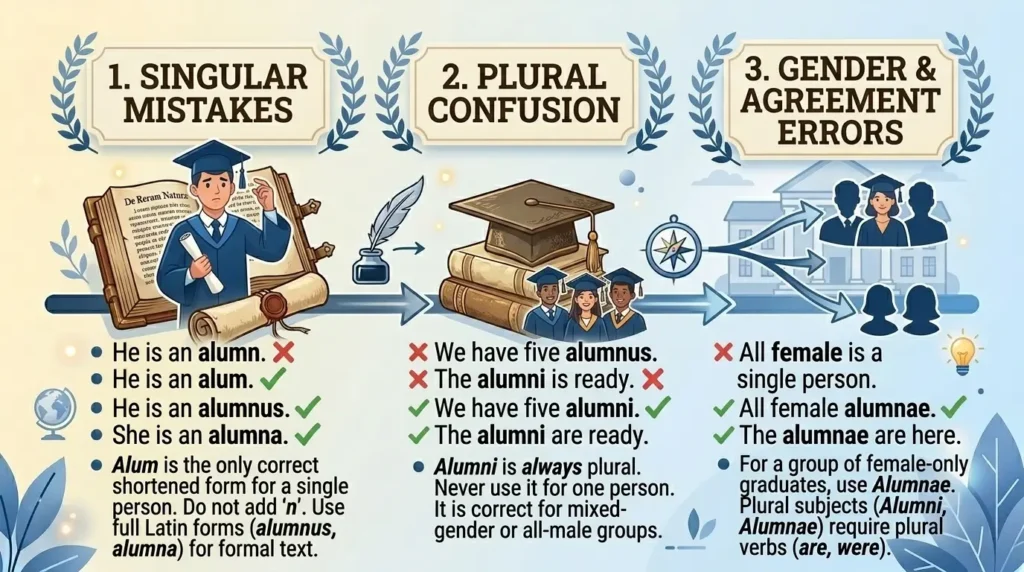
Mistake 1: Thinking “Alumn” Is the Plural
Incorrect:
The school welcomed one hundred alumn.
Better:
The school welcomed one hundred alumni.
Alumn is singular. Alumni is the traditional plural form.
Mistake 2: Using “Alumni” for One Person
Incorrect:
Sarah is an alumni of the college.
Correct:
Sarah is an alum of the college.
Or:
Sarah is an alumna of the college.
Mistake 3: Thinking “Alum” Is Always Incorrect
Some people believe alum is wrong because it is informal.
That is not true. Alum is a widely used English word. It is simply less formal than alumnus or alumna.
Mistake 4: Confusing “Alumn” and “Alum”
Both can refer to one former student.
The main difference is style:
Alumn = gender-neutral and less common.
Alum = shorter, common, and informal.
Alumn or Alum in Everyday Examples

Knowing the difference is easier when you see these words in real situations.
In an Email
Casual:
As a proud alum, I am happy to support the school.
More formal:
As an alumnus of the university, I am pleased to support this program.
In News Writing
The famous alum returned to the university to speak to students.
A news article may also use alumnus or alumna, depending on its style.
On Social Media
Proud alum! It feels great to visit my old campus.
This is a natural use of alum.
In Formal Writing
Each alumn will receive information about the annual meeting.
Here, alumn works as a singular, gender-neutral term.
In a School Newsletter
Our alumni continue to make a difference around the world.
Here, alumni refers to more than one former student.
Alumn or Alum: Google Trends & Usage Data
Search interest for “alumn or alum” usually comes from people who want to know which word sounds correct or professional.
Search patterns can vary by country and context. Alum is especially common in American English because American schools and universities often use it in informal communication.
People in the United States may see or hear alum often in university news, sports, social media, and casual conversation.
In the United Kingdom and other Commonwealth countries, terms such as alumnus, alumna, alumni, and former student may be more familiar in formal contexts.
However, search trends do not always show whether a word is grammatically correct. A word can have lower search interest and still be completely correct.
For professional writing, focus on meaning, audience, and tone, rather than search volume alone.
Alumn vs Alum – Comparison Table
| Feature | Alumn | Alum |
| Meaning | One former student | One former student |
| Gender | Gender-neutral | Gender-neutral |
| Length | 5 letters | 4 letters |
| Style | Neutral | Informal |
| Common in casual speech | Less common | More common |
| Common in American English | Yes | Very common |
| Good for social media | Yes | Yes |
| Good for formal writing | Yes, depending on style | Usually less formal |
| Plural | Alumni | Alumni |
| Example | He is an alumn of the school. | He is an alum of the school. |
FAQs About Alumn or Alum
1. Is “alumn” a correct word?
Yes. Alumn is a valid gender-neutral term for one former student. It is less common than alum.
2. Is “alum” short for alumnus?
Yes. Alum is a shortened form related to alumnus and alumna. It can refer to a former student of any gender.
3. Which is better, alumn or alum?
It depends on your audience. Alum is more common and natural in casual English. Alumn is useful when you want a gender-neutral singular term.
4. Is “alumn” singular or plural?
Alumn is singular. The traditional plural is alumni.
5. Can I use “alum” in formal writing?
You can, but it may sound informal. In very formal writing, alumnus, alumna, or former student may be a better choice.
6. Is “alumni” singular?
Traditionally, alumni is plural. For one person, use alumnus, alumna, alumn, or alum.
7. Is “alumn” better than “alumnus”?
Not always. Alumn is useful when you want gender-neutral language. Alumnus is a traditional term for one male former student.
Conclusion
The difference between alumn or alum is simple once you understand their meaning and style. Alumn is a gender-neutral word for one former student, while alum is a shorter and more informal word for the same basic idea.
For casual emails, social media, and everyday conversation, alum is usually the easiest choice. For formal writing, you may prefer alumnus, alumna, or former student, depending on the person and your audience. If you want a gender-neutral singular term, alumn is a useful option.
Remember that alumn and alum are singular. When talking about several former students, alumni is the traditional plural form.
If you are writing for an international audience, former student is often the clearest choice. The best word is the one that matches your audience, tone, and purpose.
See Also: Sempai or Senpai? Which Spelling Is Correct?

Ali Hassan is an English language writer and educator who specializes in grammar, spelling, and commonly confused words. He creates simple and easy-to-understand content to help students, writers, and English learners improve their English with confidence.