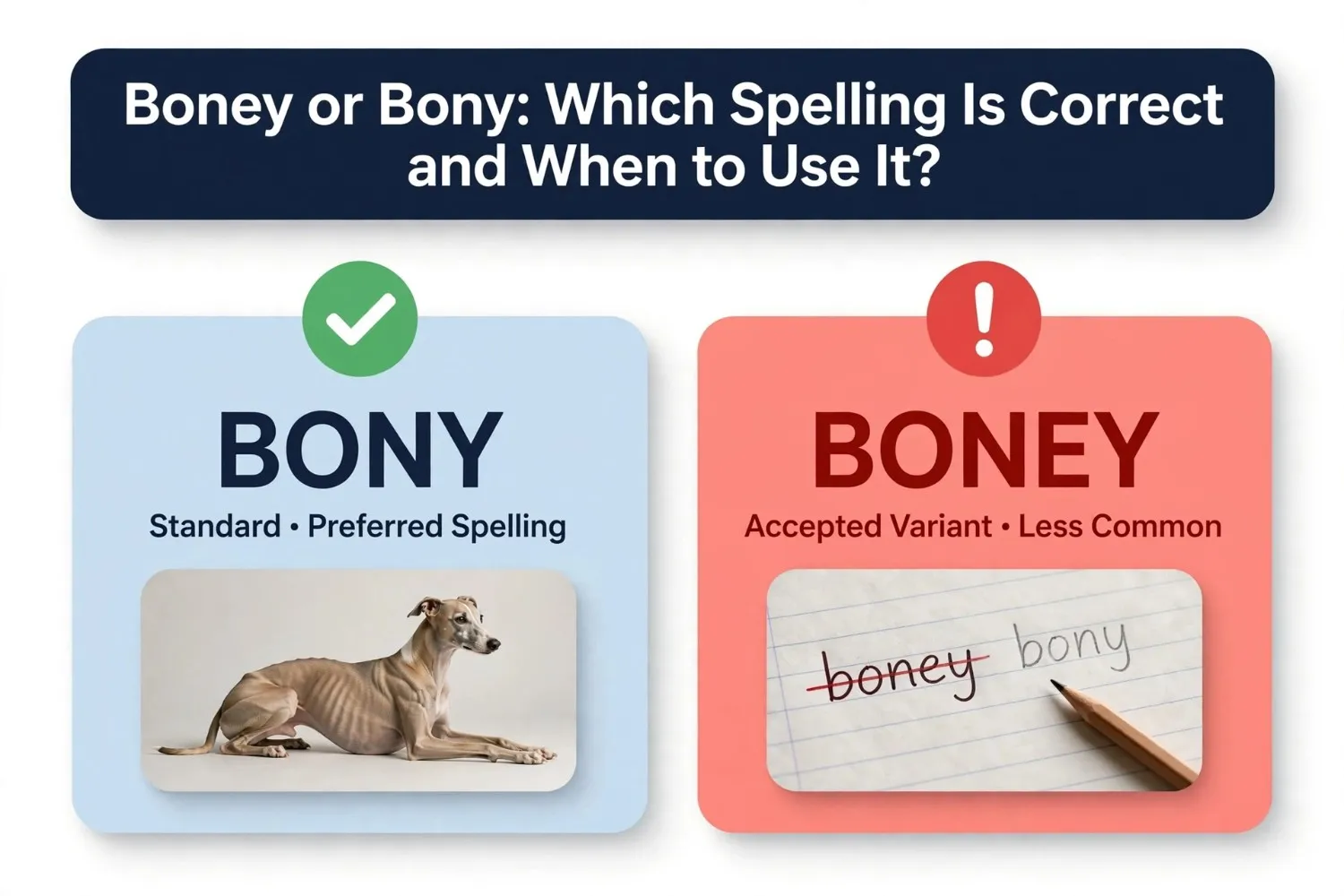
Bony is the standard and preferred spelling, while boney is a less common variant. Both relate to bones, but bony is best for most writing.
Have you ever written boney or bony and stopped because both spellings looked possible? You are not alone. The two words sound the same, and both can appear in English writing. This makes it hard to know which spelling is best.
The simple answer is that bony is the standard and preferred spelling. It describes a person, animal, body part, or object that has clear or noticeable bones. It can also describe something that contains many bones, such as a bony fish. Cambridge Dictionary lists bony as the main form while also recognizing boney as a variant.
People often search for boney or bony because they want to avoid spelling mistakes in emails, school work, articles, social posts, and professional documents. This guide clears up that confusion. You will learn which form to choose, where the words came from, how British and American English treat them, and how to use them in real sentences.
Boney or Bony – Quick Answer
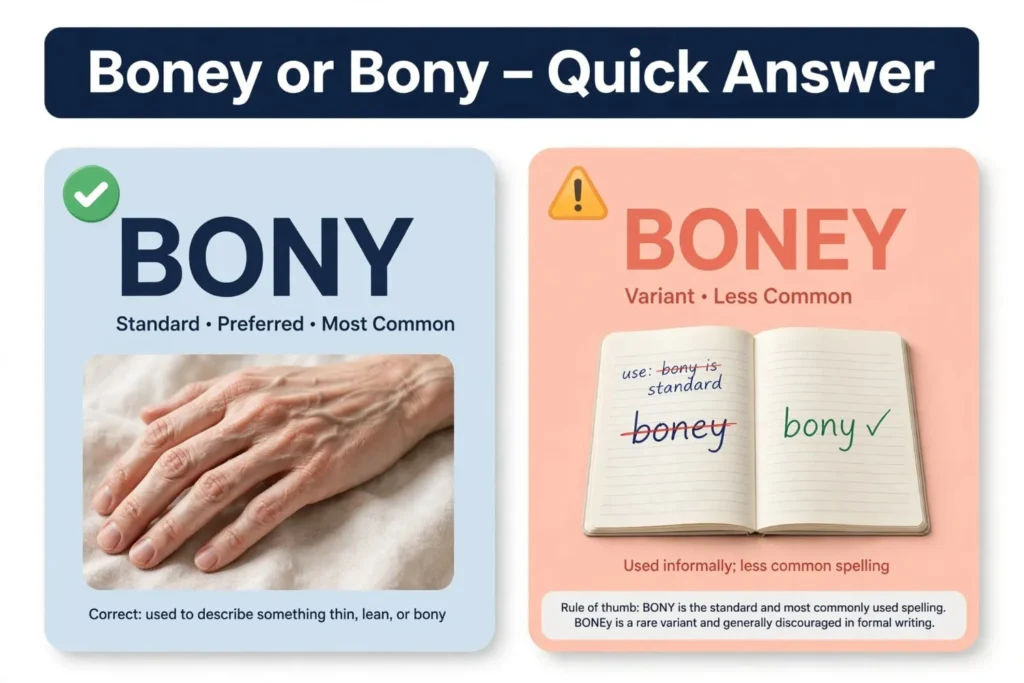
Bony is the safest and most common spelling.
The word bony is an adjective. It can mean:
- Very thin, with bones easy to see.
- Made of bone or similar material.
- Having many bones.
Cambridge Dictionary gives bony as the main spelling and boney as an alternative form. However, bony is the better choice for clear, modern, professional English.
Examples:
- The dog looked thin and bony.
- He has long, bony fingers.
- This fish is quite bony.
- The scan showed a bony growth near the joint.
So, when you are unsure about boney or bony, choose bony.
The Origin of Boney or Bony
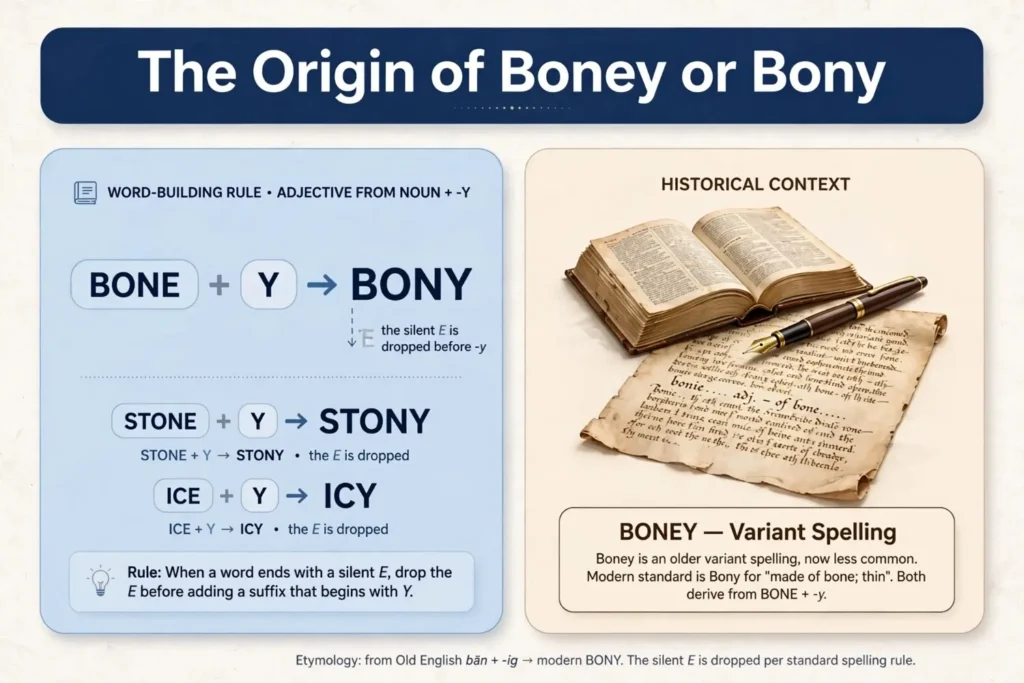
The word bony comes from bone plus the adjective ending -y. The ending gives the sense of “having” or “characterized by” something.
The spelling also follows a familiar pattern. When some English words ending in a silent e take -y, the final e disappears.
For example:
- Bone + y → Bony
- Stone + y → Stony
- Ice + y → Icy
This helps explain why bony looks different from its root word, bone.
The alternative boney keeps the letter e. This spelling has appeared in English and still exists as a variant. In fact, Cambridge includes boney as an alternative to bony.
Modern standard writing, however, normally uses the shorter form bony. That is why you are much more likely to see phrases such as bony fingers, bony fish, and bony tissue.
British English vs American English Spelling
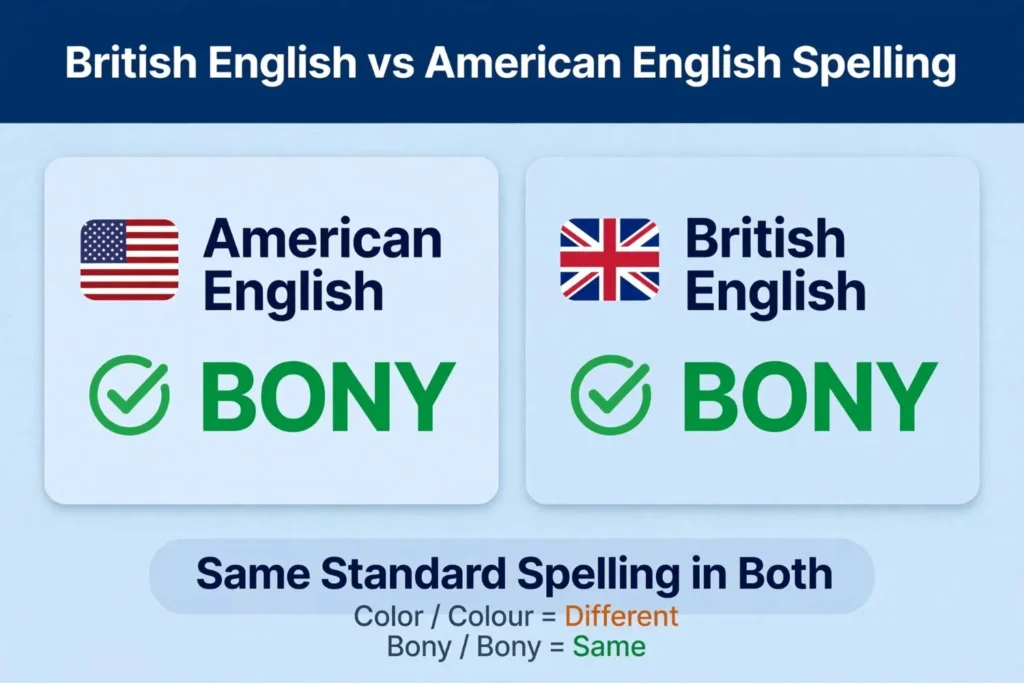
Some English words change spelling between Britain and the United States. For example, British English normally uses colour, while American English uses color.
Boney or bony is different.
There is no important US-versus-UK spelling split. Cambridge’s British and American dictionary entries both use bony as the main form.
| Meaning or Use | American English | British English | Best Choice |
| Thin with visible bones | Bony | Bony | Bony |
| Having many bones | Bony | Bony | Bony |
| Made of bone | Bony | Bony | Bony |
| Alternative spelling | Boney | Boney | Use with care |
| Formal writing | Bony | Bony | Bony |
| Academic writing | Bony | Bony | Bony |
So, unlike color/colour, you do not need to change bony based on whether your readers are American or British.
Which Spelling Should You Use?

Your safest choice is simple: use bony.
For a US audience, use bony. It is the normal spelling in American English.
For a UK or Commonwealth audience, also use bony. There is no need to switch to boney.
For a global audience, bony is again the best choice. It is easy to recognize and works well in international English.
You should especially prefer bony in:
- Business emails
- News articles
- School assignments
- Academic papers
- Medical writing
- Website content
- SEO articles
- Reports and formal documents
Boney may appear in informal or creative writing, but there is little reason to choose it when you want standard spelling.
Bony vs Boney Comparison
| Feature | Bony | Boney |
| Accepted form | Yes | Yes, as a variant |
| Main dictionary form | Yes | Usually secondary |
| Common in modern writing | Yes | Less common |
| Good for formal writing | Yes | Not preferred |
| Good for academic writing | Yes | Better avoided |
| US English | Preferred | Variant |
| UK English | Preferred | Variant |
| Global English | Recommended | Less suitable |
| SEO content | Recommended | Useful mainly when discussing the spelling |
Common Mistakes with Boney or Bony
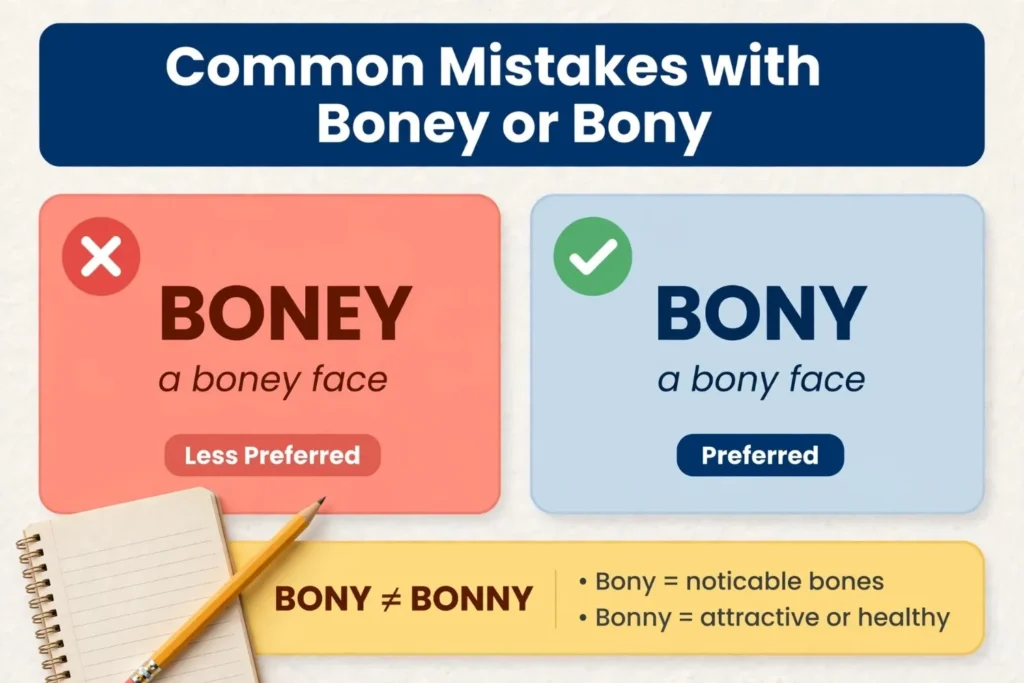
One common mistake is thinking that boney must be correct because the original noun is bone.
Less preferred: The dog has a boney face.
Preferred: The dog has a bony face.
Another mistake is thinking the spelling changes between the US and UK.
Wrong idea: Americans use bony, but British writers use boney.
Correct: Bony is the standard choice in both forms of English.
Writers can also confuse bony with bonny. These words do not mean the same thing.
- Bony = having noticeable bones.
- Bonny = attractive, healthy, or pleasant, especially in some British usage.
Another issue is using boney in technical or medical writing. Even though it is recognized as a variant, bony is clearer and more conventional for terms such as bony tissue, bony structure, and bony growth.
Boney or Bony in Everyday Examples
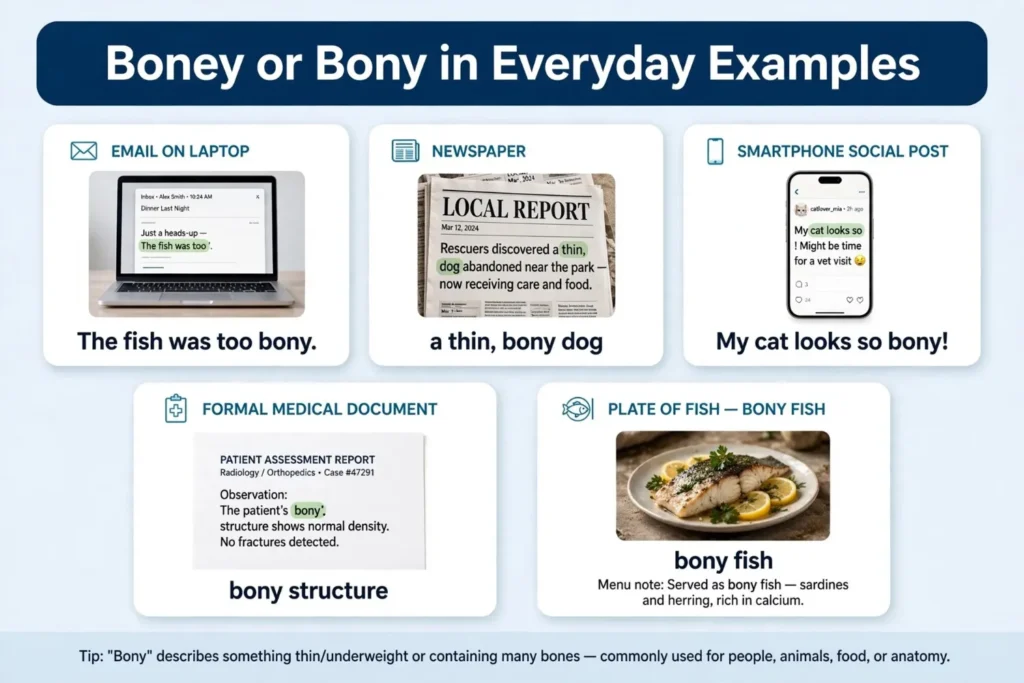
Seeing the word in real situations makes the difference easier to remember.
In Emails
The fish was tasty, but it was a little too bony for me.
This sounds natural and clear.
In News Writing
Rescuers found a thin, bony dog near the abandoned building.
The standard spelling works best in professional news copy.
On Social Media
My cat looks so bony in this photo!
Social media is informal, so you may see boney too. Still, bony is the safer spelling.
In Formal Writing
The animal developed a hard, bony structure around the joint.
Cambridge uses bony for meanings related to bone, including medical and anatomical contexts.
When Talking About Food
I like the taste of this fish, but it is very bony.
Here, bony means that the fish contains many bones.
When Describing Appearance
His face looked thin and bony.
Here, the word means that the bones are easy to see beneath the skin.
Read More: Protesters or Protestors: Which Spelling Is Correct?
Boney or Bony – Google Trends & Usage Data
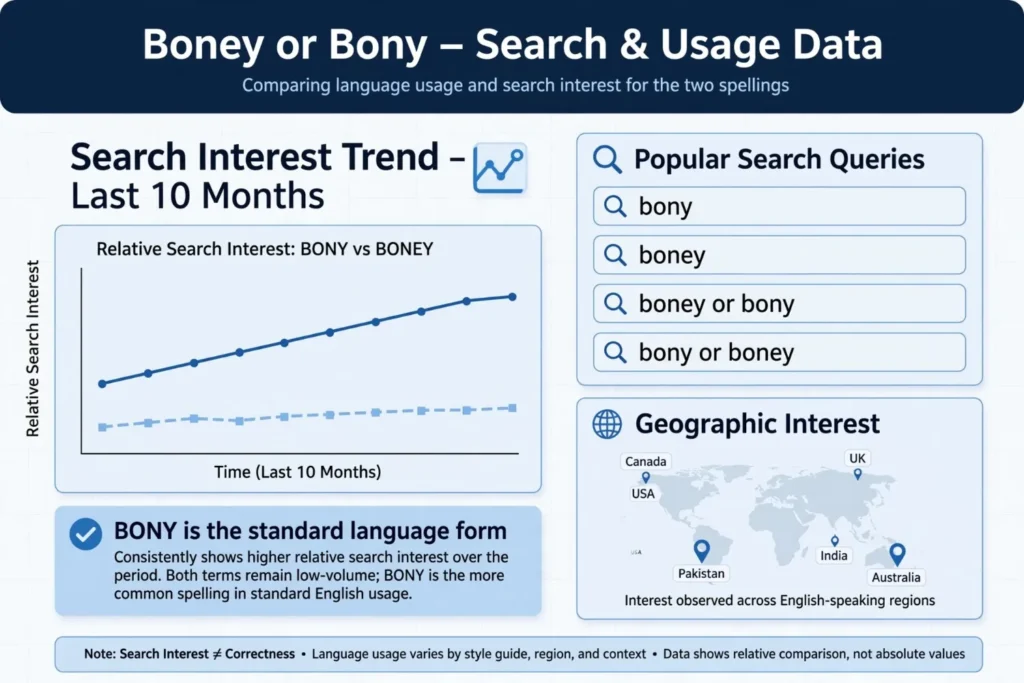
Search data needs careful interpretation. Google Trends measures relative search interest, not the total number of times a word is written or spoken. Google also explains that Trends uses a sample of searches and normalizes its data. Low-volume terms may even show a value of zero.
This matters when comparing boney vs bony. Google Trends treats exact search terms separately. It does not automatically combine spelling variations when you compare search terms.
That makes Trends useful for comparing exact forms such as:
- bony
- boney
- boney or bony
- bony or boney
The broader language evidence gives bony a clear advantage as the standard form. It is the main dictionary entry in both British and American English, while boney is listed as an alternative.
Country context can also affect searches. Users in the United States, United Kingdom, Canada, Australia, India, Pakistan, and other English-speaking markets may search both spellings because they are checking which one is correct. That search interest should not be confused with proof that both forms are equally common.
For SEO, it can make sense to mention both forms in an article about spelling. But in normal sentences, bony should be your primary form.
Boney or Bony Variations at a Glance
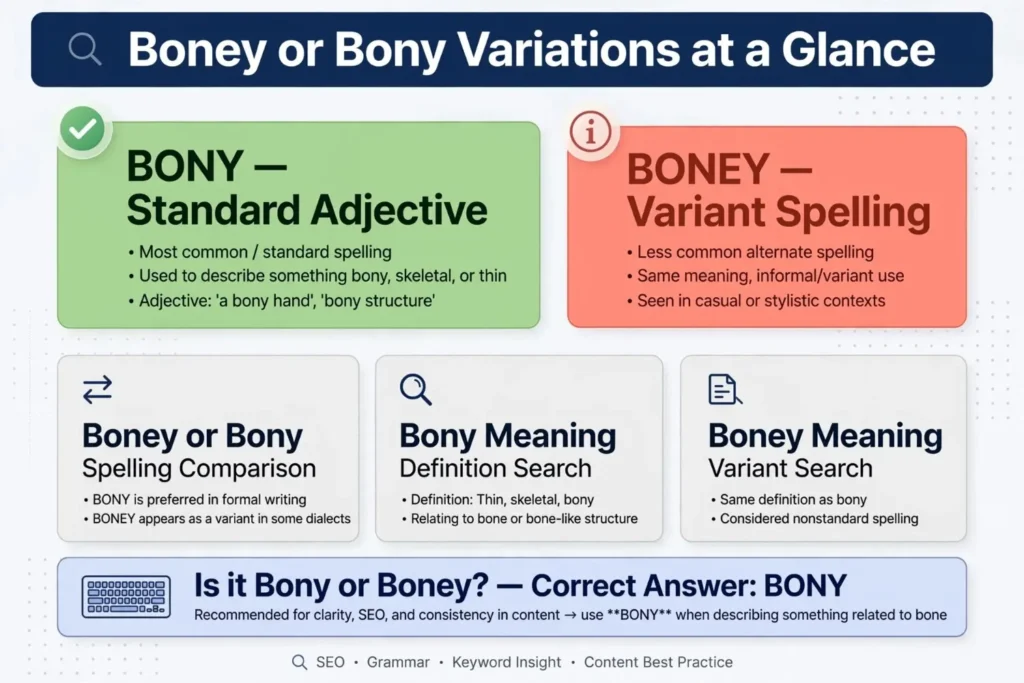
| Keyword Variation | Meaning/Search Intent | Recommended Use |
| Bony | Standard adjective | Use normally |
| Boney | Variant spelling | Avoid as primary form |
| Boney or Bony | Spelling comparison | Good for search-focused content |
| Bony or Boney | Spelling comparison | Good for search-focused content |
| Is it bony or boney? | User wants correct spelling | Answer: bony is preferred |
| Bony meaning | Definition query | Explain thin, bone-like, or full of bones |
| Boney meaning | Variant-definition query | Explain that boney is a variant of bony |
FAQs About Boney or Bony
Is it boney or bony?
Both forms can be found, but bony is the standard and preferred spelling. Cambridge lists boney as an alternative form.
Is boney a real word?
Yes. Boney is recognized as a variant spelling. However, bony is the better choice for standard modern English.
Is bony correct in American English?
Yes. Bony is correct and standard in American English.
Is it bony or boney in British English?
Use bony in British English. The spelling does not follow a major UK-US difference like colour/color.
How do you spell bony when describing a thin person?
Use bony.
Example: He had thin, bony arms.
Can bony describe fish?
Yes. A bony fish can mean a fish with many bones. The term is also used in scientific contexts involving fish with bony skeletons.
Should I use bony or boney in professional writing?
Use bony. It is the clearer choice for professional, academic, medical, and business writing.
Conclusion
The confusion over boney or bony is easy to understand. The noun is spelled bone, so keeping the e may seem natural. Yet the standard adjective is bony.
Bony can describe a thin person or animal whose bones are easy to see. It can also describe something made from bone or something that contains many bones. Cambridge Dictionary uses bony as its main entry while recognizing boney as an alternative form.
There is also no major British-versus-American difference to remember. Whether you write for readers in the US, UK, Commonwealth countries, or a worldwide audience, bony is the safest choice.
You may still see boney online, in informal writing, or as a stylistic variant. That does not mean you need to use it. For school work, emails, articles, reports, SEO content, and other professional writing, stick with bony.
The easiest rule is simple: when in doubt, choose bony.

Hi, I’m Shafqat Rehman. I write easy-to-follow guides about spelling differences, grammar, commonly confused words, comparison keywords, and British and American English variations. I enjoy breaking down confusing language topics and explaining them with clear examples. My aim is to help readers understand English differences and use the right words naturally and confidently.