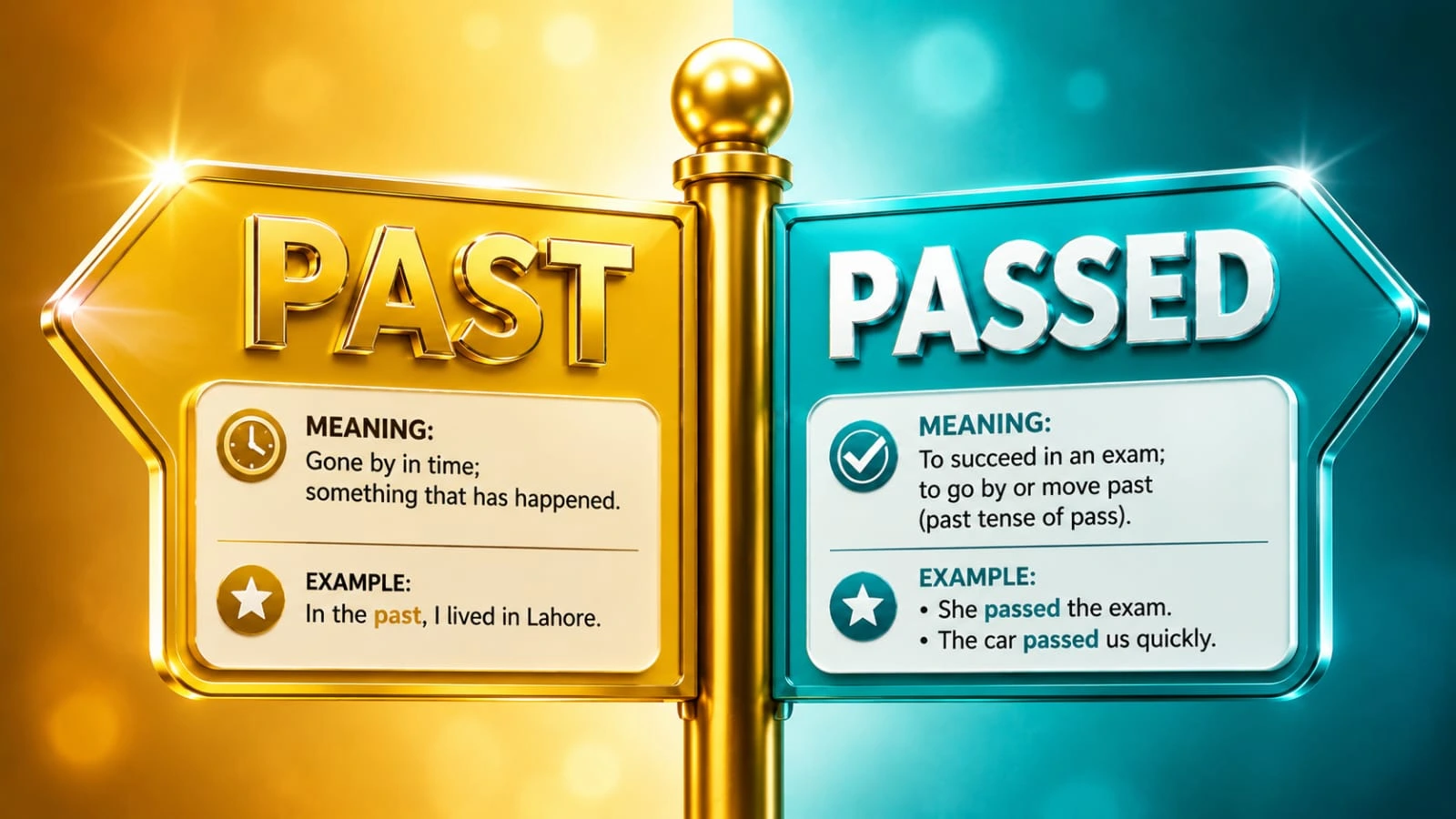
Past usually refers to an earlier time or something that happened before. Passed is the past tense of pass, meaning moved by, succeeded, handed over, or went beyond something.
Have you ever written a sentence like “I past the store” and wondered if past was really the right word? This is one of those English mistakes that can slip into your writing because the two words sound almost the same.
I have seen past and passed confused in everything from casual messages to professional writing. The problem is not that the words are difficult. The problem is that they are homophones. They sound alike but have different spellings, meanings, and jobs in a sentence.
The easiest way to separate them is to remember one simple idea: past is usually about time or position, while passed is an action.
For example, you can walk past a school, but you passed the school on your way home. You can talk about the past, but you cannot “past” an exam. You passed the exam.
Once you understand this small difference, choosing the right word becomes much easier. Let’s break it down with simple rules, examples, common mistakes, and useful memory tricks.
Past or Passed: Quick Answer
Past is usually used as a noun, adjective, preposition, or adverb. It can refer to an earlier time, something that happened before, or movement beyond a point.
I learned from my past.
Passed is the past tense and past participle of “pass.” It describes an action that has already happened.
She passed her exam.
A quick test
Ask yourself:
Is the word about time, history, or a position beyond something?
→ Use past.
Is it describing an action from the verb “pass”?
→ Use passed.
Compare:
- We walked past the library.
- We passed the library on our way home.
Both sentences are correct, but the words perform different jobs.
The Origin and Background of Past and Passed
The confusion between past and passed is mainly caused by pronunciation.
Both words are commonly pronounced like past in standard English. That makes them easy to mix up when you are writing.
However, they come from different grammatical forms.
Past developed from words connected with the idea of something being gone by or finished. It is strongly linked to time and things that have already happened.
Passed comes from the verb pass. When you change “pass” into its past tense, you get passed.
So:
pass → passed
For example:
I pass the shop every morning.
Yesterday:
I passed the shop.
This gives you a useful clue. If you can replace the word with a form of pass, passed is probably the right choice.
Past or Passed Explained: Key Differences
The biggest difference is grammatical.
| Term | Meaning | When to Use | Region/Context |
| Past | Earlier time; beyond a point; previous | Time, history, position, or direction | British and American English |
| Passed | Moved, succeeded, handed over, or went by | Past tense of pass | British and American English |
When to use “past”
Use past when talking about an earlier time.
We should learn from the past.
It can also describe something that happened before.
Her past experiences shaped her career.
You can use past for movement beyond a place or point.
He walked past the house.
It can also refer to a time after a specific hour.
It is half past six.
When to use “passed”
Use passed when describing an action involving the verb pass.
The car passed our house.
It can mean succeeded in a test or exam.
It can mean handed something to another person.
He passed me the salt.
It can also mean went by when talking about time.
Several years passed before they met again.
Which Version Should You Use?
The answer depends on what you want the word to do.
If you are talking about time
Use past.
I do not like thinking about the past.
We moved here in the past.
If you are describing movement
Both words may appear, but they work differently.
She walked past me.
Here, past acts as a preposition.
She passed me.
Here, passed is the verb.
If someone succeeded
Use passed.
He passed the exam.
Never write:
He past the exam. ❌
If you are talking about an earlier period
Use past.
Life was very different in the past.
For global and formal writing
There is no British-versus-American spelling issue here. Past and passed are used in both varieties of English.
The key is understanding their meaning and grammar, not choosing a regional spelling.
Common Mistakes with Past and Passed
1. “I past the store”
❌ I past the store yesterday.
✅ I passed the store yesterday.
Why? The sentence describes an action. The verb is pass, so its past tense is passed.
2. “I passed my childhood”
❌ I passed my childhood in Lahore.
✅ I spent my childhood in Lahore.
This sentence needs a different verb. If you mean an earlier period of your life, you can say:
My past was very different.
Passed does not normally mean “experienced” in this structure.
3. “In the passed”
❌ In the passed, people wrote letters more often.
✅ In the past, people wrote letters more often.
Here, you are talking about an earlier period. Use past.
4. “Past the exam”
❌ She past the exam.
✅ She passed the exam.
Passing an exam is an action. Therefore, the correct form is passed.
5. “The passed few years”
❌ The passed few years were difficult.
✅ The past few years were difficult.
When you mean the previous few years, use past.
The past few years have been challenging.
Past or Passed in Real-World Examples
Seeing the words in natural sentences makes the difference much easier to remember.
Professional Email
I have reviewed the past three reports and found a similar pattern in each one.
Here, past means the previous three reports.
News Article
The company passed its sales target for the second quarter.
Here, passed means the company went beyond its target.
Social Media Post
Sometimes, you have to leave the past behind and focus on what comes next.
Here, past refers to earlier experiences or events.
Formal Document
The vehicle passed the safety inspection without any major issues.
Here, passed describes the action of successfully completing the inspection.
Everyday Conversation
I walked past your house this morning.
But:
I passed your house this morning.
Both can be correct. The grammar is simply different.
A Simple Trick to Remember Past or Passed
Here is the easiest memory trick:
PAST = TIME
Think:
Past = before now
Examples:
- past year
- past experience
- past mistakes
- past events
- past few days
PASSED = ACTION
Think:
Passed = did something
Examples:
- passed the exam
- passed the house
You can also use the pass test.
Replace the word with pass.
If the sentence makes sense as an action, use passed.
She passed the ball.
Present tense:
She passes the ball.
If you are talking about time or something beyond a point, use past.
She walked past the ball.
This quick test can prevent many spelling mistakes.
Frequently Asked Questions
Q: What is the difference between past and passed?
A: Past usually refers to earlier time, history, or a position beyond something. Passed is the past tense or past participle of pass and describes an action.
Q: Is it “past or passed the exam”?
A: The correct phrase is “passed the exam.” Passing an exam is an action, so you need the verb passed.
Q: Is it “walked past” or “walked passed”?
A: The correct phrase is “walked past.” Here, past means beyond or beside a particular point.
Q: Is “past few years” correct?
A: Yes. “The past few years” means the previous few years. For example: “The past few years have been busy.”
Q: Can past be a verb?
A: No. Past is commonly used as a noun, adjective, adverb, preposition, or part of certain expressions. The verb is pass, with passed as its past tense.
Q: Is passed always the past tense of pass?
A: Yes. Passed is the simple past and past participle form of pass. For example: “She passed the test” and “She has passed the test.”
Q: How can I remember past vs passed?
A: Think past = time and passed = action. If you can connect the word to the verb pass, you probably need passed.
Past or Passed: Standalone Comparison
| Term/Variant | Meaning | Region/Context | Best Used When |
| Past | Earlier time or beyond a point | Standard English | Talking about history, previous time, or position |
| Passed | Completed an action involving “pass” | Standard English | Talking about movement, success, transfer, or time going by |
There is no “correct spelling” winner between these two words. Both are correct. The right choice depends on the sentence.
That is the key difference between past and passed.
Conclusion
The difference between past and passed becomes much easier once you focus on their jobs in a sentence.
Use past when you are talking about earlier time, history, a previous period, or something beyond a point.
We should learn from the past.
Use passed when you are describing an action connected to the verb pass.
The easiest memory trick is:
PAST = TIME
PASSED = ACTION
Remember that rule when you write emails, essays, social posts, reports, or everyday messages. Also watch for common phrases such as the past few years, walked past, and passed the test.
You do not need to memorize dozens of complicated grammar rules. Start by asking what the word means in your sentence. Is it about time or position? Choose past. Is it an action? Choose passed.
There or Their: The Easy Way to Get It Right

As an English language enthusiast, I love diving into the tricky details of word differences and spelling variations. My mission is to explain confusing terms and make them accessible to everyone, helping readers to communicate with clarity and confidence.