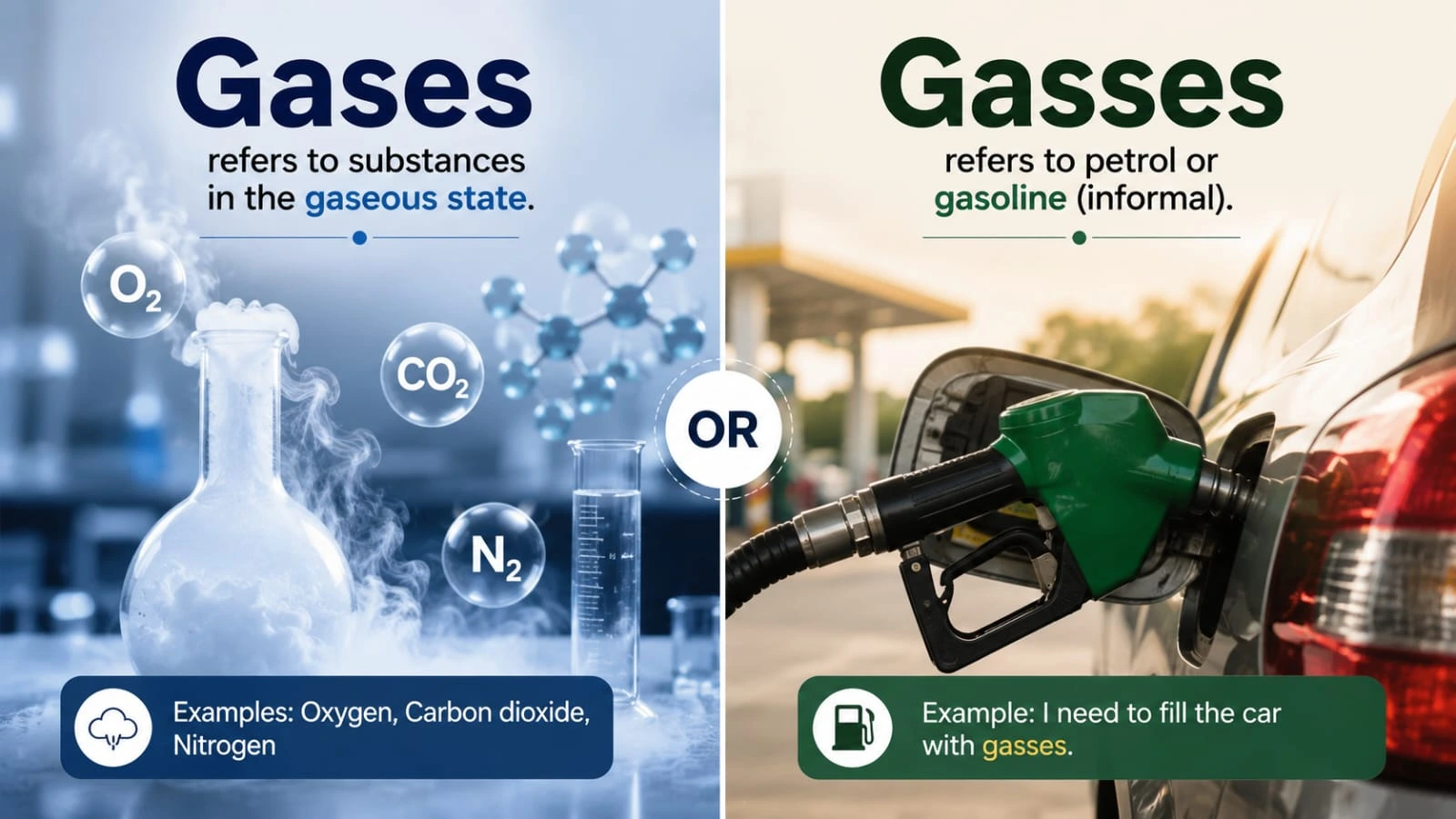
Gases is the standard plural of gas and is the best choice for most writing. Gasses is also used as an alternative plural, but it is much less common.
Have you ever typed gases and wondered if you were missing an extra s? Or maybe you wrote gasses because it looked like the natural plural of gas. This is a small spelling question, but it can cause real doubt, especially in school assignments, science articles, and professional writing.
I have come across this kind of confusion many times when checking English words that look almost correct in more than one form. Gases and gasses are a good example. They look similar, sound similar, and both can be found in English. That makes the choice less obvious than it first appears.
The good news is that you do not need a complicated grammar rule.
Gases is the spelling you should normally use. It is the familiar plural form used when talking about more than one gas. Gasses can also be used as a plural, but it is far less common.
In this guide, you will learn the difference between gases and gasses, when to use each form, common mistakes, and easy examples that make the spelling simple to remember.
Gases or Gasses: Quick Answer
Gases is the preferred plural of gas in most situations.
Use gases when you mean more than one gas:
- Oxygen and nitrogen are gases.
- Several gases are present in the atmosphere.
- Some greenhouse gases affect the climate.
Gasses can also be used as a plural form, but it is much less common.
The simple rule
One gas → two gases
If you are writing a school essay, science report, website article, or professional document, gases is the safest choice.
The Origin and Background of Gases and Gasses
The word gas has a long history in English. It refers to a state of matter that has no fixed shape or volume.
Air contains several gases. Common examples include:
- Oxygen
- Nitrogen
- Carbon dioxide
- Hydrogen
- Water vapor
The spelling question appears when we change gas from singular to plural.
English sometimes forms plurals by simply adding -s. But words ending in s do not always follow a simple spelling pattern.
For example:
one book → two books
But:
one gas → two gases
The extra e helps create the familiar plural form gases.
The alternative gasses also appears in English. However, most readers are more familiar with gases, especially in science and formal writing.
That is why gases is the better default.
Gases or Gasses Explained: Key Differences
The biggest point to remember is that gases and gasses can both refer to more than one gas.
The difference is mainly about usage and frequency.
| Term | Meaning | When to Use | Region/Context |
| Gases | More than one gas | General, academic, and scientific writing | Widely used |
| Gasses | More than one gas | Alternative plural form | Less common |
| Gas | One gas | Singular situations | All standard English |
| Gassed | Past form of the verb “gas” | Describing an action | All standard English |
Gases
Gases is the normal plural form.
For example:
The atmosphere contains many different gases.
Scientists study the behavior of gases.
Some gases can be dangerous when inhaled.
This is the spelling most readers expect.
Gasses
Gasses can also be used to mean more than one gas.
For example:
The machine releases several gasses.
However, this form is much less common. If you are unsure which spelling to choose, gases is the better option.
Gases vs. Gasses: What About the Verb?
There is another reason this pair can be confusing.
Gas can also be used as a verb.
For example:
The workers gas the material.
When the subject is third-person singular, the verb becomes:
The machine gases the material.
Here, gases does not mean “more than one gas.” It is a verb.
Compare these two sentences:
The atmosphere contains several gases.
Here, gases is a plural noun.
The machine gases the material.
Here, gases is a verb.
The spelling is the same, but the grammar is different.
The past tense is:
gassed
For example:
The material was gassed during the process.
So, do not confuse gases with gassed.
Which Version Should You Use?
For most readers, the answer is simple: use gases.
For students
Choose gases in:
- Essays
- Science assignments
- Exams
- School projects
- Research papers
Example:
The atmosphere contains several important gases.
For scientific writing
Gases is the better choice for chemistry, physics, biology, and environmental science.
Examples include:
- Greenhouse gases
- Noble gases
- Toxic gases
- Atmospheric gases
- Exhaust gases
For professional writing
Use gases in reports, emails, presentations, and technical documents.
The test measured the concentration of harmful gases.
For general writing
If your audience is broad, gases is the clearest choice.
It is familiar and easy to recognize.
What about American and British English?
Gases works well in both American and British English.
Gasses may also be found, particularly in American English, but it is much less common.
So, if you want one spelling that works naturally for a wide international audience, choose gases.
Common Mistakes With Gases and Gasses
1. Thinking “gasses” is always wrong
❌ Gasses is never a word.
That is too strong.
Gasses can be used as a plural form of gas. It is simply less common than gases.
2. Using “gasses” as your default spelling
❌ The atmosphere contains several gasses.
✅ The atmosphere contains several gases.
The first sentence is understandable, but gases is the more natural choice for most formal and scientific writing.
3. Confusing “gases” with “gassed”
❌ The material was gases.
✅ The material was gassed.
Gassed is the past form of the verb gas.
4. Thinking every word ending in “s” needs “-es”
English plurals are not always predictable.
The safest pattern here is simply:
gas → gases
5. Assuming the extra “s” makes the pronunciation different
Both gases and gasses, when used as plural nouns, are commonly pronounced with an -iz ending.
So, the main issue is spelling and usage rather than a major difference in pronunciation.
Gases or Gasses in Real-World Examples
Seeing these words in real situations makes the difference easier to understand.
Professional Email
Please review the report on the gases released during the manufacturing process.
Here, gases is the plural noun.
News Article
Scientists are studying how greenhouse gases affect the Earth’s climate.
The standard plural gases works naturally in news writing.
Social Media Post
Did you know that plants exchange gases with the atmosphere?
The standard form is clear and familiar.
Formal Report
The experiment measured several gases inside the sealed chamber.
This is the preferred form for technical and academic writing.
Everyday Conversation
Different gases are used in medical equipment.
Again, gases is the natural choice.
Gases or Gasses: Usage and Search Intent
People who search “gases or gasses” usually have one simple question:
Which spelling should I use?
The search intent is mainly informational.
Readers may be:
- Students checking an assignment
- Writers editing an article
- English learners improving spelling
- Researchers writing reports
- Teachers preparing lessons
- Anyone unsure about the plural of gas
The confusion is understandable because gasses looks like a logical plural. However, gases is much more familiar and is the form most writers should choose.
This is especially true in science-related writing.
When you see phrases such as greenhouse gases, toxic gases, or noble gases, the standard spelling is gases.
Standalone Comparison Table
| Term/Variant | Meaning | Region/Context | Best Used When |
| Gases | Plural of gas | General English | Most situations |
| Gasses | Alternative plural of gas | Less common usage | When an alternative plural is intended |
| Gas | Singular noun | General English | Referring to one gas |
| Gases | Verb meaning “uses gas to treat” | General English | When gas is being used as a verb |
| Gassed | Past form of “gas” | General English | Describing a completed action |
The easiest comparison
Singular:
One gas
Plural:
Several gases
Past verb:
The material was gassed.
This simple pattern clears up most confusion.
Gases or Gasses: Easy Examples
Here are some quick examples to help you remember the correct form.
Correct
Oxygen and hydrogen are gases.
Correct
The factory released harmful gases.
Correct
Scientists study different gases.
Less common alternative
The factory released harmful gasses.
Incorrect for the intended meaning
Oxygen and hydrogen are gasses.
This last example may be seen in English, but gases is the better standard choice.
A Simple Trick to Remember Gases
You do not need a complicated spelling trick.
Just remember:
Gas → gases
Think of a basic science sentence:
One gas can become several gases.
You can also remember common phrases:
- Greenhouse gases
- Noble gases
- Toxic gases
- Waste gases
- Atmospheric gases
Whenever you are writing about more than one gas, gases should be your first choice.
If you see gasses somewhere, do not immediately assume it is a spelling error. It can be used as an alternative plural. But for your own writing, gases is usually the better option.
FAQs
Q: Is gases or gasses correct?
A: Gases is the standard and more common plural of gas. Gasses is also used as an alternative plural, but it is much less common.
Q: What is the plural of gas?
A: The most common plural is gases. For example, “Oxygen and nitrogen are gases.”
Q: Is gasses a misspelling of gases?
A: Not always. Gasses can be used as an alternative plural of gas. However, gases is the safer and more widely used form.
Q: Should I use gases in formal writing?
A: Yes. Gases is the recommended choice for formal, academic, scientific, and professional writing.
Q: Is gases American or British English?
A: Gases is used in both American and British English. It is a broadly accepted standard form.
Q: What is the difference between gases and gassed?
A: Gases can be the plural noun of gas or the third-person singular form of the verb gas. Gassed is the past tense and past participle of the verb.
Q: Why do people write gasses instead of gases?
A: Gasses looks like a natural plural because English often adds -es to words ending in certain consonants. It is also an accepted alternative plural, although it is much less common than gases.
Conclusion
So, gases or gasses? In most cases, choose gases.
Gases is the standard plural form of gas and is the best choice for schoolwork, science writing, professional documents, and everyday English. Gasses is also possible as an alternative plural, but it is far less common.
The easiest rule is:
One gas → two gases
You should also remember that gases can sometimes be a verb. In a sentence like “The machine gases the material,” it describes an action rather than more than one gas. The past form is gassed.
If you are writing for a broad audience, there is little reason to choose the less common form. Gases is familiar, clear, and widely accepted.
Busses or Buses: The Correct Spelling Explained

As an English language enthusiast, I love diving into the tricky details of word differences and spelling variations. My mission is to explain confusing terms and make them accessible to everyone, helping readers to communicate with clarity and confidence.