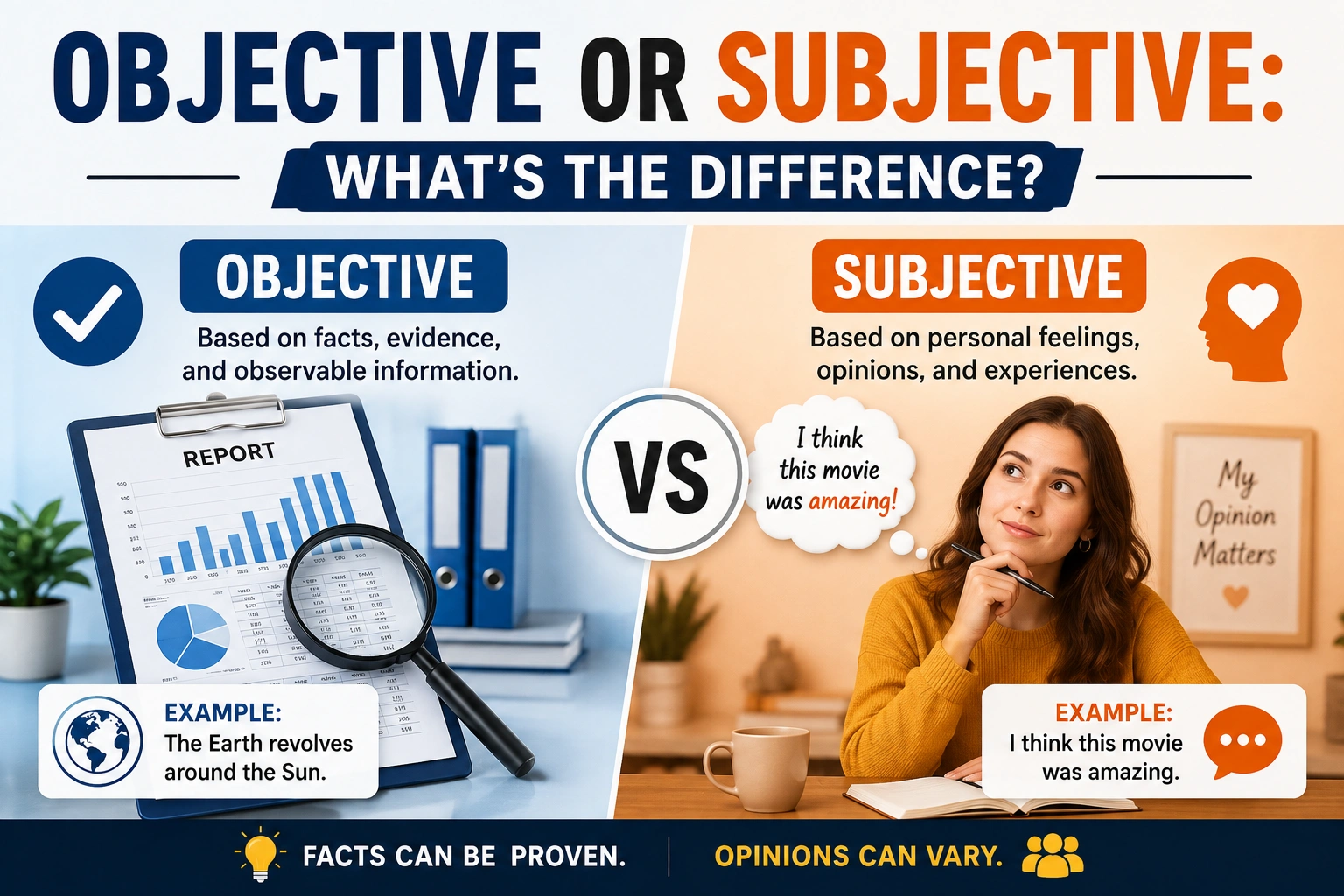
Have you ever wondered whether a statement is objective or subjective? You are not alone. These two words appear often in school essays, news reports, reviews, research, workplace discussions, and everyday conversations. Because they are commonly used as opposites, it can be easy to mix them up.
The basic difference is simple: objective means based on facts, evidence, or observable information, while subjective means based on personal feelings, opinions, experiences, or views.
For example, “The book has 300 pages” is objective because its page count can be checked. “The book is boring” is subjective because different readers may feel differently.
People often search for “objective or subjective” because they want to know which word fits a sentence, how to tell facts from opinions, or how to write in a more neutral way. This guide explains the difference in simple language and provides practical examples for school, work, journalism, social media, and everyday communication.
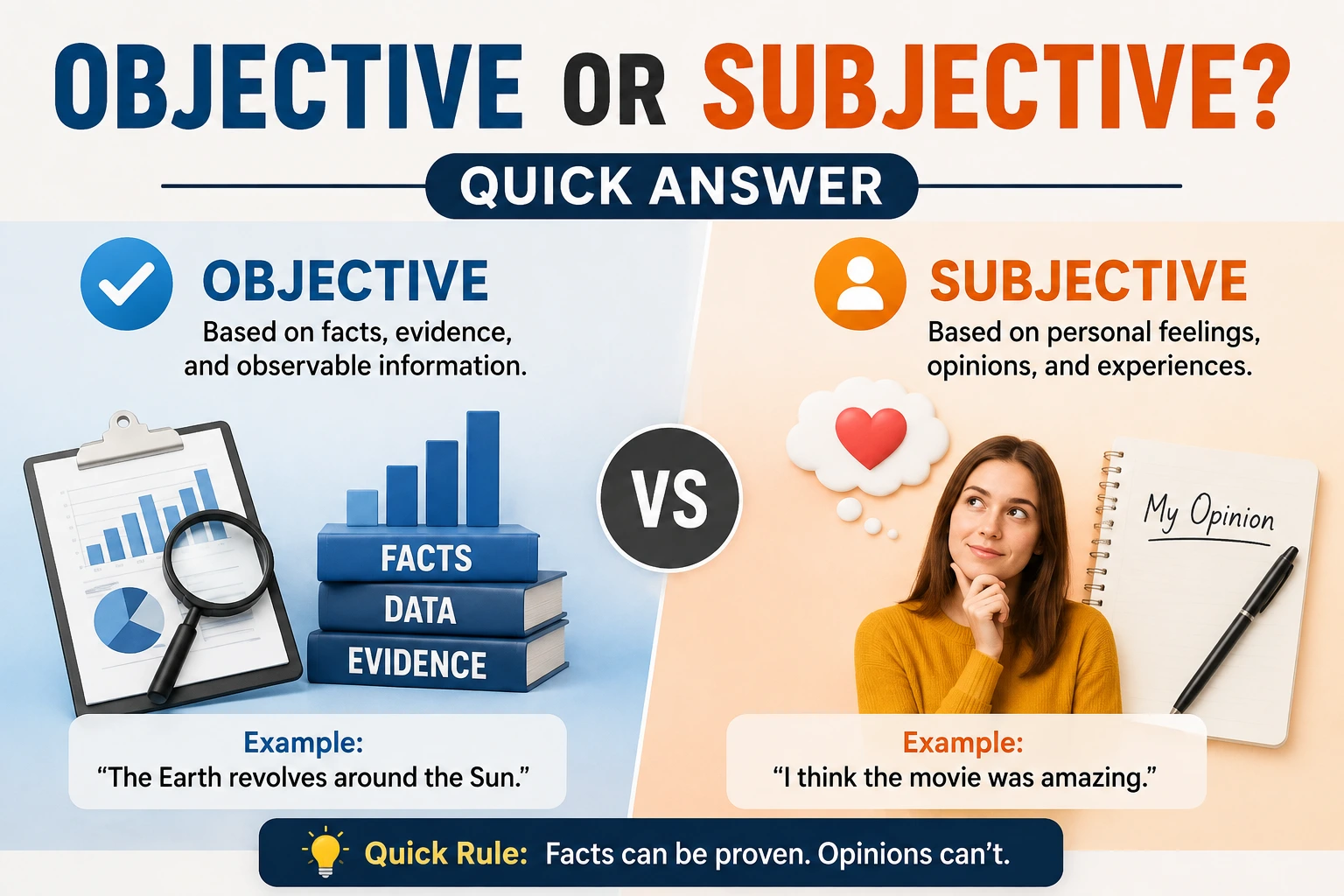
The quick answer is:
- Objective = based on facts, evidence, or information that can be checked.
- Subjective = based on personal feelings, opinions, experiences, or interpretations.
Objective Example
The company reported a 10% increase in sales.
This is objective if the figure is supported by reliable records.
Subjective Example
The company’s new product is excellent.
This is subjective because “excellent” expresses an opinion.
Easy Memory Trick
Think:
Objective → Object → Observable
Subjective → Subject → Personal viewpoint
This is a useful shortcut, although real-world statements can sometimes contain both factual and interpretive elements.
| Objective | Subjective |
|---|---|
| Based on facts | Based on opinions |
| Can often be verified | Depends on personal perspective |
| More neutral | More personal |
| Uses evidence | Uses feelings or interpretation |
| Example: “The car costs $30,000.” | Example: “The car is beautiful.” |
Objective and subjective are commonly treated as contrasting concepts, especially when discussing information, writing, opinions, and judgment.

The words objective and subjective have a long history connected to Latin and philosophical language.
Objective comes from Medieval Latin objectivus, related to objectum, meaning an object or something placed before the mind. In English, “objective” developed several meanings. It can describe something impartial or fact-based, and it can also mean a goal or aim.
Subjective comes from Late Latin subiectivus, meaning related to the subject. Over time, its meaning became connected with the individual mind, personal experience, and personal perception.
Interestingly, the historical meanings were not always identical to the meanings we commonly use today. The modern contrast between objective and subjective developed over centuries, particularly through philosophical discussion.
Why Are They Different Words?
There is no spelling mistake between objective and subjective. They are separate words.
Their endings look similar because both use the suffix -ive, but their beginnings point to different ideas:
- object- → an object or external thing
- subject- → a subject or individual perspective
So, if you are asking “objective or subjective,” you are choosing between two meanings, not two spellings.

Unlike words such as colour/color or centre/center, objective and subjective are spelled the same in standard British and American English.
| Word | British English | American English |
|---|---|---|
| Objective | objective | objective |
| Subjective | subjective | subjective |
| Objectively | objectively | objectively |
| Subjectively | subjectively | subjectively |
| Objectivity | objectivity | objectivity |
| Subjectivity | subjectivity | subjectivity |
Therefore, you do not need to choose a British or American spelling when using these words.
The important choice is meaning.
For example:
- “The report gives an objective account.” ✅
- “The report gives a subjective account.” ✅
- “The report gives an objectiv account.” ❌
- “The report gives a subjectiv account.” ❌
Both English varieties use objective and subjective.
Which Spelling Should You Use?
You should use objective or subjective according to what you mean.
Use “objective” when:
- You are describing facts.
- Information can be checked.
- You want to sound neutral.
- Evidence supports the statement.
- You are discussing measurable information.
Example:
The test lasted 60 minutes.
Use “subjective” when:
- You are expressing an opinion.
- Personal feelings influence the statement.
- Different people may have different views.
- You are describing personal experience.
- Interpretation plays an important role.
Example:
The test was extremely difficult.
The second sentence may be true for one student but not another.
Advice for Writers
If you are writing an article, report, academic paper, or news story, clearly separate facts from opinions. Objective information can be supported with evidence, while subjective statements should be presented as opinions or interpretations.
Mistake 1: Thinking objective means “always true”
An objective statement should be based on evidence or facts, but that does not automatically make every statement labeled “objective” correct.
Better:
The report provides evidence for the claim.
Mistake 2: Thinking every opinion is useless
Subjective information can be valuable. Reviews, personal experiences, artistic judgments, and preferences naturally involve subjectivity.
Example:
The restaurant’s food was delicious.
This is subjective, but it can still help another person understand the reviewer’s experience.
Mistake 3: Using “objective opinion” without context
People often say:
“Give me your objective opinion.”
This can make sense when they mean an unbiased or evidence-based assessment. However, a personal opinion is naturally influenced by the person giving it.
A clearer phrase may be:
“Give me an unbiased assessment based on the evidence.”
Mistake 4: Assuming subjective means false
Subjective does not mean false.
For example:
“I found the movie frightening.”
This is a subjective statement about someone’s experience. It can be completely genuine.
Mistake 5: Assuming objective means emotionless
A person can discuss facts while still having emotions. Objectivity mainly concerns how information or judgment is formed and presented.
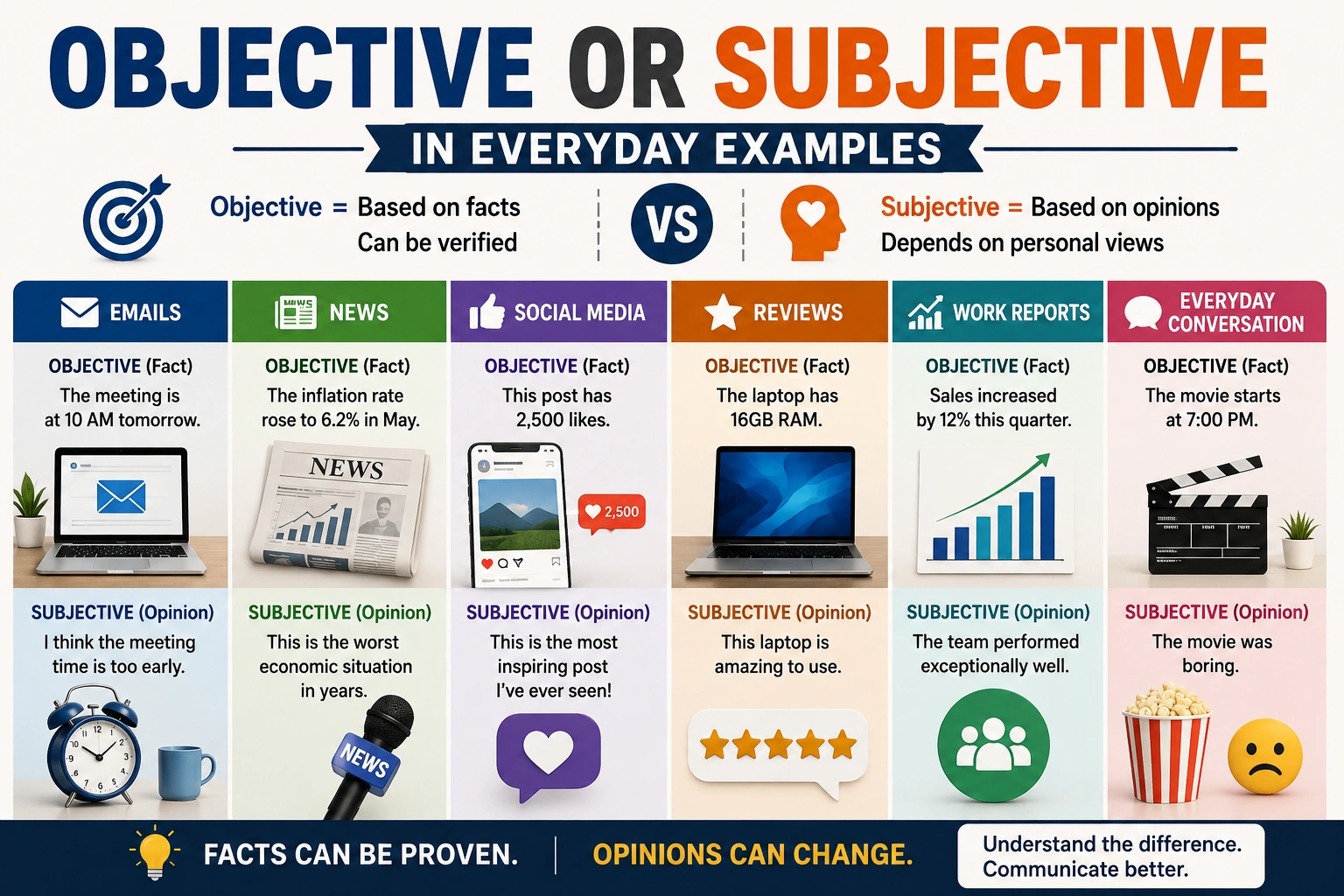
The difference becomes much easier when you see it in real situations.
In Emails
Objective:
The meeting starts at 10 a.m.
Subjective:
I think the meeting starts too early.
The first gives information. The second gives a personal view.
In News
More objective:
The storm caused flooding in several areas, according to local authorities.
More subjective:
It was the worst storm the city has ever experienced.
The second statement may require evidence and can also reflect personal judgment.
On Social Media
Objective:
The video has received 500,000 views.
Subjective:
This is the best video on the internet.
The first can be measured. The second is an opinion.
In Reviews
Objective:
The phone has a 6.7-inch display.
Subjective:
The display looks amazing.
The first describes a measurable feature. The second expresses an opinion.
In Formal Writing
Academic and professional writing often benefits from clear evidence and careful wording.
Instead of:
This is clearly the best solution.
Try:
This solution performed better in the test results.
The second sentence gives the reader a basis for the claim.
Objective or Subjective – Google Trends & Usage Data
Search interest in “objective or subjective” is driven largely by questions about meaning, writing, facts versus opinions, and how to identify each type of statement. Search results and educational resources show that the distinction is widely discussed in writing, journalism, education, science, psychology, and everyday communication.
The phrase also appears in searches such as:
- objective vs subjective
- objective and subjective meaning
- objective vs subjective examples
- objective or subjective writing
- objective vs subjective opinion
- objective and subjective statements
- objective vs subjective information
Usage varies by context. Students often encounter the terms when learning about writing and evidence. Professionals may use them when discussing reports, decisions, research, or assessments. Online discussions frequently use them when comparing facts with personal opinions.
Because Google Trends numbers change over time, location, and search settings, exact trend figures should be checked directly for the desired country and date range rather than treated as permanent statistics.
Objective vs Subjective Comparison Table
| Feature | Objective | Subjective |
|---|---|---|
| Main idea | Facts or evidence | Personal view |
| Based on | Observable information | Feelings and experience |
| Personal opinion | Usually minimized | Often central |
| Can be checked? | Often yes | Not always |
| Tone | Neutral | Personal |
| Common use | Reports, research, news | Reviews, opinions, personal writing |
| Example | “The book has 250 pages.” | “The book is fascinating.” |
A key point is that the two categories are not always perfectly separate. Some statements combine facts with interpretation, so context matters.
FAQs About Objective or Subjective
1. What is the difference between objective and subjective?
Objective information is based on facts, evidence, or observable information. Subjective information is influenced by personal feelings, opinions, or experiences.
2. Is an opinion objective or subjective?
An opinion is generally subjective because it represents a person’s judgment or viewpoint.
3. Is a fact always objective?
A fact is normally presented as objective when it can be verified with reliable evidence. However, the way a fact is selected or described can still involve interpretation.
4. Is “I think” subjective?
Usually, yes. Phrases such as “I think,” “I feel,” and “in my opinion” often introduce subjective statements.
5. Is science objective or subjective?
Scientific methods aim for objectivity by using evidence, measurement, testing, and methods that other researchers can examine. However, scientific work can still involve human judgment and interpretation.
6. Is a movie review objective or subjective?
A movie review can contain both. Information such as the release date or running time can be objective, while opinions about acting, story, or entertainment value are subjective.
7. Are objective and subjective spelled differently in British English?
No. Objective and subjective have the same spelling in standard British and American English.
Conclusion
Understanding objective or subjective becomes much easier when you remember one simple idea: objective focuses on evidence and observable facts, while subjective focuses on personal experience, feelings, and opinions.
For example, “The laptop weighs 1.5 kilograms” is objective because the weight can be measured. “The laptop is too heavy” is subjective because different people may have different opinions about its weight.
These words are not alternative spellings. They are two different words with different meanings. Unlike some British and American spelling differences, objective and subjective remain spelled the same in both varieties of English.
When writing professionally, use objective language when you need to present facts, evidence, measurements, or neutral information. Use subjective language when discussing opinions, experiences, preferences, or interpretations. Most importantly, do not assume that subjective information is false or that objective information is automatically correct. The real issue is how the statement is supported and presented.
Once you understand this difference, you can use objective and subjective with confidence in essays, articles, reports, emails, reviews, and everyday conversations.

My name is iqbal hussain, and I am an article writer passionate about creating clear, engaging, and informative content. I specialize in SEO-friendly articles and blog posts. I enjoy researching different topics and turning complex information into simple, useful content that informs readers and provides real value.