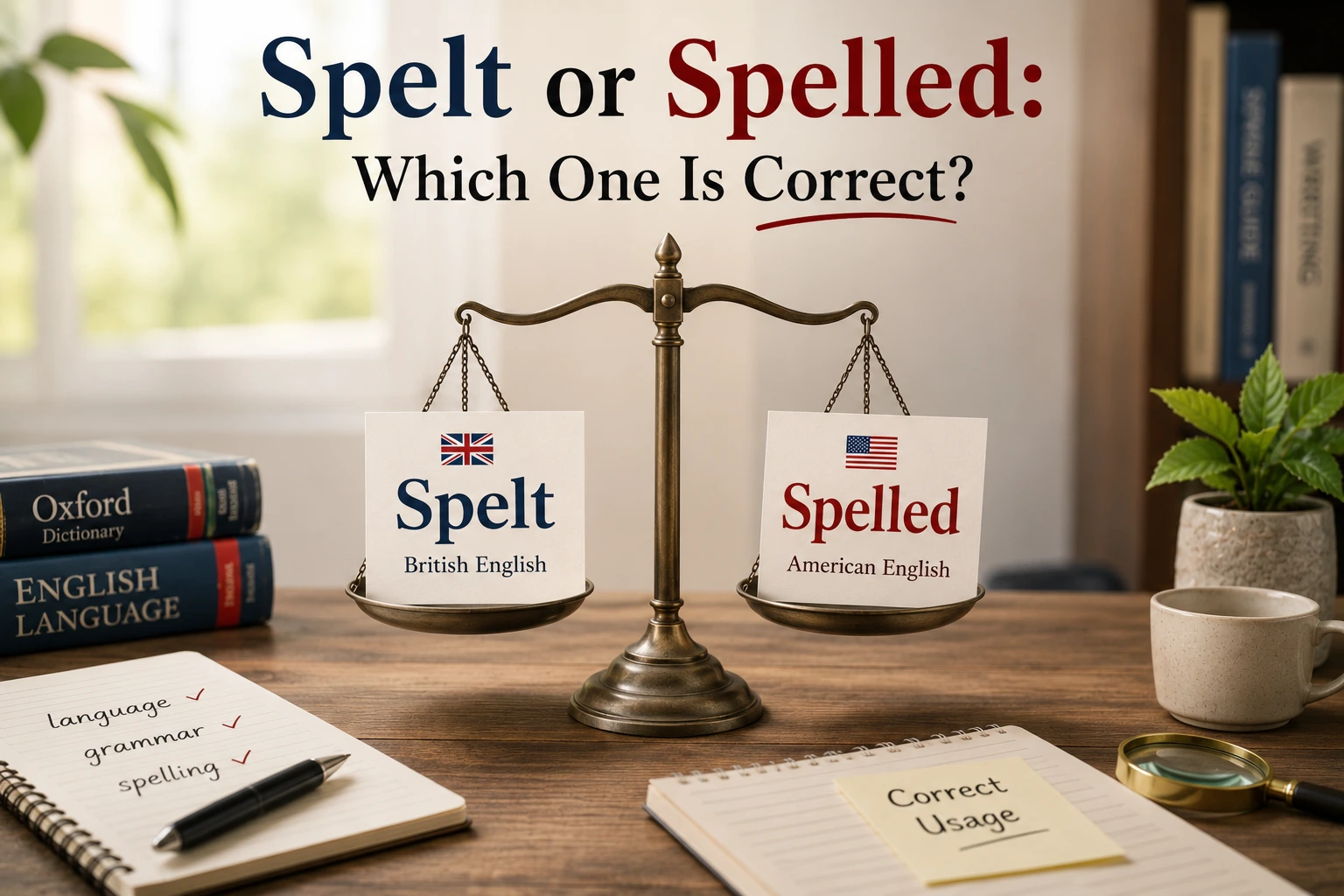
Both spelt and spelled are correct past tense forms of spell. Spelled is preferred in American English, while spelt is more common in British English, although spelled is also widely accepted in the UK.
Have you ever paused while writing and wondered whether it should be spelt or spelled? I have. Years ago, while editing an article for an international audience, I noticed one editor changed every spelt to spelled, while another changed them all back. That small disagreement made me realize this wasn’t a spelling mistake at all, it was simply a difference between British and American English.
Many English learners face the same confusion. Both words appear in books, newspapers, and online articles, so it’s easy to assume one must be wrong. The good news is that both are correct. The key is knowing where and when to use each one.
In this guide, you’ll learn the difference between spelt and spelled, why both forms exist, which one fits your audience, and how to avoid common mistakes. By the end, you’ll be able to choose the right form with confidence.
Spelt or Spelled: Quick Answer
Both spelt and spelled are correct past tense and past participle forms of the verb spell.
- Spelled is the standard form in American English.
- Spelt is more common in British English, though spelled is also widely used there.
- Neither form changes the meaning of the sentence.
Examples
- She spelled my name correctly. ✅
- She spelt my name correctly. ✅ (British English)
- We spelled every difficult word during the test. ✅
- We spelt every difficult word during the test. ✅ (British English)
The only real difference is the variety of English you’re writing.
How to Pronounce Spelt and Spelled
Although spelt and spelled have the same meaning, they’re pronounced slightly differently because of their endings. Learning the pronunciation can help you recognize both forms in conversations and improve your spoken English.
Pronunciation of Spelt
Spelt (spelt)
IPA: /spelt/
Break it into one syllable:
Spelt (rhymes with “belt” and “felt”)
Example:
- She spelt my surname correctly.
- The answer was spelt differently in British English.
Memory Tip: Spelt is short and ends with a crisp “t” sound, just like felt or dealt.
Pronunciation of Spelled
Spelled (speld)
IPA: /speld/
Break it into one syllable:
Spelled (also rhymes with “held” and “welled”)
Example:
- He spelled every word correctly during the test.
- The teacher spelled the difficult word aloud.
Memory Tip: Spelled ends with “-ed,” but the -ed is pronounced as a simple “d” sound not as a separate syllable.
The Origin of Spelt and Spelled
The verb spell comes from Old English spellian, meaning to tell, speak, or relate. Over time, its meaning shifted to arranging letters to form words.
Like many English verbs, spell developed two accepted past tense forms:
- Spelled follows the regular -ed pattern used by most English verbs.
- Spelt follows an older pattern found in British English, similar to words like dreamt, learnt, and burnt.
As English spread around the world, different regions developed different preferences.
- American English gradually favored regular verb endings such as learned, burned, and spelled.
- British English continued using many traditional -t endings, including spelt.
Today, both forms are recognized by major dictionaries. Choosing between them is mostly a matter of regional style, not correctness.
Spelt vs Spelled Explained
Although spelt and spelled have the same meaning, they are used differently depending on the type of English you write.
| Term | Meaning | When to Use | Region/Context |
| Spelt | Past tense of spell | British writing and publications | Mainly British English |
| Spelled | Past tense of spell | American writing and international audiences | American English and widely accepted worldwide |
Use Spelled if:
- You’re writing for an American audience.
- You’re creating international business content.
- Your company or school follows American English.
Example:
- The teacher spelled every new word clearly.
Use Spelt if:
- You’re writing in British English.
- Your publisher or organization follows UK style.
- You’re matching the spelling style of the rest of your document.
Example:
- The reporter spelt the company’s name correctly.
The important thing is to stay consistent. Avoid switching between spelt and spelled in the same piece of writing unless you’re quoting someone or following different style guides.
Which Version Should You Use?
The best choice depends on who will read your writing. Since both forms are correct, you should match the variety of English your audience expects.
For American English
Use spelled.
It is the standard form in the United States and appears in schools, newspapers, businesses, and official documents.
Example:
- The student spelled every word correctly during the spelling bee.
For British English
You can use spelt or spelled, but spelt is often preferred in traditional British writing.
Example:
- She spelt his surname incorrectly on the application form.
For International Readers
Choose spelled if you’re writing for a global audience.
It is more widely recognized and understood across different English-speaking countries.
Quick Recommendation
| Audience | Recommended Form | Why |
| American readers | Spelled | Standard American English |
| British readers | Spelt or Spelled | Both are accepted |
| International audience | Spelled | Most familiar worldwide |
| Academic writing | Follow your style guide | Stay consistent |
Tip: Once you choose one form, use it throughout your document. Mixing spelt and spelled in the same article can distract readers.
Common Mistakes with Spelt and Spelled
Because both words are correct, many writers make mistakes by using them inconsistently or assuming one is always wrong.
Mistake 1: Thinking Spelt Is Incorrect
❌ Wrong: Spelt is not a real English word.
✅ Correct: Spelt is a correct British English past tense of spell.
Why?
Many people only learn American English, so they mistakenly believe spelt is an error.
Mistake 2: Mixing Both Forms in One Article
❌ She spelt the word correctly. Later she spelled another difficult word.
✅ Choose one style and stay consistent.
Why?
Switching between British and American spellings can make your writing look unedited.
Mistake 3: Using the Wrong Style for Your Audience
❌ Using spelt in a document that follows American English.
✅ Use spelled for American readers.
Why?
Following your audience’s language style makes your writing feel more natural.
Mistake 4: Assuming They Have Different Meanings
❌ Spelt and spelled mean different things.
✅ Both mean exactly the same thing.
Why?
The only difference is regional preference, not meaning.
Mistake 5: Confusing Spelt with the Grain
Remember that spelt is also the name of an ancient type of wheat.
Example:
- I bought spelt flour from the grocery store. ✅
- She spelt my surname correctly. ✅
The sentence makes it clear which meaning is intended.
Spelt and Spelled in Real-World Examples
Seeing these words in context makes the difference much easier to remember.
Professional Email
Please check whether you spelled the client’s name correctly before sending the contract.
(Businesses in the US usually prefer spelled.)
News Headline
The student’s surname was spelt incorrectly on the examination certificate.
(A British publication may naturally use spelt.)
Social Media Post
I finally spelled “entrepreneur” without autocorrect!
Formal Report
Every technical term was spelled correctly throughout the document.
Everyday Conversation
You spelt my last name perfectly.
or
You spelled my last name perfectly.
Both are correct, the choice depends on whether you’re using British or American English.
Spelt or Spelled: Data, Trends & Usage
Interest in spelt vs spelled remains high because English learners often encounter both forms online and wonder which one is correct.
Here’s what usage patterns show:
- Spelled dominates in the United States.
- Spelt appears more often in the United Kingdom, Australia, and New Zealand.
- Many British publishers now use spelled alongside spelt, making both acceptable.
- Search intent for this topic is mainly informational, as users want to know which form is correct rather than looking to buy a product.
A useful insight is that international companies increasingly choose spelled because it is familiar to readers in most English-speaking countries. However, if your writing follows British English, spelt remains a perfectly correct and natural choice.
Spelt vs Spelled Comparison Table
| Term/Variant | Meaning | Region/Context | Best Used When |
| Spelt | Past tense and past participle of spell | Mainly British English | Writing for UK readers or following British style |
| Spelled | Past tense and past participle of spell | American English and international writing | Writing for US or global audiences |
Frequently Asked Questions
Is spelt or spelled correct?
Both are correct. Spelled is the preferred form in American English, while spelt is commonly used in British English. The meaning is exactly the same.
Is spelt used in American English?
Not often. Most American writers, schools, and publishers use spelled almost exclusively. Although Americans understand spelt, it may sound unusual.
Is spelled acceptable in British English?
Yes. British English accepts both spelt and spelled. Some writers prefer the traditional spelt, while others use spelled, especially in modern publications.
Does spelt have another meaning?
Yes. Besides being the past tense of spell, spelt is also an ancient type of wheat used to make flour, bread, and pasta. The meaning depends on the context.
Which form should students use?
Students should follow the style required by their school, teacher, or exam board. If no style is specified, use spelled for American English and spelt or spelled for British English.
Do dictionaries accept both words?
Yes. Major dictionaries such as Oxford, Cambridge, and Merriam-Webster recognize both forms, though they note different regional preferences.
Should I use spelt or spelled for international readers?
For a global audience, spelled is usually the safer choice because it is more widely recognized across different varieties of English.
Conclusion
Choosing between spelt and spelled is much easier once you know the difference. The important thing to remember is that both forms are correct. They share the same meaning and grammar. The only real difference is the variety of English you’re using.
If you’re writing for an American audience, spelled is the standard choice. If you’re writing in British English, you can confidently use spelt, although spelled is also widely accepted. For international readers, spelled is often the clearest option.
The key is consistency. Pick one spelling style and use it throughout your writing. Doing so makes your work look polished and professional.
Now that you know the difference between spelt and spelled, you’ll never have to second-guess this word again. Bookmark this guide and share it with anyone who’s ever wondered which spelling is correct.
Travelling or Traveling: Which Spelling Should You Use?

As an English language enthusiast, I love diving into the tricky details of word differences and spelling variations. My mission is to explain confusing terms and make them accessible to everyone, helping readers to communicate with clarity and confidence.