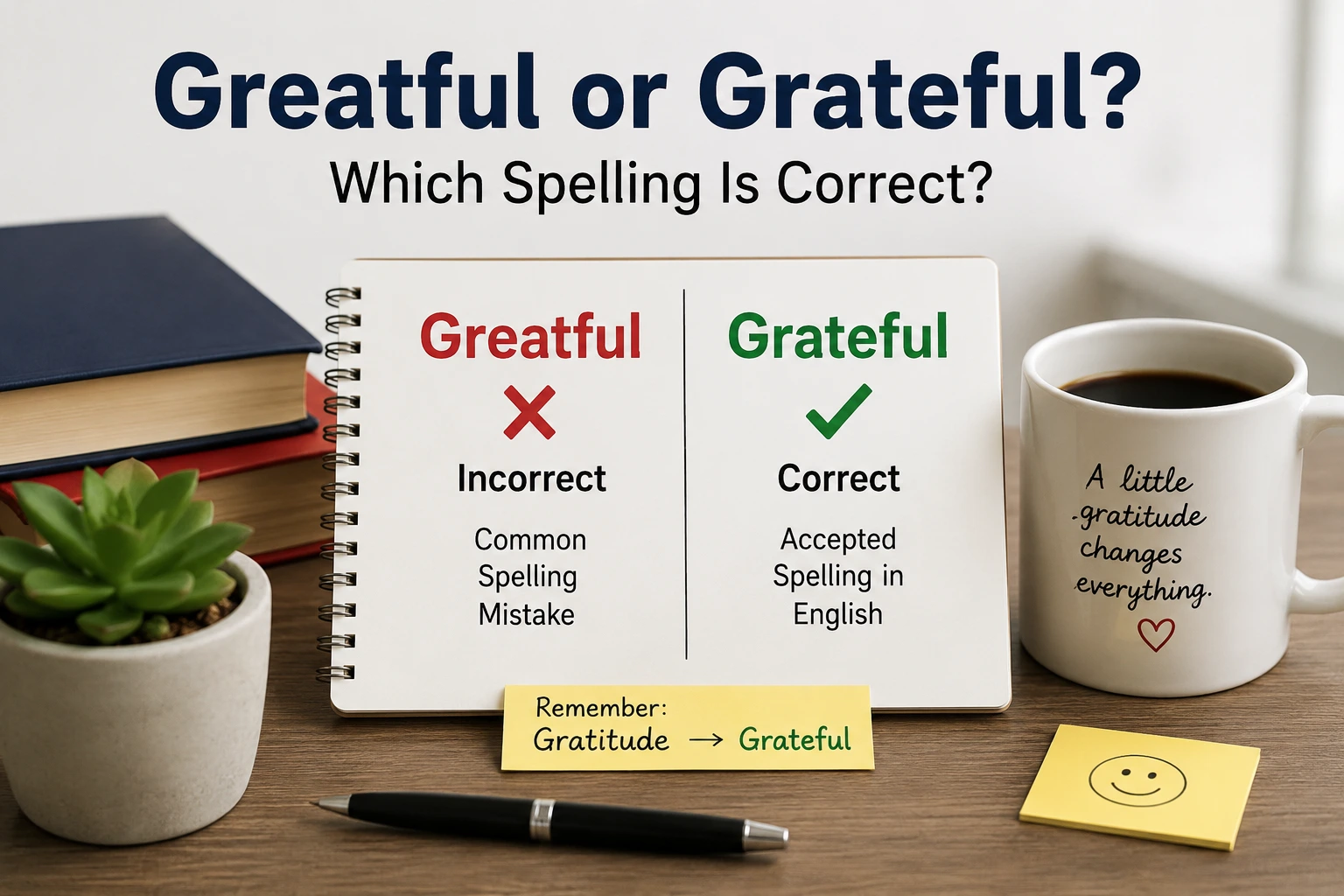
Grateful is the correct English spelling. Greatful is a common misspelling and should be avoided in formal and informal writing.
Have you ever typed greatful in a message only to see that annoying red underline? You’re not alone. I made the same mistake years ago while writing a thank-you email. At first, I assumed greatful made sense because it looks connected to the word great. But English has a few spelling surprises, and this is one of them.
Many students, writers, and even native English speakers search for greatful or grateful because the two words look so similar. One feels logical. The other looks slightly unusual. That tiny difference causes thousands of spelling mistakes every day.
The good news is that the answer is simple once you know where the word comes from. After that, you’ll probably never confuse these spellings again.
In this guide, you’ll learn the correct spelling, why people make this mistake, where the word came from, how to use it correctly, and plenty of real-life examples.
Greatful or Grateful: Quick Answer
The correct spelling is grateful.
The spelling greatful is incorrect and is considered a spelling mistake in modern English.
Correct examples:
- I am grateful for your support.
- She felt grateful after receiving the scholarship.
Incorrect examples:
- ❌ I am greatful for your help.
- ❌ We are greatful to our customers.
Simple rule: If you want to express thankfulness or appreciation, always write grateful.
The Origin of Grateful
The confusion becomes much easier to understand when you know the history of the word.
Although grateful looks like it should come from great, it actually comes from the word grate, which is related to the older meaning of gratitude, grace, and the Latin word gratus, meaning pleasing, thankful, or welcome.
That is why the spelling uses grat- instead of great-.
Here is a simple word family:
- Gratitude
- Grateful
- Ungrateful
- Gratefully
Notice how every word begins with grat-, not great-.
Once you remember gratitude, remembering grateful becomes much easier.
Why Do People Write “Greatful”?
There are several reasons.
- People naturally connect the word with great.
- Both words sound almost identical when spoken.
- English contains many irregular spellings.
- Spellcheck is often ignored when typing quickly.
Because of these reasons, greatful remains one of the most common spelling mistakes in English.
Greatful or Grateful Explained
Both spellings look believable, but only one is accepted in dictionaries.
| Term | Meaning | When to Use | Region/Context |
| Grateful | Feeling thankful or appreciative | Always | Worldwide English |
| Greatful | Incorrect spelling | Never | Considered a spelling error |
Grateful
Grateful describes someone who feels thankful.
Examples:
- She was grateful for the doctor’s kindness.
- I’m grateful that everyone arrived safely.
- We remain grateful to our loyal readers.
Greatful
Greatful is not a recognized English word.
Although millions of people search for it every year, dictionaries treat it as a misspelling of grateful.
Whenever you write greatful, replace it with grateful.
Which Version Should You Use?
The answer is simple.
| Audience | Recommended Spelling | Why |
| Students | Grateful | Correct in exams and assignments |
| Professionals | Grateful | Appropriate for emails and reports |
| Content Writers | Grateful | Improves credibility |
| Businesses | Grateful | Looks professional in customer communication |
| Global English Users | Grateful | Accepted everywhere |
There is no situation where greatful is considered the correct spelling.
Whether you’re writing an email, social media caption, essay, article, or business proposal, always choose grateful.
Common Mistakes with Greatful or Grateful
Here are mistakes people make most often.
| Mistake | Correct Version | Why |
| ❌ Greatful | ✅ Grateful | Standard spelling |
| ❌ Greatfully | ✅ Gratefully | Derived from grateful |
| ❌ Ungreatful | ✅ Ungrateful | Uses the same root |
| ❌ Greatfulness | ✅ Gratefulness | Correct noun form |
Easy Memory Trick
Think of the word gratitude.
If you can spell gratitude, then you already know how to spell grateful.
Gratitude → Grateful
Not:
Great → Greatful ❌
This simple connection helps many learners remember the correct spelling forever.
Greatful or Grateful in Real-World Examples
Seeing a word used in context is one of the fastest ways to remember it. Here are examples from everyday writing.
Professional Email
Thank you for your guidance throughout the project. I am truly grateful for your support and encouragement.
News Headline
Local Community Grateful to Volunteers After Flood Relief Efforts
Social Media Post
Feeling incredibly grateful for everyone who made my birthday so special. Thank you all! ❤️
Formal Report
The organization is grateful for the continued support of its partners and donors.
Everyday Conversation
- I’m grateful for your honesty.
- We are grateful to have such wonderful neighbors.
- She felt grateful after receiving the award.
- They were grateful that no one was injured.
In every example above, grateful is the only correct spelling.
Greatful or Grateful: Data, Trends & Usage
Although greatful is incorrect, thousands of people search for it every month because they are unsure which spelling is right.
Search Intent
Primary Intent: Informational
People usually want to know:
- Which spelling is correct?
- Is greatful ever acceptable?
- Why is it spelled grateful instead of greatful?
- How can I remember the correct spelling?
Who Searches This Most?
- English learners
- Students
- Bloggers
- Content writers
- Professionals writing emails
- Job seekers
- Teachers and editors
Where Is It Commonly Searched?
The topic is popular in English-speaking countries, including:
- United States
- United Kingdom
- Canada
- Australia
- India
- Pakistan
It also receives searches worldwide from people learning English as a second language.
Why It Matters Today
Emails, LinkedIn posts, resumes, and social media have made written English more important than ever.
A simple spelling mistake like greatful can leave a poor impression, while grateful shows attention to detail and confidence in your writing.
Greatful vs Grateful Comparison Table
| Term/Variant | Meaning | Region/Context | Best Used When |
| Grateful | Feeling thankful or appreciative | Standard English worldwide | Always |
| Greatful | Incorrect spelling | Not accepted in English | Never |
Frequently Asked Questions
Is greatful a real word?
No. Greatful is a spelling mistake. The correct spelling is grateful.
Why is grateful spelled without “great”?
Because the word comes from gratitude, not from great. Both words share the same historical root.
Is grateful correct in formal writing?
Yes. Grateful is appropriate in academic papers, business emails, books, resumes, and professional documents.
How can I remember the correct spelling?
Remember the phrase:
Gratitude → Grateful
Both words begin with grat-.
Can I use grateful in an email?
Absolutely. It’s one of the most common words used to express appreciation.
Example:
I am grateful for your quick response.
What is the difference between grateful and thankful?
Both express appreciation.
Generally:
- Grateful often describes a deeper feeling of appreciation.
- Thankful is more common in everyday conversation.
In many situations, they can be used interchangeably.
What is the opposite of grateful?
The opposite is ungrateful, which describes someone who does not appreciate kindness or help.
Conclusion
The debate over greatful or grateful has a simple answer: grateful is always the correct spelling, while greatful is a common mistake.
The easiest way to remember this is to connect grateful with gratitude. Both words share the same root and both begin with grat-. Once you make that connection, the incorrect spelling becomes much easier to spot.
Whether you’re writing a school assignment, a professional email, a social media caption, or a thank-you message, using grateful helps your writing look polished and trustworthy.
Small spelling choices make a big difference. Learning one confusing word today can save you from repeating the same mistake in the future.
Truely or Truly? Most People Get This Wrong

As an English language enthusiast, I love diving into the tricky details of word differences and spelling variations. My mission is to explain confusing terms and make them accessible to everyone, helping readers to communicate with clarity and confidence.