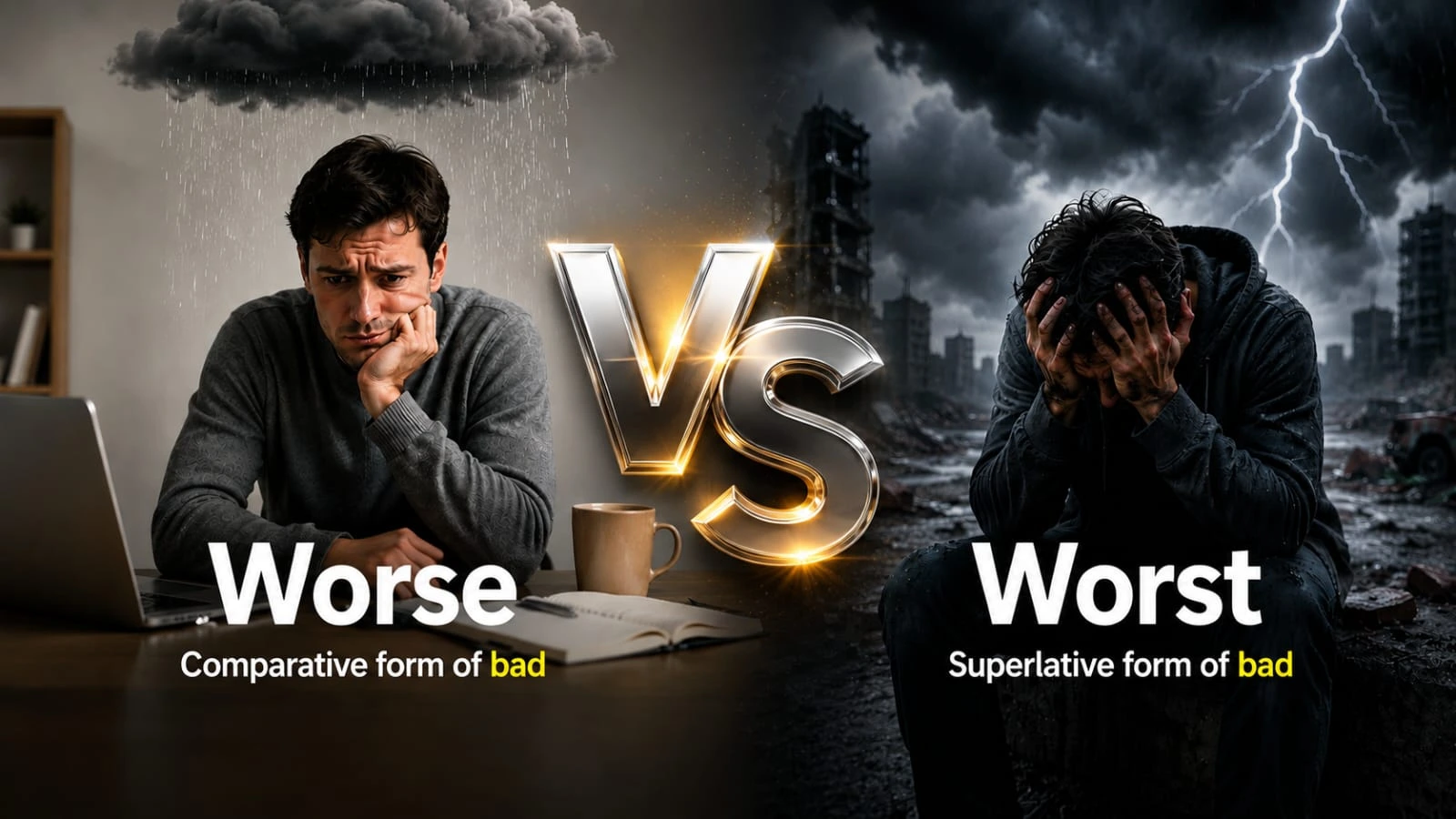
"Worse compares two things and means more bad. Worst means the most bad and is used when something is at the lowest level among three or more things."
Have you ever typed a sentence like “This is the worse movie I’ve ever seen” and then paused?
I have.
The word looked right at first. But the longer I stared at it, the more I doubted myself. After checking a dictionary, I realized I’d mixed up worse and worst, a mistake that many native English speakers make too.
These two words are closely related, which is why they’re easy to confuse. They sound similar, have nearly the same meaning, and both describe something negative. Yet they are not interchangeable.
The good news is that the difference is surprisingly simple. Once you understand one basic grammar rule, you’ll know exactly when to use each word.
In this guide, you’ll learn the meaning of worse and worst, how they compare, why people mix them up, and plenty of real-life examples you can copy with confidence.
Worse or Worst: Quick Answer
The easiest way to remember the difference is this:
- Worse = compares two things.
- Worst = describes the lowest or most negative among three or more things.
Quick examples
✅ My cold is worse today than it was yesterday.
✅ That was the worst meal I’ve ever eaten.
Whenever you’re comparing two, choose worse.
Whenever something ranks at the very bottom, choose worst.
The Origin of Worse and Worst
Although they look different, worse and worst come from the same family of words.
Both are forms of the adjective bad.
English uses irregular comparison, meaning some words don’t simply add -er or -est.
Instead of saying:
- ❌ bad → badder → baddest
English changes the word completely:
- Bad
- Worse
- Worst
This pattern has existed for hundreds of years. It comes from Old English, where different forms were already used to compare degrees of something negative.
Today, English still follows the same rule.
Other irregular comparisons include:
| Positive | Comparative | Superlative |
| Good | Better | Best |
| Bad | Worse | Worst |
| Little | Less | Least |
| Many | More | Most |
Because these words don’t follow the usual grammar pattern, they’re easier to confuse—especially if you’re learning English.
Worse or Worst Explained: Key Differences
Although the words are related, they have different jobs in a sentence.
Worse
Worse is the comparative form of bad.
Use it when comparing two people, things, situations, or ideas.
Examples:
- My headache feels worse today.
- This route is worse than the highway.
- Winter weather is worse in the mountains.
Notice that each sentence compares one thing with another.
Worst
Worst is the superlative form of bad.
Use it when talking about the lowest quality or most negative example in a group.
Examples:
- This is the worst hotel in town.
- She had the worst luck today.
- That was the worst decision we made.
Instead of comparing two items, you’re identifying the one at the bottom of the list.
A simple trick
If your sentence includes words like:
- than
- compared with
- compared to
you probably need worse.
If your sentence includes words like:
- ever
- of all
- in the class
- the entire team
you’ll usually need worst.
Examples:
✔ This book is worse than the first one.
✔ This is the worst book I’ve ever read.
Which One Should You Use?
The answer depends on what you’re trying to say.
If you’re comparing two things
Use worse.
Examples:
- Your cough sounds worse today.
- My phone battery is worse than yours.
- The second exam was worse than the first.
If you’re talking about the lowest level
Use worst.
Examples:
- This was the worst experience of my life.
- February had the worst weather this year.
- He gave the worst performance in the competition.
A helpful memory trick is:
Worse compares. Worst ranks.
Keep that one sentence in mind, and you’ll avoid this mistake almost every time.
Worse and Worst Pronunciation
Knowing the correct pronunciation can make you feel more confident when speaking English.
Worse
worse (wurs)
- Part of speech: Comparative adjective
- Meaning: More bad; used when comparing two things.
Examples:
- My cough is worse today than yesterday.
- The weather became worse after lunch.
Worst
worst (wurst)
- Part of speech: Superlative adjective
- Meaning: The most bad; used for the lowest or most negative one in a group.
Examples:
- This is the worst movie I’ve ever watched.
- She had the worst luck of anyone on the team.
Quick Tip: Both words begin with the same “wor-“ sound. The only difference is that worst ends with a clear “st” sound.
Common Phrases with Worse and Worst
These everyday expressions will help you use worse and worst naturally.
| Phrase | Meaning | Example |
| Worse than | More bad compared with something else | This book is worse than the first one. |
| Get worse | Become more serious or unpleasant | His headache continued to get worse. |
| Make matters worse | Cause an already bad situation to become even worse | To make matters worse, it started raining. |
| If worse comes to worst | If the worst possible situation happens | If worse comes to worst, we’ll take a taxi home. |
| The worst of all | The most negative among everything | That was the worst of all the presentations. |
| At worst | In the most negative possible case | At worst, we’ll arrive a little late. |
| Prepare for the worst | Be ready for the most difficult outcome | It’s wise to prepare for the worst during storms. |
| Worst-case scenario | The most serious possible outcome | Let’s discuss the worst-case scenario before making a decision. |
Quick Memory Trick
- Worse → Compare two things.
- Worst → Choose one from three or more.
Remember: Worse compares. Worst ranks. This simple rule will help you choose the correct word every time.
Common Mistakes with Worse and Worst
Even fluent English speakers mix up these two words. Most mistakes happen because both words describe something negative, but they follow different grammar rules.
Here are the most common errors and how to fix them.
| ❌ Mistake | ✅ Correct | Why? |
| This is the worse movie I’ve ever seen. | This is the worst movie I’ve ever seen. | “Ever” signals a superlative. |
| My headache is the worst than yesterday. | My headache is worse than yesterday. | “Than” compares two things. |
| She had the worse score in the class. | She had the worst score in the class. | You’re talking about the lowest score. |
| Today’s weather is worst than Monday’s. | Today’s weather is worse than Monday’s. | Two-day comparison needs worse. |
| He is the worse player on the team. | He is the worst player on the team. | Ranking within a team requires worst. |
Why do people make this mistake?
- The words sound very similar.
- Both are forms of bad.
- Many learners forget the difference between comparative and superlative adjectives.
- People often write quickly without checking the sentence structure.
Easy rule: If you see than, think worse. If you see the and you’re choosing one from many, think worst.
Worse or Worst in Real-World Examples
Seeing these words in everyday writing makes them much easier to remember.
Professional email
Sales were worse this quarter than last quarter, so we’ll review our marketing strategy.
News headline
Heavy storms create the worst flooding in the region in a decade.
Social media post
I thought Monday was bad, but Tuesday was even worse! 😅
Formal report
Customer satisfaction reached its worst level since the survey began.
Everyday conversation
Friend: Which exam was harder?
You: The math exam was worse than the science exam.
Friend: Which exam was the hardest this year?
You: Math was definitely the worst.
Worse or Worst: Data, Trends & Usage
Search Intent: Informational
People usually search “worse or worst” because they’re unsure which word fits their sentence. The confusion often appears while writing emails, school assignments, blog posts, or social media captions.
Who searches this topic most?
- English learners
- Students
- Teachers
- Content writers
- Bloggers
- Business professionals
Why does this topic stay popular?
Grammar mistakes are easy to make, especially with irregular adjectives. As more people write online every day, they want quick answers that help them sound natural and professional.
A simple grammar mistake can change how confident your writing appears, making this one of the most searched English usage questions.
Worse vs. Worst Comparison Table
| Term | Meaning | Region/Context | Best Used When |
| Bad | Negative quality | Standard English | Describing something generally |
| Worse | More bad | All English varieties | Comparing two things |
| Worst | Most bad | All English varieties | Choosing the lowest among three or more |
Frequently Asked Questions
Q: What is the difference between worse and worst?
A: Worse compares two things, while worst describes the lowest or most negative one in a group of three or more.
Q: Is it “worse than” or “worst than”?
A: The correct phrase is “worse than.” The word worst is not used with than because it isn’t a comparative adjective.
Q: Is “worst” always used with “the”?
A: Usually, yes. Since worst identifies the lowest-ranked item, it often appears with the, such as the worst mistake or the worst day.
Q: Can worse be used without “than”?
A: Yes. The comparison can be implied. For example, “His condition became worse overnight.”
Q: Which word is correct in formal writing?
A: Both worse and worst are correct in formal writing. The right choice depends on whether you’re making a comparison or identifying the lowest level.
Q: Are worse and worst used in British and American English?
A: Yes. Both words have the same meanings and grammar rules in British English and American English.
Q: How can I remember the difference easily?
A: Remember this simple trick: Worse compares. Worst ranks. If you’re comparing two things, use worse. If you’re talking about the lowest of many, use worst.
Conclusion
The difference between worse and worst is easier than it first appears. Once you know that worse is used for comparing two things and worst is used for the lowest or most negative example, choosing the right word becomes almost automatic.
Whenever you write, look for clues in your sentence. If you see than, you probably need worse. If you’re talking about the lowest, the most difficult, or the most negative in a group, worst is almost always the correct choice.
These small grammar details make a big difference. Using the right word helps your writing sound more natural, professional, and confident.
Lead or Led: Meaning, Difference & Examples

As an English language enthusiast, I love diving into the tricky details of word differences and spelling variations. My mission is to explain confusing terms and make them accessible to everyone, helping readers to communicate with clarity and confidence.