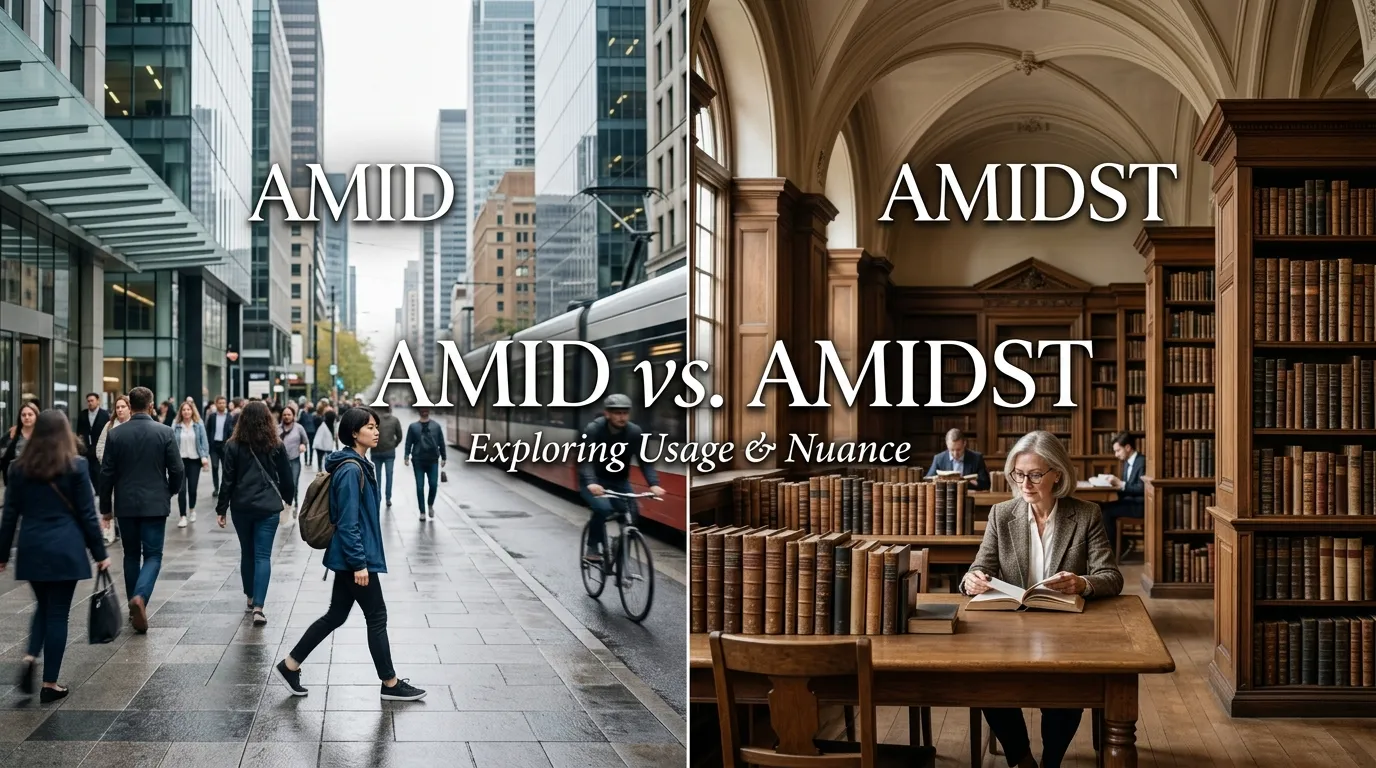
Amid and amidst mean the exact same thing: in the middle of or surrounded by something. For example, you can say “we found the keys amid the trash” or “amidst the trash” without changing the meaning.
Have you ever stopped mid-sentence, your fingers hovering over the keyboard, wondering whether to type amid or amidst? I used to do this all the time during my first year teaching English. I was grading a stack of student essays. One student wrote about a ship lost “amidst the waves.” Another wrote about a town built “amid the mountains.” Both sounded good. But as the teacher, I had to know for sure: which one was actually right?
I spent that evening digging through grammar books. I wanted to see if there was a hidden rule I was missing. What I found surprised me. The confusion around these two words is huge, but the answer is simple. People search for this topic because the two words look and sound different, making us think they must have different rules.
This guide will clear up that confusion for good. You will learn the history of both words, see how they work in real life, and know exactly which one to pick for your own writing.
Amid vs Amidst: Quick Answer
The short truth is that amid and amidst are synonyms. They are prepositions. They mean “in the middle of,” “during,” or “surrounded by.” You can swap one for the other in any sentence.
- The kids played safely amid the tall trees.
- The kids played safely amidst the tall trees.
Both sentences are correct. They tell the reader the exact same thing.
The Origin and Background of Amid and Amidst
To understand why we have both words, we have to look back at the history of the English language.
The word amid came first. It comes from an Old English phrase on middan, which meant “in the middle.” By the 12th century, this became amidde, and later, just amid.
Then came the 13th century. Writers started adding an “s” sound to the end of words. They did this to turn nouns into adverbs. This was called the adverbial genitive. Soon after, they added a “t” sound to make the word sound stronger. This process turned amid into amidst. It is the same reason we have words like while and whilst, or among and amongst.
The variation exists today purely because of geography and style, not because the meanings changed.
Amid and Amidst Explained: Key Differences or Variations
While the definition is identical, the way people use these words depends heavily on where they live and how formal they want to be.
| Term | Meaning | When to Use | Region or Context |
| Amid | In the middle of / surrounded by | Standard everyday writing and news | Preferred in American English |
| Amidst | In the middle of / surrounded by | Literary, poetic, or formal writing | More common in British English |
Let us look at some clear examples to see how they fit into sentences:
- Example 1 (American News): The stock market rose amid fears of a recession.
- Example 2 (British Novel): She stood silently amidst the ruins of the old castle.
Which Version Should You Use?
Choosing between these two words comes down to your audience. Here is a direct recommendation for your writing:
For Students and Academic Writers
Use amid. It is simple, direct, and clean. Modern professors prefer clear language over words that sound old-fashioned.
For Creative Writers and Poets
Use amidst if you want a softer, more classic tone. The extra syllable can help create a specific rhythm in your sentences.
For Business and Global Use
Stick to amid. It is the safest choice for a global audience. It keeps your emails and reports punchy and easy to read.
Common Mistakes with Amid and Amidst
Even though both words are correct, writers still trip over them. Here are the most frequent errors and how to fix them.
1. Using them with plural countable nouns
You should use among when talking about distinct, countable items in a group. Use amid for mass nouns or general situations.
- Incorrect: He sat amid his four friends.
- Correct: He sat among his four friends.
- Correct: He sat amid the crowd.
2. Spelling errors with amidst
People often forget the “st” at the end or mix up the letters.
- Incorrect: The dog ran amids the flock of sheep.
- Correct: The dog ran amidst the flock of sheep.
3. Overusing them to sound smart
Using these words too much makes writing feel heavy.
- Incorrect: I found my pen amid the papers amid the books on my desk.
- Correct: I found my pen among the papers on my desk.
Amid and Amidst in Real-World Examples
Let us see how professional writers use these words in different formats. Notice how the word choice changes based on the platform.
A Professional Email
“Hi Team, amid the current changes to our software system, we are extending the project deadline by two weeks.”
A News Headline
“Local Businesses Thrive Amid Economic Shifts”
A Social Media Post
“Found this beautiful little flower growing amidst the sidewalk cracks today. Nature always finds a way! 🌸”
A Formal Document or Report
“The company managed to increase its market share amid intense competition from international rivals.”
Amid and Amidst: Data, Trends, and Usage
If you look at reading data over the last century, you will see a clear trend. The word amid is much more popular than amidst today.
This is an informational search topic. Most people search for it because they want to avoid making a typo in an essay or work email.
This matters now because modern English values brevity. We like short words. Since amid saves you two letters, it has become the dominant choice in digital spaces and newsrooms around the world.
Standalone Comparison Table
Here is your quick-reference guide for the next time you write.
| Term/Variant | Meaning | Region/Context | Best Used When |
| Amid | In the middle of | Global / US preferred | Writing news, business emails, and essays |
| Amidst | In the middle of | UK / Literary context | Writing fiction, poetry, or formal speeches |
FAQ Section
Q: What does amid mean?
A: It means to be in the middle of something, surrounded by things, or happening during an event. It describes being surrounded by a larger mass or situation.
Q: How do you use amidst correctly?
A: Use it just like you would use the word amid or “in the middle of.” For example, you can say “she smiled amidst her tears.”
Q: Amid vs amidst: what is the difference?
A: There is no difference in meaning. Amid is shorter and more common in American English, while amidst is older and more common in British English.
: Is amidst acceptable in formal writing?
A: Yes, it is fully acceptable. However, many modern style guides suggest using amid instead because it is less pretentious.
Q: Which version is correct: amid or amidst?
A: Both versions are completely correct. They are just spelling variations of the same underlying preposition.
Q: Where does the word amid come from?
A: It comes from the Old English phrase on middan, which meant “in the middle.” The “st” was added later in the Middle Ages.
Q: Can amid be used in a legal document?
A: Yes, amid is often used in legal documents to describe the circumstances surrounding an event or agreement.
Conclusion
To wrap things up, remember these three simple facts. First, amid and amidst share the exact same definition. Second, amid is the preferred choice for modern, everyday writing, especially in America. Third, amidst works well if you want a poetic or old-school British feel.
My final advice is to stick with amid for your daily work. It keeps your sentences short and clear for your readers.
Bookmark this guide so you never second-guess amid or amidst again.
Read More: Fulfilment or Fulfillment: Real Guide to Spelling It Right

I am an English language expert dedicated to exploring the nuances of words and their meanings. Through detailed comparisons and practical insights, I help readers understand the finer points of language and use words with accuracy and confidence.