
Lay is used for the present tense when you put or place something somewhere, while laid is used for the past tense and past participle. Remember: lay → laid → laid, and “layed” is not correct in standard English
Choosing between lay or laid can stop even a skilled writer. Both words look simple. They also come from the same verb. Yet they cannot always be used in the same place.
People often search for lay or laid because they are not sure which word shows the present and which shows the past. The problem gets harder because lay is also the past form of another verb: lie. This causes mistakes such as “I laid on the bed” or “She lay the book on the desk yesterday.”
The basic rule is simple. Use lay when you place something somewhere now. Use laid when you placed it somewhere in the past. Both forms usually need an object. You lay or laid a book, phone, blanket, plan, or rule.
This guide explains the difference in plain English. You will learn the main rule, word history, common mistakes, regional use, and examples for work and daily life. By the end, you will know which form fits your sentence.
Lay or Laid – Quick Answer
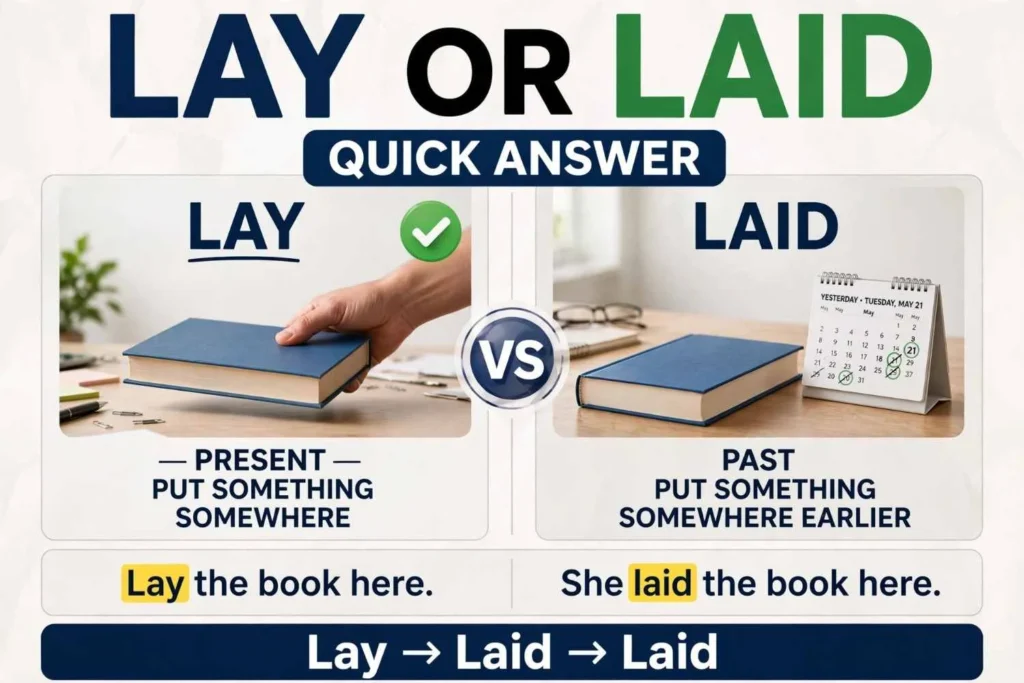
Use lay for the present tense. Use laid for the past tense and past participle.
- Present: Please lay the keys on the table.
- Past: She laid the keys on the table.
- Past participle: She has laid the keys on the table.
The verb lay means to put or place someone or something somewhere. It needs an object. That object receives the action. Cambridge and Merriam-Webster both define lay as placing something down, while laid is its past form.
A simple test can help:
Can you name the thing being placed?
If yes, use a form of lay.
- Lay the book here.
- He laid the baby in the crib.
- We have laid the carpet.
Do not write layed. The correct past form is always laid.
Lay or Laid Comparison Table
| Form | Tense | Meaning | Example |
| Lay | Present | Put something somewhere | Lay the coat on the chair. |
| Lays | Present, third person | Puts something somewhere | She lays the files on my desk. |
| Laying | Present participle | Putting something somewhere | He is laying the tiles. |
| Laid | Past | Put something somewhere earlier | I laid the letter beside you. |
| Laid | Past participle | Has or had put something somewhere | We have laid the plan before them. |
| Layed | Incorrect | Not a standard form | Incorrect: She layed the book down. |
The correct verb pattern is:
Lay → laid → laid
Example:
- Today, I lay the tools on the bench.
- Yesterday, I laid the tools on the bench.
- I have laid the tools there many times.
The Origin of Lay or Laid
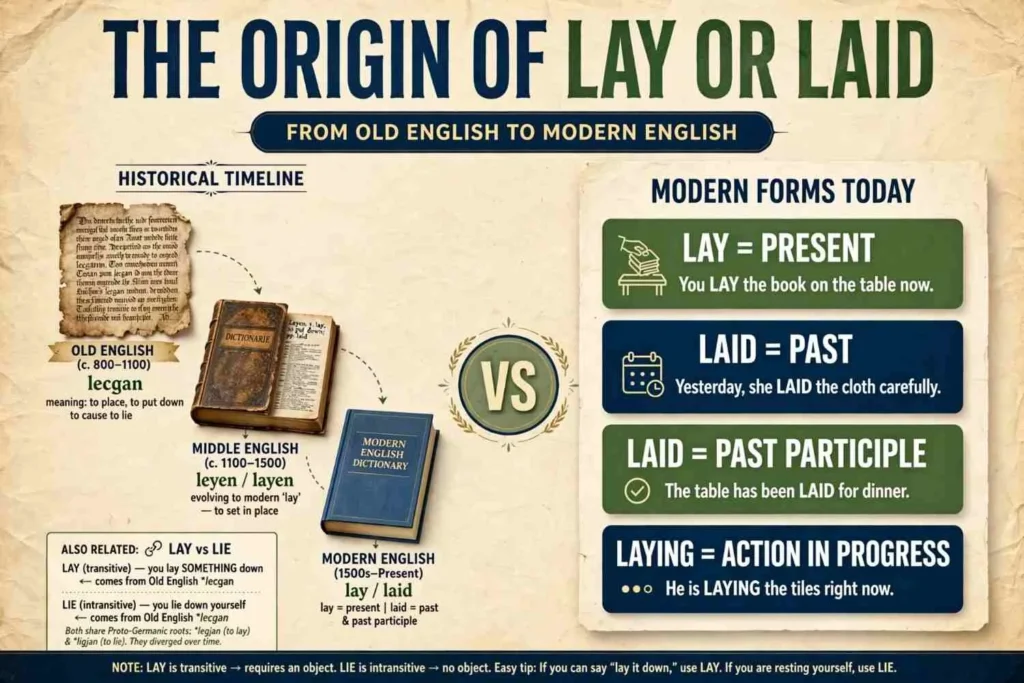
The word lay has very old roots. It came through Middle English from the Old English word lecgan. That word meant to place, put down, or cause something to rest.
It is also linked to an old root connected with the verb lie. In simple terms, lay once carried the idea of causing something to lie down. This old link helps explain why lay and lie still look and sound similar.
Over time, the forms became:
- Lay for the present
- Laid for the past
- Laid for the past participle
- Laying for an action in progress
The confusion is not new. English speakers have mixed up lay and lie for hundreds of years. One reason is that lay has two grammar jobs.
It is the present form of lay:
- I lay the phone on the desk each day.
It is also the past form of lie:
- Yesterday, I lay on the sofa.
This overlap makes the rule harder than it first appears.
British English vs American English Spelling
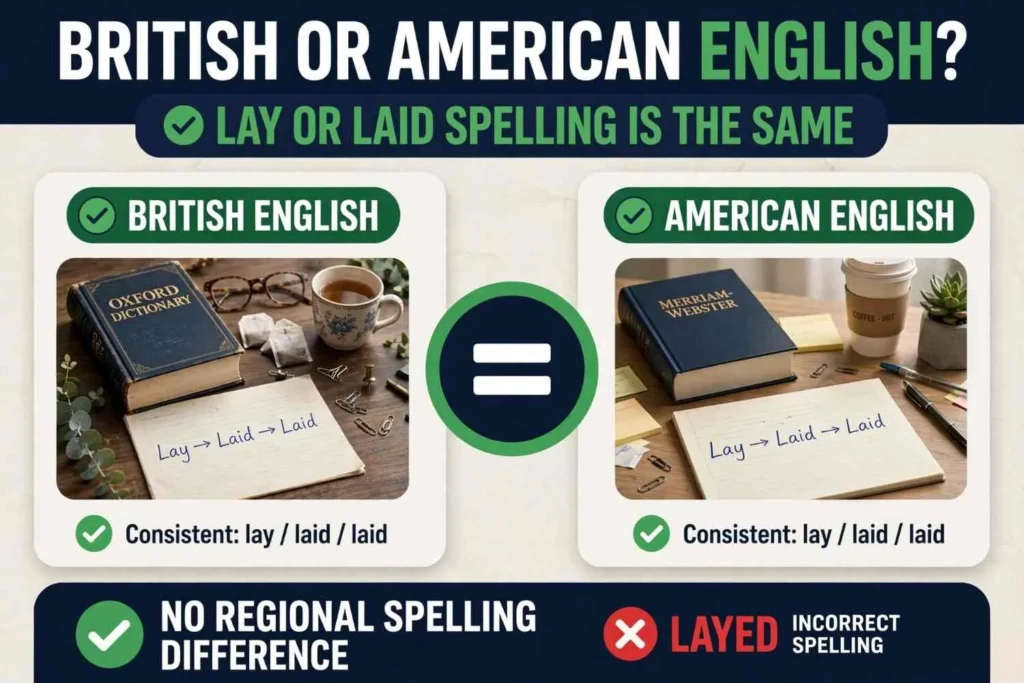
There is no British and American spelling difference between lay or laid. Writers in the United States, United Kingdom, Canada, Australia, and other English-speaking regions use the same standard forms.
Both British and American English follow this pattern:
Lay → laid → laid
Cambridge gives laid as the correct past form in British grammar. Collins lists the same form in both British and American English.
| Meaning | British English | American English |
| Present action | Lay the book down. | Lay the book down. |
| Past action | She laid the book down. | She laid the book down. |
| Past participle | She has laid it down. | She has laid it down. |
| Incorrect spelling | Layed | Layed |
| Ongoing action | Laying | Laying |
The difference is not regional. It is based on tense.
Informal speech may sound different in some places. People may say “I laid down” when they mean that they rested. This is common in casual speech, but careful written English uses “I lay down” for a past act of resting.
Which Spelling Should You Use?

Your choice between lay or laid should depend on time.
Use Lay for the Present
Use lay when the action happens now or happens often.
- Lay your bag beside the door.
- I lay fresh paper in the printer each morning.
- Workers lay bricks in straight lines.
- Chickens lay eggs.
The sentence should contain an object. Ask, “Lay what?”
Use Laid for the Past
Use laid when the action is complete.
- She laid her bag beside the door.
- I laid fresh paper in the printer this morning.
- The workers laid the bricks yesterday.
- The chicken laid an egg.
Use Laid After Has, Have, or Had
Use laid as the past participle.
- He has laid the papers on my desk.
- We have laid a strong base.
- They had laid the pipes before winter.
Advice for US Writers
Use lay for a present act of placing something. Use laid for a past act. Follow the same rule in school, business, news, and formal writing.
Advice for UK and Commonwealth Writers
The same rule applies. Do not use layed. Use laid as the past form in British, Canadian, Australian, Pakistani, Indian, and other Commonwealth English.
Advice for Global Content
Use standard forms when writing for an international audience. They are understood across all major forms of English.
Common Mistakes with Lay or Laid
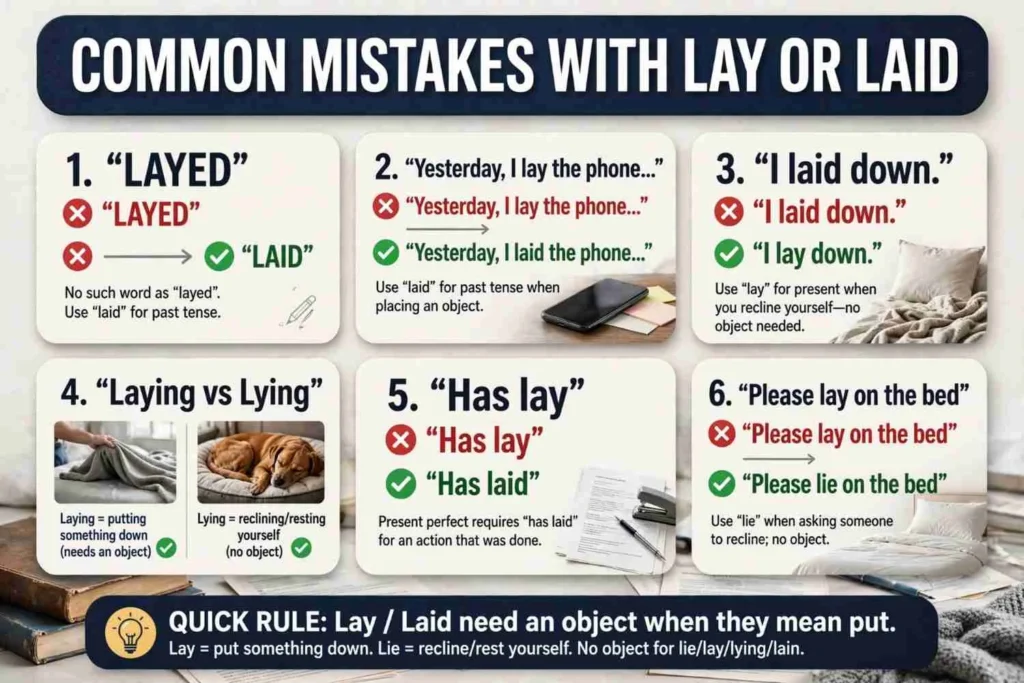
Mistake 1: Using Layed
Incorrect:
- She layed the blanket on the floor.
Correct:
- She laid the blanket on the floor.
Although many English past-tense verbs end in -ed, lay changes to laid.
Mistake 2: Using Lay for a Past Action
Incorrect:
- Yesterday, I lay the phone on the desk.
Correct:
- Yesterday, I laid the phone on the desk.
The phone is an object. The action happened yesterday, so laid is correct.
Mistake 3: Using Laid Without an Object
Incorrect in formal English:
- I laid down for an hour.
Correct:
- I lay down for an hour.
Here, no object was placed. The person rested. The verb is lie, whose past form is lay.
Mistake 4: Confusing Laying and Lying
- Laying means placing something.
- Lying means resting in a flat position.
Correct:
- She is laying the blanket on the bed.
- The dog is lying on the blanket.
Mistake 5: Writing Has Lay
Incorrect:
- She has lay the papers on the desk.
Correct:
- She has laid the papers on the desk.
After has, have, or had, use laid.
Mistake 6: Forgetting the Object
Incorrect:
- Please lay on the bed.
Correct:
- Please lie on the bed.
- Please lay the baby on the bed.
The first correct sentence has no object. The second has an object: the baby.
Lay or Laid in Everyday Examples
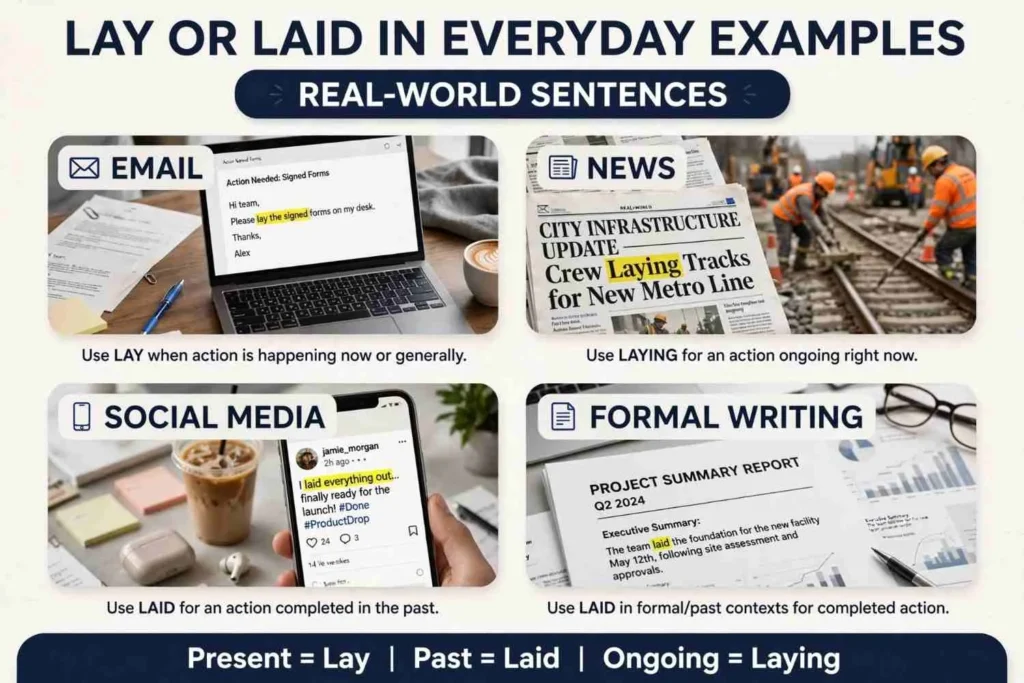
The difference between lay or laid appears in many forms of writing.
Email Examples
Present:
Please lay the signed forms on my desk.
Past:
I laid the signed forms on your desk this morning.
Past participle:
We have laid all the facts before the client.
News Examples
Present:
Workers lay new tracks across the city.
Past:
Workers laid new tracks during the weekend.
Formal phrase:
The court laid down clear rules for the case.
Social Media Examples
Present:
I always lay my clothes out the night before.
Past:
I laid everything out, but I still forgot my shoes.
Ongoing action:
We are laying the final tiles today.
Formal Writing Examples
- The report lays out the main risks.
- The team laid the foundation for future growth.
- The company has laid down new safety rules.
- Engineers laid the cable under the road.
- The evidence was laid before the court.
Daily Conversation Examples
- Lay your phone on the counter.
- Who laid this towel here?
- I have laid your clothes on the bed.
- She laid her head on his shoulder.
- They are laying a new floor.
Lay or Laid – Google Trends and Usage Data

Google Trends can compare interest in lay and laid over time and across regions. However, its numbers are relative. A score of 100 marks the highest point of interest for the chosen place and time. It does not show the total number of searches. Regional results also depend on each term’s share of all searches in that location.
The word lay normally covers more search contexts. People may search for:
- Lay or lie
- Lay meaning
- Lay down
- Lay person
- How to lay tiles
- How to lay flooring
- Lay an egg
The word laid has narrower grammar use, but it can appear in searches such as:
- Laid meaning
- Lay or laid
- Laid down
- Laid off
- Laid-back
- Has laid or has lay
This means a direct chart does not only measure grammar questions. It may include jobs, building work, common phrases, music, and other topics.
Interest can also change by country. English-speaking and English-learning regions may show different patterns. The United States, United Kingdom, Canada, Australia, India, and Pakistan may use the words in different search contexts. Yet the grammar rule stays the same in every region.
For useful research, compare the full phrases “lay or laid,” “lay vs laid,” and “lay or lie.” These phrases show grammar intent more clearly than comparing the single words alone.
Lay, Laid, Lie, and Lain Compared
The largest problem is often not lay or laid. It is the difference between lay and lie.
| Meaning | Present | Past | Past Participle | Example |
| Put something down | Lay | Laid | Laid | She laid the book down. |
| Rest in a flat position | Lie | Lay | Lain | She lay on the bed. |
| Say something false | Lie | Lied | Lied | He lied about the call. |
Remember:
- You lay something down.
- You lie down yourself.
- Yesterday, you laid something down.
- Yesterday, you lay down yourself.
Merriam-Webster and Cambridge both note that lay needs an object, while lie does not. They also confirm that laid is the past form of lay.
Read More: Shinny or Shiny: Which Spelling Is Correct?
Frequently Asked Questions
Is It Lay or Laid on the Table?
Use lay for a present action:
- Lay the book on the table.
Use laid for a past action:
- She laid the book on the table.
Is Layed a Correct Word?
No. Layed is not the standard past form of lay. The correct word is laid.
Incorrect:
- He layed the tiles.
Correct:
- He laid the tiles.
Is It I Lay Down or I Laid Down?
For resting, use:
- I lie down every afternoon.
- I lay down yesterday.
- I have lain down.
“I laid down” needs an object:
- I laid the baby down.
Is It Has Laid or Has Lay?
Use has laid.
Correct:
- She has laid the keys on the desk.
Incorrect:
- She has lay the keys on the desk.
Is It Lay the Foundation or Laid the Foundation?
Both can be correct.
Use lay the foundation for the present or future:
- We will lay the foundation tomorrow.
Use laid the foundation for the past:
- The team laid the foundation last year.
Is It Laying or Laiding?
The correct form is laying.
- They are laying new carpet.
Do not write laiding or layying.
Is Laid Used in British English?
Yes. Laid is the standard past and past participle form of lay in both British and American English.
What Is an Easy Way to Remember Lay or Laid?
Look for a time word.
- Today or usually: lay
- Yesterday or last week: laid
- Has, have, or had: laid
Then check for an object. You must lay or laid something.
Conclusion
The difference between lay or laid is mainly about time. Use lay when someone puts or places something somewhere in the present. Use laid when the action happened in the past. Also use laid after has, have, or had.
The verb normally needs an object. You can lay a book, lay a blanket, lay a floor, or lay a plan. Yesterday, you laid those things. The spelling layed is not correct in standard English.
Be careful when talking about rest. A person lies down in the present and lay down in the past. This is why “I lay on the bed yesterday” is correct. However, “I laid the baby on the bed” is also correct because the baby is the object.
British and American writers follow the same rule. There is no regional spelling change. For clear professional writing, check the tense and find the object. These two steps will help you choose the right word almost every time.

Hi, I’m Shafqat Rehman. I write easy-to-follow guides about spelling differences, grammar, commonly confused words, comparison keywords, and British and American English variations. I enjoy breaking down confusing language topics and explaining them with clear examples. My aim is to help readers understand English differences and use the right words naturally and confidently.