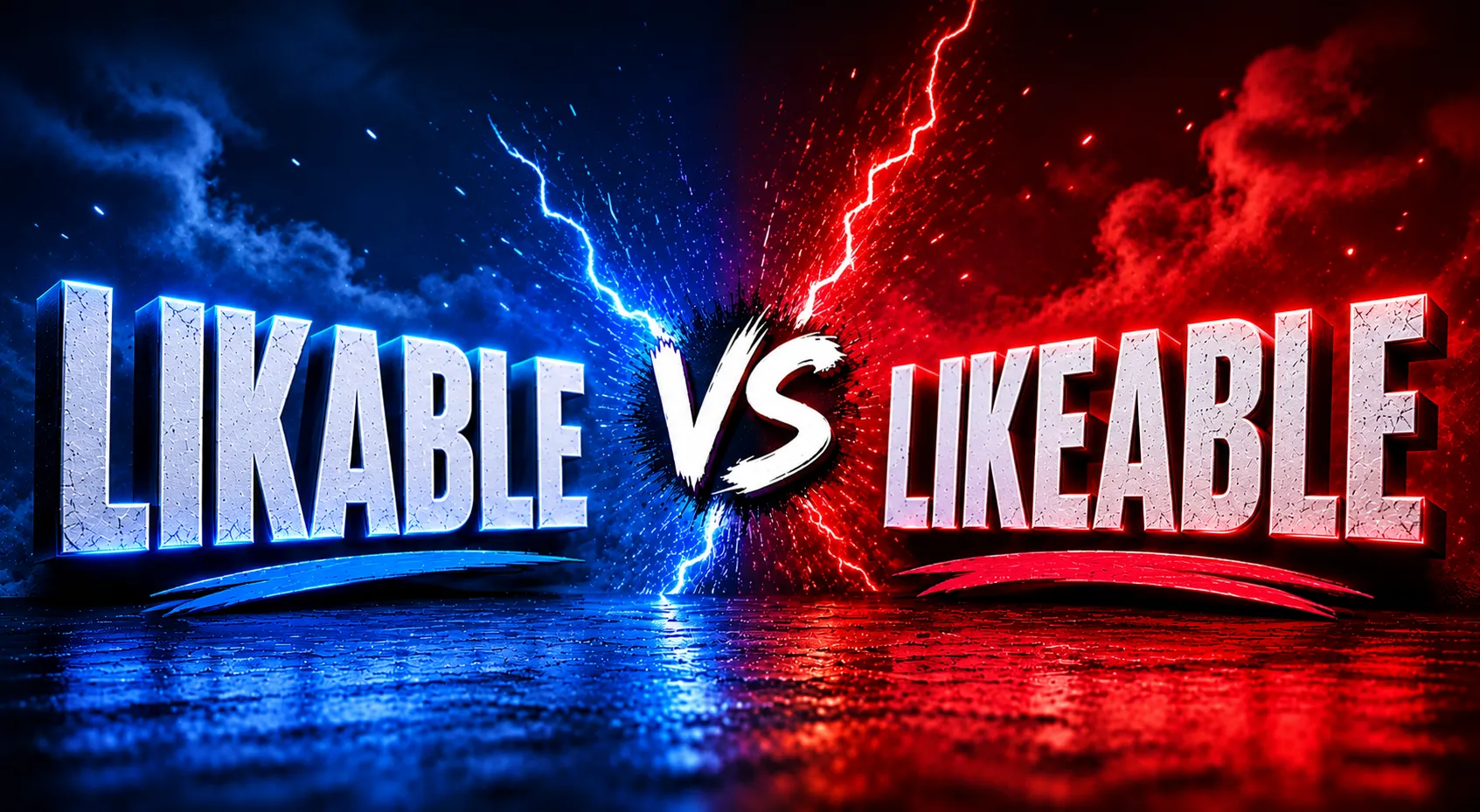
Likable and likeable mean the same thing: someone or something that is easy to like. Likable is the more common spelling, especially in American English, while likeable is also correct and often seen in British English.
A few years ago, I was editing a blog post written by one of my students. The article described a famous actor as a “very likeable person.” A few paragraphs later, the same writer used “likable.”
Neither spelling was wrong.
The problem was consistency.
The student stopped and asked a question I hear all the time:
“Should I write likable or likeable?”
If you’ve searched for the same answer, you’re not alone. Many English words have more than one accepted spelling. That can make writing feel confusing, especially when different dictionaries and websites show different versions.
The good news is that this is not a grammar mistake. Both spellings are accepted in modern English.
The real challenge is knowing which version is more common, which one suits your audience, and how to stay consistent in your writing.
Let’s break it down in a simple way so you’ll never hesitate over likable or likeable again.
Likable or Likeable : Quick Answer
Both likable and likeable describe a person, thing, or character that people find pleasant and easy to like.
The meaning is exactly the same.
Examples
- She is a very likable teacher.
- She is a very likeable teacher.
Both sentences are correct.
The choice comes down to spelling preference and audience.
The Origin / Background of Likable or Likeable
The word comes from the verb like.
English often creates adjectives by adding suffixes such as:
- -able
- -ible
For many years, writers used both:
- likable
- likeable
The shorter spelling, likable, became increasingly popular because it follows a simpler pattern.
Many modern dictionaries now list likable as the preferred spelling.
However, likeable never disappeared.
It remains accepted and continues to appear in books, articles, and publications around the world.
This is why both versions still exist today.
Likable or Likeable Explained : Key Differences or Variations
There is no difference in meaning.
The distinction is mainly about spelling style.
| Term | Meaning | When to Use | Region/Context |
| Likable | Easy to like | Modern and widely preferred spelling | American English and global usage |
| Likeable | Easy to like | Alternative accepted spelling | Often seen in British English |
Example 1
- The new manager is very likable.
Example 2
- The new manager is very likeable.
Example 3
- The movie’s main character is highly likable.
Example 4
- The movie’s main character is highly likeable.
The meaning stays exactly the same.
Which Version Should You Use?
The best choice depends on your audience.
For Students
Use likable.
Many modern dictionaries and educational resources prefer this spelling.
For American Audiences
Use likable.
It is the dominant spelling in American English.
For British Audiences
Both forms are accepted.
You may see likeable more often in British publications.
For Content Writers and Bloggers
Use likable if you want the most widely recognized version.
It tends to appear more frequently in online content.
For International Audiences
Choose one spelling and use it consistently throughout your writing.
Consistency always looks professional.
Common Mistakes with Likable or Likeable
Mistake #1: Mixing Both Spellings
| Incorrect | Correct |
| The character is likable. Later, the character becomes likeable. | Use one spelling throughout the document. |
Why it happens: Writers switch between sources with different spelling preferences.
Mistake #2: Assuming One Is Wrong
| Incorrect Belief | Correct Fact |
| Likeable is incorrect. | Likeable is an accepted spelling. |
Why it happens: Many people only encounter the shorter version.
Mistake #3: Thinking the Meanings Differ
| Incorrect Belief | Correct Fact |
| Likable and likeable have different meanings. | They mean exactly the same thing. |
Why it happens: Different spellings often suggest different meanings.
Mistake #4: Ignoring Style Guides
| Less Effective | Better Approach |
| Switching spellings randomly | Follow one style guide consistently |
Why it happens: Writers focus on words individually rather than document consistency.
Mistake #5: Overusing the Word
| Less Natural | More Natural |
| He is likable, likable, and very likable. | He is friendly, charming, and likable. |
Why it happens: Writers repeat the same adjective too often.
Likable or Likeable in Real-World Examples
Professional Email
Sarah has been a highly likable team member and works well with clients.
News Headline
Why Voters Find the Candidate So Likable
Social Media Post
This puppy is the most likeable pet I’ve ever met.
Formal Report
Participants described the speaker as knowledgeable and likable.
Likable or Likeable : Data, Trends & Usage
The phrase likable or likeable is frequently searched by people who want spelling guidance.
Search Intent
Primary Search Intent: Informational
Users typically want to know:
- Which spelling is correct
- Whether one version is preferred
- Which form should be used in writing
Who Searches Most?
Common searchers include:
- Students
- English learners
- Bloggers
- Editors
- Business writers
- Content creators
Geographic Trends
Likable is especially common in:
- United States
- Canada
- International digital content
Likeable appears more often in:
- United Kingdom
- Australia
- Some British-style publications
Why This Matters Today
Online writing reaches global audiences.
A single article may be read by people from many countries. Understanding spelling preferences helps writers create polished and professional content.
Comparison Table
| Term/Variant | Meaning | Region/Context | Best Used When |
| Likable | Easy to like | American English, global content | Most modern writing |
| Likeable | Easy to like | British English, traditional usage | British-focused audiences |
| Likable Person | Pleasant individual | General usage | Modern publications |
| Likeable Person | Pleasant individual | British-style writing | UK publications |
Frequently Asked Questions
Q: What does likable or likeable mean?
A: Both words describe someone or something that is easy to like. The meanings are identical.
Q: How do you use likable or likeable correctly?
A: Use either spelling when describing a pleasant or appealing person, character, or thing. Stay consistent throughout your writing.
Q: Likable vs likeable : what’s the difference?
A: The difference is spelling only. There is no difference in meaning or pronunciation.
Q: Is likable acceptable in formal writing?
A: Yes. It is widely accepted in formal, academic, and professional writing.
Q: Which version is correct : likable or likeable?
A: Both are correct. However, likable is generally more common today.
Q: Where does the word come from?
A: It comes from the verb like, combined with the adjective-forming suffix -able.
Q: Can likable be used in business writing?
A: Yes. It is often used to describe employees, leaders, speakers, or public figures in professional contexts.
Conclusion
The question of likable or likeable is easier than it first appears.
Both spellings are correct. Both have the same meaning. Both describe a person or thing that people enjoy and appreciate.
Here are the key takeaways:
- Likable and likeable mean the same thing.
- Likable is generally more common today.
- Likeable remains an accepted spelling.
- Consistency matters more than the version you choose.
If you’re writing for a broad audience, likable is usually the safest choice. It appears more frequently in modern dictionaries, websites, and publications.
Still, if your style guide or audience prefers likeable, you can use it confidently.
Now you know exactly how to use likable or likeable. Bookmark this guide so you never second-guess the spelling again, and share it with someone who has been wondering which version is correct.
Read More: Sip or Sin: Easy Guide to the Real Difference

SEO enthusiast focused on improving website visibility and driving organic growth through effective optimization strategies.