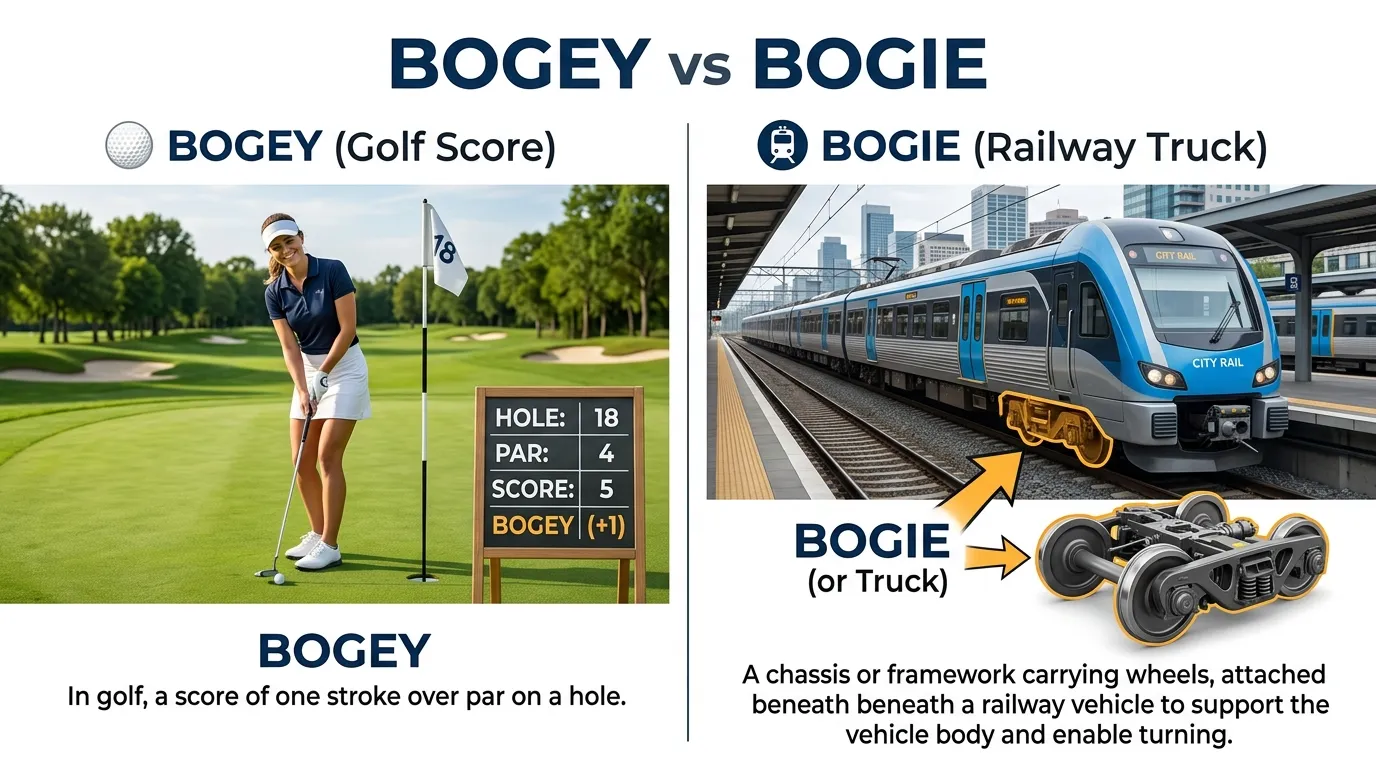
Bogey and bogie are both correct words, but they are used in different situations. Bogey is common in golf and military contexts, while bogie is often used for train wheel assemblies and some British English meanings.
A few years ago, I was editing a sports article when I spotted the word bogie in a golf story. At first, I thought it was a typo. Then I checked several dictionaries and discovered something interesting. Both bogey and bogie are real words, but they do not always mean the same thing.
This is where many people get confused.
You may see bogey in a golf tournament report. Then you might read about a train bogie in an engineering article. Some people even use the words interchangeably because they sound alike.
The confusion grows because both spellings have a shared history and different meanings depending on the country and context.
If you have ever wondered which spelling is correct, when to use each one, and whether they mean the same thing, you are in the right place. By the end of this guide, you will know exactly when to write bogey and when to write bogie.
Bogey or Bogie: Quick Answer
The correct choice depends on the meaning.
- Bogey is usually used in golf.
- Bogey can also mean a suspicious or unidentified target.
- Bogie is commonly used for a train wheel assembly.
- Bogie is often preferred in certain British English uses.
Examples
- She scored a bogey on the fifth hole.
- The fighter pilot reported an unidentified bogey.
- Engineers inspected the train bogie before departure.
The words look similar, but context determines which one is correct.
The Origin / Background of Bogey or Bogie
The history of these words is surprisingly interesting.
The word bogey dates back to the 1800s. It originally referred to a frightening or mysterious figure, similar to a bogeyman.
Later, golfers adopted the term. In early golf, a bogey score represented a target score that a good player should achieve.
Over time, golf scoring changed. Today, a bogey means one stroke over par on a hole.
The spelling bogie developed as a variation. In railway engineering, it became the standard term for the wheeled framework underneath train cars.
Because both words share similar roots and pronunciation, confusion still exists today.
Bogey or Bogie Explained: Key Differences
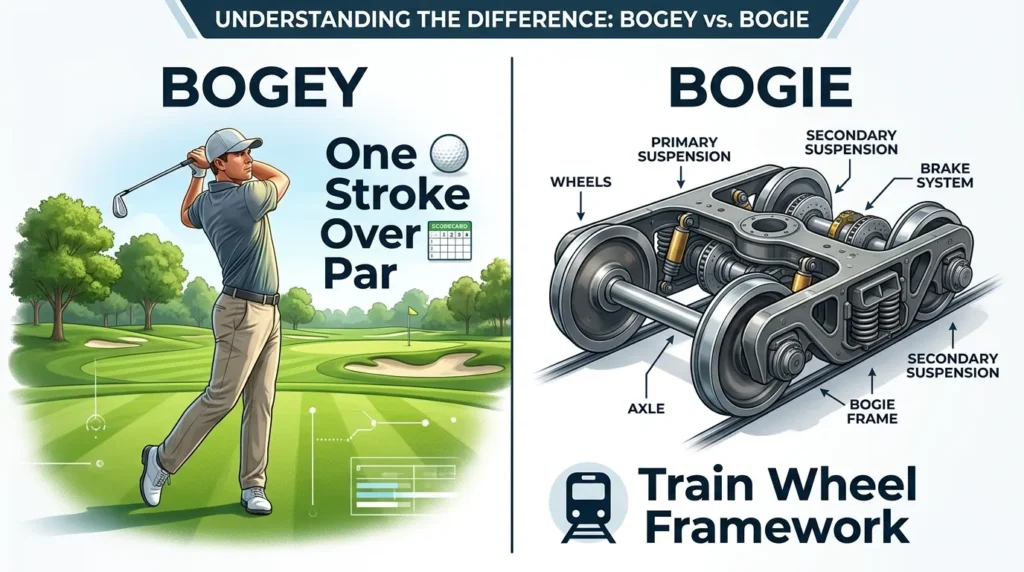
The biggest difference is the context in which each word appears.
| Term | Meaning | When to Use | Region/Context |
| Bogey | One stroke over par in golf | Golf writing and sports coverage | Worldwide |
| Bogey | Unknown aircraft or target | Military and aviation | Worldwide |
| Bogie | Wheel assembly under a train | Railway and engineering topics | Worldwide |
| Bogie | Alternate spelling in some British uses | Informal British English | UK |
Golf Meaning
In golf, bogey is the standard spelling.
Example:
- He made a bogey on the final hole.
Military Meaning
Military personnel often use bogey for an unidentified object.
Example:
- Radar detected a possible bogey approaching the area.
Railway Meaning
In transportation and engineering, bogie is correct.
Example:
- The damaged bogie was replaced during maintenance.
Which Version Should You Use?
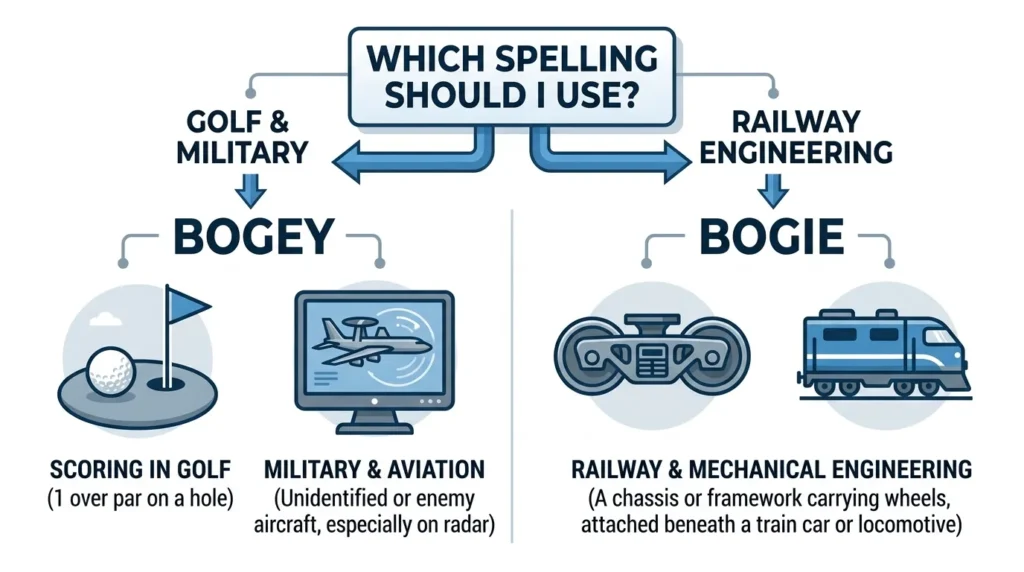
The right choice depends on your audience.
For Golf Fans
Use bogey.
This is the accepted spelling in golf around the world.
Example:
- The player avoided a double bogey.
For Aviation or Military Writing
Use bogey.
This is the standard term for an unidentified aircraft or target.
Example:
- The pilot tracked the bogey on radar.
For Engineers and Railway Professionals
Use bogie.
This spelling refers to train wheel systems.
Example:
- The railway company upgraded the bogie design.
For Global Readers
Follow the context rather than the region.
If discussing golf, choose bogey.
If discussing trains, choose bogie.
Common Mistakes with Bogey or Bogie
Many writers mix these words because they sound identical.
Here are some common mistakes.
| Mistake | Correction |
| He scored a bogie on the hole. | He scored a bogey on the hole. |
| The train bogey needed repair. | The train bogie needed repair. |
| The radar found a bogie aircraft. | The radar found a bogey aircraft. |
| Engineers checked the bogey wheels. | Engineers checked the bogie wheels. |
Why These Mistakes Happen
- The words sound the same.
- Spell check tools may miss the error.
- People assume one spelling fits every meaning.
- British and American usage can vary.
A simple trick is to remember:
Golf and military = bogey
Railways and trains = bogie
Bogey or Bogie in Real World Examples

Professional Email
“During yesterday’s tournament, I recorded only one bogey, which helped improve my final score.”
News Headline
“Golfer Recovers After Early Bogey to Win Championship”
Social Media Post
“Made a bogey on the last hole, but still had a great round today!”
Formal Report
“The inspection found wear on the front bogie, requiring replacement before service resumes.”
These examples show how the correct spelling depends entirely on context.
Bogey or Bogie: Data, Trends & Usage
People search for bogey or bogie because the words sound alike but have different meanings.
Search Intent
The search intent is primarily informational.
Readers want to know:
- Which spelling is correct
- What each word means
- When to use each version
- Whether they are interchangeable
Popular Audiences
The topic is most relevant to:
- Golf players
- Students
- Writers and editors
- Railway professionals
- Aviation enthusiasts
Regional Interest
- Golf related searches often use bogey.
- Railway searches frequently use bogie.
- British readers encounter both forms more often.
Why It Matters Today
Online communication moves fast. A single spelling mistake can change the meaning of a sentence. Understanding the difference helps your writing look more professional and accurate.
Bogey vs Bogie Comparison Table
| Term/Variant | Meaning | Region/Context | Best Used When |
| Bogey | One stroke over par in golf | Golf worldwide | Discussing golf scores |
| Bogey | Unidentified target or aircraft | Military and aviation | Discussing radar or defense topics |
| Bogie | Train wheel framework | Railway engineering | Discussing trains and rail systems |
| Bogie | Alternate spelling in some British uses | UK English | Limited British contexts |
Frequently Asked Questions
Q: What does bogey mean?
A: In golf, a bogey means one stroke over par on a hole. It can also mean an unidentified aircraft or target in military language.
Q: What does bogie mean?
A: A bogie is usually the wheeled framework underneath a train carriage or locomotive. It supports the vehicle and helps it move smoothly.
Q: How do you use bogey correctly?
A: Use bogey when talking about golf scores or military targets. The meaning depends on the context of the sentence.
Q: Bogey vs bogie: what’s the difference?
A: Bogey is mainly used in golf and military language. Bogie is primarily used in railway engineering and transportation.
Q: Is bogey acceptable in formal writing?
A: Yes. It is completely acceptable when used correctly in sports, aviation, or military contexts.
Q: Which version is correct: bogey or bogie?
A: Both are correct. The correct choice depends on the meaning you want to express.
Q: Where does bogey come from?
A: The word originated in the nineteenth century and was first associated with an imaginary figure before gaining new meanings in golf and military language.
Q: Can bogie be used in railway engineering?
A: Yes. In fact, bogie is the standard engineering term for the wheel assembly found beneath railway vehicles.
Conclusion
The debate between bogey and bogie becomes simple once you understand the context.
Remember these key points:
- Bogey is the standard golf term.
- Bogey is also used in military and aviation language.
- Bogie refers to the wheel assembly beneath trains.
- Both spellings are correct, but they are not always interchangeable.
When writing, think about the subject first. If you are discussing golf scores or radar targets, choose bogey. If you are talking about railways and train equipment, choose bogie.
Getting this small detail right makes your writing clearer and more professional.
Now you know exactly how to use bogey and bogie. Bookmark this guide so you never second guess these words again, and share it with someone who has been confused by them.
Read more: Until or Till: The Easy Guide to Using Them Correctly

I am an English language writer dedicated to creating clear, accurate, and easy-to-understand content. My goal is to help readers build confidence in their language and communication skills.