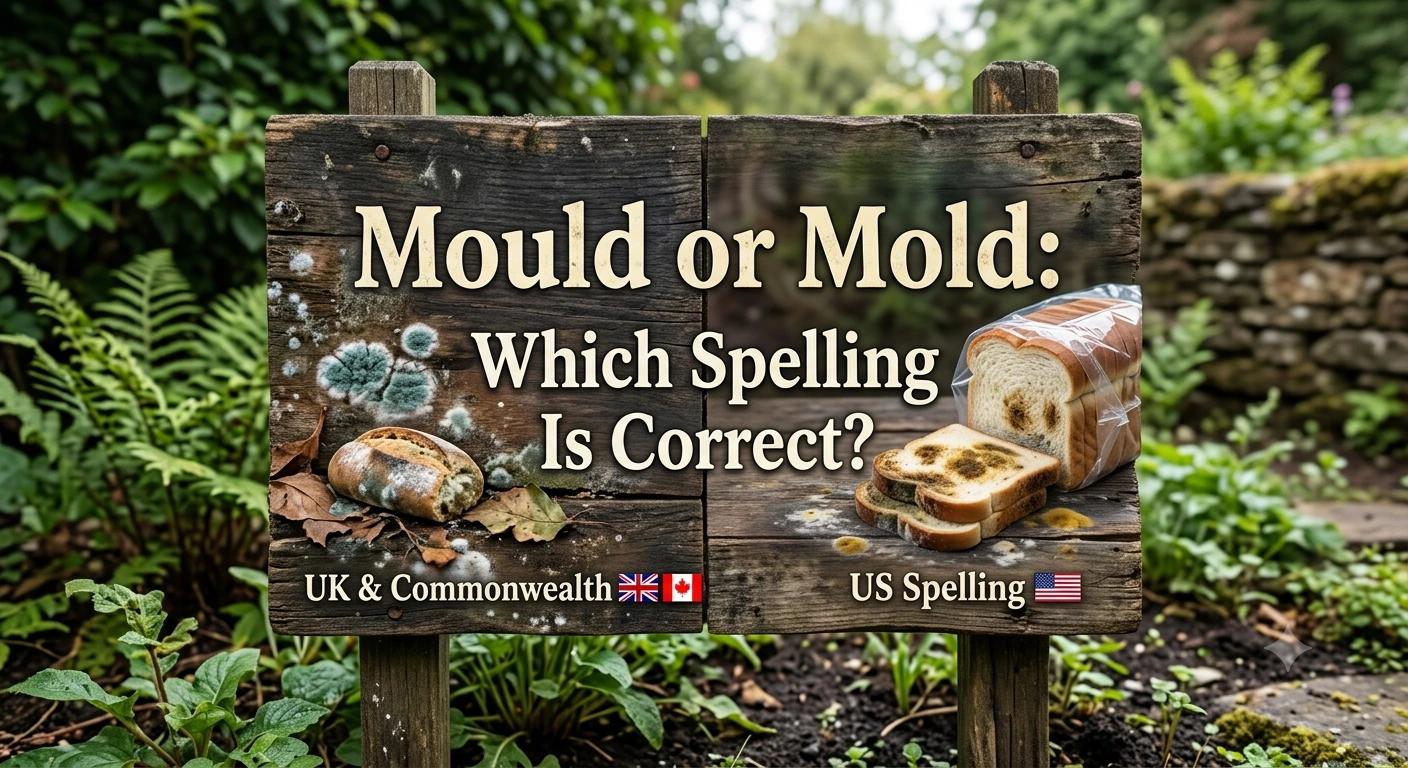
Mould (British English) and mold (American English) are different spellings of the same word. It refers to a type of fungus that grows in damp places, forming a fuzzy layer on food, walls, or other surfaces. The word can also mean a hollow shape used to form objects or the act of shaping something.
Have you ever seen the words mould and mold and wondered which one is correct? If so, you’re not alone. Thousands of people search for “mould or mold” every month because they encounter both spellings in books, articles, product descriptions, health information, and construction guides.
The confusion comes from the fact that both words are correct. They have the same meaning but are used in different regions of the world. Whether you are talking about fungus growing on food, a container used for shaping objects, or the act of forming something into a shape, the choice between mould and mold usually depends on the type of English you use.
Understanding the difference is important for writers, students, businesses, and website owners who want to communicate clearly with their target audience. This guide explains the meaning of both spellings, their history, regional usage, common mistakes, and practical examples.
By the end of this article, you’ll know exactly when to use mould and when to use mold, helping you write with confidence and accuracy.
Mould or Mold: Quick Answer
Both “mould” and “mold” are correct.
The difference is regional:
- Mould = British English spelling
- Mold = American English spelling
Examples
British English
- There is mould on the bathroom wall.
- The cake mixture was poured into a mould.
American English
- There is mold on the bathroom wall.
- The cake mixture was poured into a mold.
The meaning stays exactly the same.
📔The Origin of Mould or Mold
The word comes from Old French and Germanic roots that referred to shaping, forming, or creating something.
Over time, English adopted the word with different spellings.
Historical Development
- Early English used several spelling forms.
- British English eventually standardized mould.
- American English simplified the spelling to mold.
Why the Difference Exists
Many American spellings became shorter during spelling reforms in the 18th and 19th centuries.
Similar examples include:
| British English | American English |
| Mould | Mold |
| Colour | Color |
| Honour | Honor |
| Labour | Labor |
This is why both spellings continue to exist today.
British English vs American English Spelling
The main difference is the extra “u” in British English.
Comparison Table
| Meaning | British English | American English |
| Fungus | Mould | Mold |
| Shaping Container | Mould | Mold |
| Forming Shape | Mould | Mold |
| Growth on Food | Mould | Mold |
Example Sentences
British English
- The bread developed mould after several days.
American English
- The bread developed mold after several days.
Both sentences are correct.
Which Spelling Should You Use?
Choose the spelling that matches your audience.
For US Audiences
Use:
- Mold
Examples:
- Mold removal
- Mold inspection
- Mold damage
For UK Audiences
Use:
- Mould
Examples:
- Mould treatment
- Mould growth
- Mould prevention
For Australia, New Zealand, and Canada
British spelling is often preferred:
- Mould
For Global Audiences
Choose one version and stay consistent throughout your content.
Many international websites use:
- Mold for US-focused content
- Mould for UK-focused content
⚠️Common Mistakes with Mould or Mold
Mistake 1: Mixing Both Spellings
❌ The mould problem requires mold removal.
✅ The mould problem requires mould removal.
✅ The mold problem requires mold removal.
Stay consistent.
Mistake 2: Thinking One Is Wrong
❌ Mold is incorrect.
✅ Mold and mould are both correct.
Mistake 3: Using the Wrong Regional Version
❌ UK website using only American spellings.
✅ Match the spelling to your target audience.
Mistake 4: Assuming Meanings Differ
❌ Mould and mold have different meanings.
✅ They mean the same thing.
Mould or Mold in Everyday Examples
In Emails
“The mould issue in the basement needs attention.”
“The mold issue in the basement needs attention.”
In News Articles
“Experts warn homeowners about mould growth during winter.”
“Experts warn homeowners about mold growth during winter.”
On Social Media
“Found mold behind the kitchen cabinets.”
In Formal Writing
“The inspection identified significant mould damage throughout the property.”
In Product Descriptions
“Silicone mold for baking cakes and desserts.”
“Silicone mould for baking cakes and desserts.”
Read more: Cerebus or Cerberus: Complete Guide to the Correct Term
Mould or Mold: Google Trends & Usage Data
Search interest varies by country.
Popular Countries for “Mould”
| Country | Preferred Spelling |
| United Kingdom | Mould |
| Australia | Mould |
| New Zealand | Mould |
| Ireland | Mould |
Popular Countries for “Mold”
| Country | Preferred Spelling |
| United States | Mold |
| Philippines | Mold |
| Many Latin American English Users | Mold |
Common Search Contexts
| Topic | Search Interest |
| Home Maintenance | Very High |
| Health Concerns | High |
| Construction | High |
| Food Safety | High |
| Baking Tools | Moderate |
People most commonly search these terms when dealing with household fungus, building issues, or baking equipment.
Mould or Mold Comparison Table
| Feature | Mould | Mold |
| Meaning | Fungus or shaping form | Fungus or shaping form |
| Correct Spelling | Yes | Yes |
| Region | UK English | US English |
| Pronunciation | Same | Same |
| Usage | UK, Australia, NZ | United States |
| SEO Target | UK Audience | US Audience |
FAQs
Is mould or mold correct?
Both are correct. The choice depends on the type of English you use.
What is the difference between mould and mold?
The only difference is spelling. The meaning is the same.
Which spelling is used in the UK?
The UK uses mould.
Which spelling is used in the United States?
The United States uses mold.
Is mould a fungus?
Yes. Mould (or mold) is a type of fungus that grows in damp environments.
Do pronunciation differences exist?
No. Both words are pronounced the same way.
Which spelling is better for SEO?
Use the spelling that matches your target audience’s location.
🎯Conclusion
The debate between mould or mold is not about right versus wrong. Both spellings are correct and carry the same meaning. The difference simply comes down to regional language preferences. British English uses mould, while American English uses mold.
Understanding this distinction helps writers, students, businesses, and website owners create content that feels natural to their audience. If your readers are primarily in the United Kingdom, Australia, or New Zealand, mould is usually the best choice. If your audience is in the United States, mold is the preferred spelling.
The most important rule is consistency. Once you choose a spelling, use it throughout your article, website, or document. Switching between the two can confuse readers and make your writing appear less professional.
Whether you’re discussing household fungus, baking equipment, construction materials, or manufacturing processes, knowing when to use mould or mold ensures clear communication and stronger writing. Choose the version that matches your audience, and you’ll always be correct.
Read more: tweak or tweek: Complete Guide to Correct Usage

I am an English author, language explorer dedicated to analyzing words, phrases, and idioms. Through my writing, I uncover subtle language differences and help readers improve their communication skills. My content helps readers navigate English with clarity and confidence.