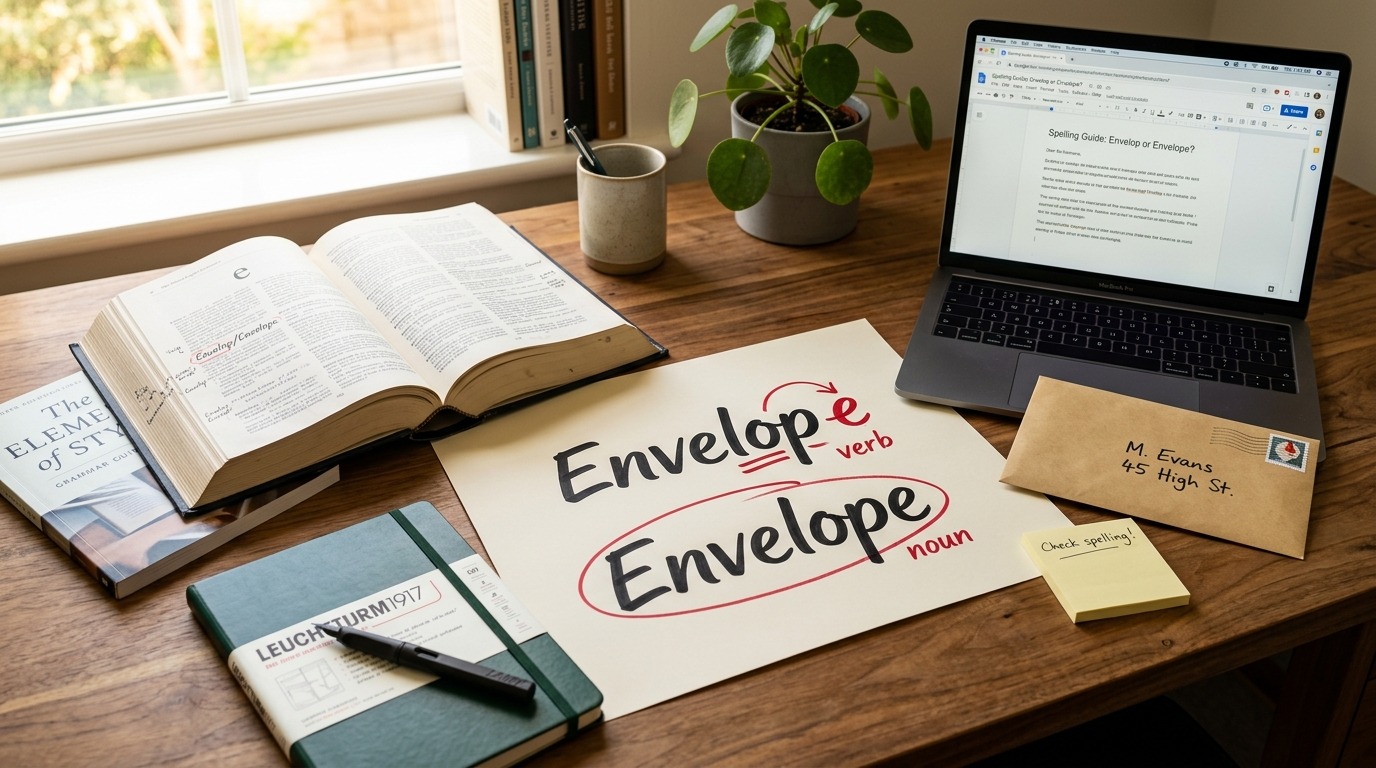
Envelope is a noun the paper packet you mail a letter in. Envelop is a verb it means to wrap, surround, or completely cover something. Same letters, totally different jobs.
A Mix-Up That Trips Up Even Good Writers
I once sent a work email asking a colleague to “envelope the documents in plastic before shipping.” She wrote back, gently, asking if I meant envelop. I did. And I felt my face go hot.
That tiny mistake is more common than you’d think. Envelop and envelope look almost identical. They share a root. They even sound similar when you say them fast. But mixing them up can make a professional email look careless, or turn a school essay into a red-flag for your teacher.
This guide clears up the confusion for good. You’ll learn exactly what each word means, how to use them correctly, and how to avoid the mistake that catches so many writers off guard. By the end, you won’t have to pause and guess again.
Envelop or Envelope:Quick Answer
Here’s the short version before we go deeper.
- Envelope (noun) a flat paper container used to mail letters or documents. “She sealed the envelope and dropped it in the mailbox.”
- Envelop (verb) to wrap around, surround, or cover completely. “Fog began to envelop the entire valley.”
One is a thing you hold. The other is an action something does. Keep that distinction in your head, and you’ll rarely slip up again.
The Origin Behind the Confusion
Both words trace back to the same French root: envelopper, meaning “to wrap up” or “to enclose.” That shared ancestry explains why they look so similar today.
Envelop entered English first, as a verb, in the late 1300s. It kept its original meaning: to wrap something so it’s fully covered.
Envelope came later, borrowed directly as a noun for a wrapper or covering. Over time, it narrowed to mean specifically the paper holder we use for mail. The spelling difference (no final e for the verb, final e for the noun) stuck and it’s the only thing separating them in writing.
This is also why pronunciation differs slightly. Envelop is pronounced en-VEL-up. Envelope is pronounced EN-vuh-lope or AHN-vuh-lope. If you say the word out loud, your ear can often catch which one you actually mean.
Envelop vs Envelope : Key Differences
| Term | Meaning | When to Use | Region/Context |
|---|---|---|---|
| Envelop | Verb: to wrap, cover, or surround completely | When describing an action — fog, darkness, smoke, emotion surrounding something | Used the same way in US, UK, and other English-speaking regions |
| Envelope | Noun: a paper holder for letters or documents | When naming the physical object used in mail or filing | Used the same way globally; spelling never changes |
A simple memory trick: envelope ends in -ope, like the “hope” you feel when waiting for good mail. Envelop has no final e because a verb doesn’t need decoration, it just acts.
Which Version Should You Use?
Your choice depends entirely on the role the word plays in your sentence not on region or formality.
- For writers and students → Use envelope anytime you’re naming an object a letter, a package wrapper, a mailing supply.
- For storytellers and descriptive writing → Use envelop when describing something spreading, surrounding, or covering — smoke enveloping a room, silence enveloping a house.
- For business and formal writing → Either word may appear, but check your sentence structure first. If you can replace the word with “wrap” or “surround,” you need envelop. If you can replace it with “package” or “letter holder,” you need envelope.
This test works almost every time. Try swapping the word for “wrap” if the sentence still makes sense, you want envelop.
Common Mistakes with Envelop and Envelope
1. Using “envelope” as a verb
- ❌ “The fog began to envelope the city.”
- ✅ “The fog began to envelop the city.”
- Why it happens: writers default to the more familiar noun spelling without checking word function.
2. Dropping the final “e” on the noun
- ❌ “Put the letter in an envelop.”
- ✅ “Put the letter in an envelope.”
- Why it happens: people assume shorter is simpler, but the noun needs that final e.
3. Mispronouncing envelop like envelope
- ❌ Saying “EN-vuh-lope” when describing fog surrounding a hill.
- ✅ Saying “en-VEL-up” for the verb form.
- Why it happens: the visual similarity carries over into speech, even when the meaning is different.
4. Using “envelope” in a metaphorical, action-based sentence
- ❌ “Sadness seemed to envelope her.”
- ✅ “Sadness seemed to envelop her.”
- Why it happens: metaphorical writing often feels like it needs the more common spelling, but the action still calls for the verb form.
5. Forgetting the noun form in technical or business writing
- ❌ “Please envelop the check before mailing.”
- ✅ “Please put the check in an envelope before mailing.”
- Why it happens: writers try to economize words and accidentally swap in the verb.
Envelop and Envelope in Real:World Examples
Professional Email:
“Please seal the documents in a padded envelope before sending them to the client.”
News Headline:
“Thick Smoke Continues to Envelop Downtown After Warehouse Fire”
Social Media Post:
“Watched the fog completely envelop the bridge this morning. Eerie but beautiful. 🌫️”
Formal Document:
“All applicants must submit their forms in a sealed envelope marked with the department’s reference number.”
Notice how the noun version always points to a physical object, while the verb version always describes movement or coverage.
Envelop vs Envelope : Data, Trends & Usage
Search interest for “envelop or envelope” spikes most among students, writers, and non-native English speakers double-checking grammar before submitting written work. It’s classified as an informational search people aren’t shopping, they’re clarifying.
Interest also rises seasonally around tax season and holiday card season, when people are physically buying envelopes and searching to confirm spelling before printing labels or addressing mail.
This distinction matters more now than ever. With so much writing happening through quick typing on phones, autocorrect often “fixes” envelop into envelope, even in sentences where the verb form is correct. Knowing the difference yourself is the only real safeguard.
Envelop vs Envelope : At a Glance
| Term/Variant | Meaning | Region/Context | Best Used When |
|---|---|---|---|
| Envelop | To wrap or surround completely | All English-speaking regions | Describing fog, smoke, darkness, or emotion covering something |
| Envelope | A paper holder for mail or documents | All English-speaking regions | Naming a physical mailing or filing object |
Frequently Asked Questions
Q: What does “envelop” mean?
A: Envelop is a verb meaning to wrap something completely or surround it on all sides. It’s often used to describe fog, smoke, darkness, or strong emotions covering a person or place.
Q: What does “envelope” mean?
A: Envelope is a noun for the flat paper container used to hold and mail letters, cards, or documents. It’s the object you seal before dropping it in the mailbox.
Q: Envelop vs envelope : what’s the real difference?
A: The difference is part of speech. Envelop is always a verb (an action). Envelope is always a noun (a thing). The meaning shifts entirely based on which one you need in the sentence.
Q: Is “envelope” ever used as a verb?
A: No. Envelope is strictly a noun in standard English. If you need a verb for wrapping or surrounding, envelop is the only correct choice.
Q: How do you pronounce “envelop” correctly?
A: Envelop is pronounced en-VEL-up, with stress on the second syllable. This differs from envelope, which is pronounced EN-vuh-lope, stressing the first syllable.
Q: Where does the confusion between these words come from?
A: Both words come from the French envelopper, meaning “to wrap.” Because they share a root and nearly identical spelling, many writers default to the more familiar noun form even when a verb is needed.
Q: Can “envelop” be used in formal or technical writing?
A: Yes. Envelop is fully acceptable in formal writing whenever you’re describing something covering or surrounding another thing for example, in scientific, weather, or descriptive business writing.
Final Takeaway
Here’s what to remember: envelope is the object, envelop is the action. If you can swap the word for “wrap” or “surround,” choose envelop. If you can swap it for “letter holder” or “package,” choose envelope.
Run that quick swap test any time you’re unsure, and you’ll never second-guess these two words again. Bookmark this guide so it’s there the next time your fingers freeze mid-sentence and share it with anyone who’s ever made the same mix-up.
Envelop or Envelope: The Easy Way to Tell Them Apart

I am an English language enthusiast who enjoys exploring word differences and spelling variations.
My work focuses on making confusing English terms easier to understand for everyday readers.
I believe clear language helps people communicate with confidence.