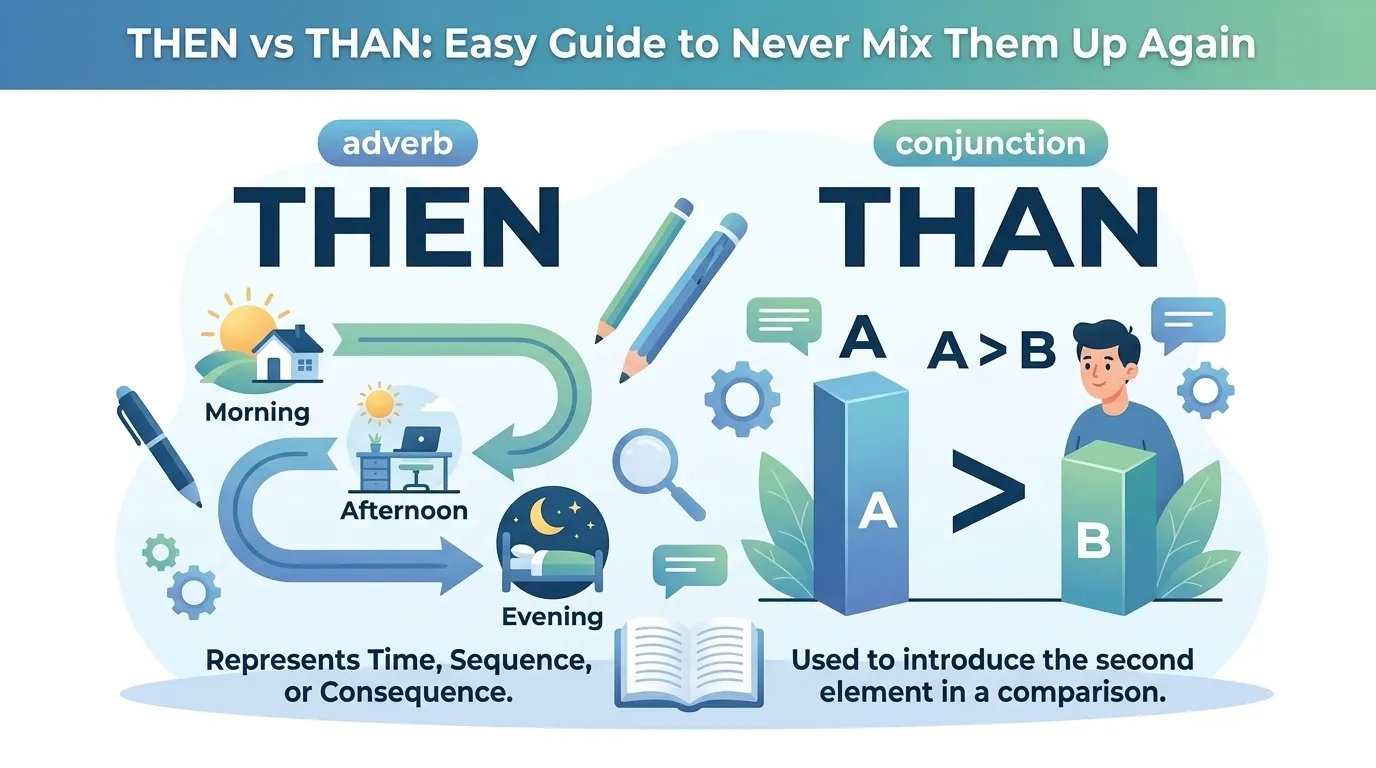
Then relates to time, sequence, or what happens next. Than is used for comparisons between two or more things.
A few years ago, while reviewing essays from my students, I noticed the same mistake again and again. Smart students. Great ideas. Yet many wrote sentences like, “She is taller then her brother” or “Finish your homework than go outside.”
At first glance, these words look almost identical. They differ by just one letter. That tiny difference causes confusion for native speakers and English learners alike.
If you’ve ever paused while writing and wondered whether to use then or than, you’re not alone. It is one of the most common grammar mistakes in English.
The good news is that the rule is simple once you understand it.
By the end of this guide, you’ll know exactly when to use each word. You’ll see clear examples, learn easy memory tricks, avoid common mistakes, and gain the confidence to use then and than correctly every time.
Let’s clear up the confusion once and for all.
Then vs Than: Quick Answer
The easiest way to remember the difference is this:
- Then = Time
- Than = Comparison
Examples
✅ We ate dinner, then watched a movie.
✅ My car is faster than yours.
Think of then as something that happens next.
Think of than as comparing one thing with another.
The Origin / Background of Then vs Than
These two words have been confusing writers for centuries.
Both come from Old English and were once more closely related than they are today. Over time, English evolved and the meanings became separate.
Then
The word then developed as a time related word. It refers to:
- A specific moment
- Something that happens next
- A consequence
Example:
“Back then, life was very different.”
Than
The word than became a comparison word.
It helps compare:
- Size
- Age
- Speed
- Quality
- Quantity
Example:
“This book is better than the last one.”
Because the words look and sound similar, many people still mix them up.
Then vs Than Explained: Key Differences
The main difference is simple.
| Term | Meaning | When to Use | Region/Context |
|---|---|---|---|
| Then | Time or sequence | Something happens next or at that time | All English speaking regions |
| Than | Comparison | Comparing two or more things | All English speaking regions |
When to Use Then
Use then when talking about:
- Time
- Order
- Sequence
- Results
Examples:
- First wash your hands, then eat.
- We were younger then.
- If it rains, then we will stay home.
When to Use Than
Use than when making comparisons.
Examples:
- She is taller than me.
- Coffee costs more than tea.
- He runs faster than his brother.
Quick Memory Trick
Than = Compare
Both words contain the letter A.
Then = Time
Both words contain the letter E.
This simple trick helps many writers remember the correct choice.
Which Version Should You Use?
The answer depends on what you’re trying to say.
For Students
Use than when comparing things in essays or assignments.
Example:
“Math is harder than science.”
For Business Professionals
Use then when describing steps or processes.
Example:
“Submit the report, then notify the manager.”
For Content Writers
Use both correctly because grammar mistakes can reduce credibility.
Example:
“This phone is cheaper than competitors. Then it offers several premium features.”
For Global and Neutral English
The same rules apply everywhere.
Whether you write American English, British English, Canadian English, or Australian English:
- Then = Time
- Than = Comparison
There are no regional differences.
Common Mistakes with Then vs Than
Here are the mistakes people make most often.
Mistake #1
❌ She is smarter then me.
✅ She is smarter than me.
Why?
The sentence compares two people.
Mistake #2
❌ Finish your work than go home.
✅ Finish your work then go home.
Why?
The sentence describes sequence.
Mistake #3
❌ Today is better then yesterday.
✅ Today is better than yesterday.
Why?
You are comparing two days.
Mistake #4
❌ We ate lunch and than went shopping.
✅ We ate lunch and then went shopping.
Why?
One action follows another.
Mistake #5
❌ This route is shorter then the other one.
✅ This route is shorter than the other one.
Why?
The sentence compares two routes.
Then vs Than in Real World Examples
Let’s see how these words appear in everyday writing.
Professional Email
Correct Example:
“Please review the proposal, then send your feedback by Friday.”
The word then shows the next step.
News Headline
Correct Example:
“Inflation Falls Faster Than Experts Expected.”
The word than introduces a comparison.
Social Media Post
Correct Example:
“Finished my workout, then grabbed a healthy breakfast.”
The word then shows sequence.
Formal Report
Correct Example:
“Sales this quarter were higher than the previous quarter.”
The word than compares two periods.
Business Presentation
Correct Example:
“Launch the campaign, then monitor customer engagement.”
The word then indicates order.
Then vs Than: Data, Trends & Usage
Search interest for then vs than remains consistently high because grammar mistakes appear everywhere online.
Who Searches This Topic Most?
- Students
- ESL learners
- Teachers
- Bloggers
- Copywriters
- Business professionals
Search Intent
Primary Intent: Informational
People want to know:
- Which word is correct
- When to use each word
- How to avoid mistakes
Why It Matters Today
Digital communication moves fast.
Emails, social posts, blog articles, and messages are often written quickly. Small grammar mistakes can hurt credibility and create confusion.
Learning the difference helps your writing look polished and professional.
Standalone Comparison Table
| Term/Variant | Meaning | Region/Context | Best Used When |
|---|---|---|---|
| Then | Refers to time, order, or sequence | Universal English | Discussing what happens next |
| Than | Used for comparisons | Universal English | Comparing people, objects, or ideas |
| Back Then | Refers to a past time | Informal and formal writing | Talking about the past |
| More Than | Indicates comparison of amount or quality | Universal English | Comparing quantity or value |
| Then Again | Means reconsidering a point | Conversational English | Introducing another perspective |
Frequently Asked Questions
Q: What does then mean?
A: Then refers to time, order, or sequence. It tells readers when something happened or what happens next.
Q: What does than mean?
A: Than is a comparison word. It connects two things being compared, such as size, speed, age, or quality.
Q: How do you use then correctly?
A: Use then when discussing time or sequence. Example: “We finished dinner, then watched a movie.”
Q: Then vs than: what’s the difference?
A: Then relates to time and order. Than relates to comparison. Remember: Then = Time, Than = Compare.
Q: Is then acceptable in formal writing?
A: Yes. Then is perfectly acceptable in formal reports, academic papers, business emails, and professional documents when used correctly.
Q: Which is correct: then or than?
A: Both are correct. The right choice depends on the sentence. Use then for time and than for comparison.
Q: Where do then and than come from?
A: Both words originated in Old English. Over time, their meanings separated, creating today’s distinction between sequence and comparison.
Q: Can then and than be used in the same sentence?
A: Yes. Example: “I would rather study now than later, and then relax afterward.” Each word serves a different purpose.
Conclusion
The difference between then and than is small, but it matters.
Remember these key points:
- Then relates to time, sequence, and what happens next.
- Than is used for comparisons.
- Most mistakes happen because the words look similar.
- A simple memory trick can help: Then = Time, Than = Compare.
Whenever you write, pause for a second and ask yourself a simple question:
“Am I talking about time or comparing things?”
If it’s time, choose then.
If it’s a comparison, choose than.
With a little practice, you’ll stop second guessing yourself and start using both words naturally.
Now you know exactly how to use then vs than go try it in your next piece of writing. Bookmark this guide so you never mix them up again, and share it with someone who still does.
Read more: Affect vs Effect: Easy Guide to Never Mix Them Up Again

I am an English language writer dedicated to creating clear, accurate, and easy-to-understand content. My goal is to help readers build confidence in their language and communication skills.