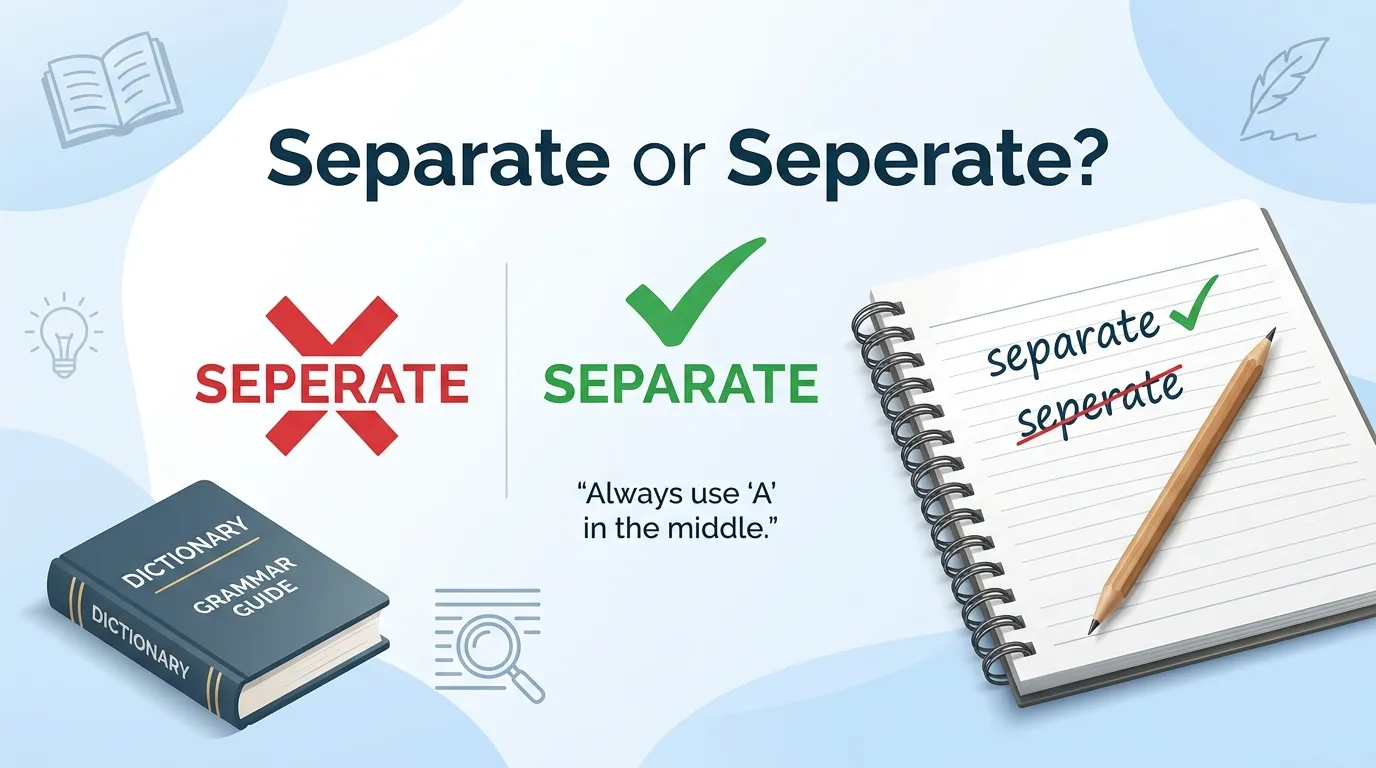
Separate is the correct spelling. Seperate is a common misspelling and should not be used in formal or informal writing.
A few years ago, while editing student essays, I noticed one spelling mistake more than almost any other. The word was “seperate.” It appeared again and again.
The funny thing? Even strong writers made this mistake.
You may have typed seperate into Google because your spell checker flagged it. Or maybe you saw both versions online and wondered which one is right.
You’re not alone.
Many people struggle with this word because its pronunciation can trick the ear. When spoken quickly, it doesn’t clearly reveal its spelling. That makes it easy to swap the letters and end up with the wrong version.
The good news is simple. There is only one correct spelling.
In this guide, you’ll learn the difference between separate and seperate, where the confusion comes from, common mistakes to avoid, and how to remember the correct spelling forever.
Let’s clear it up once and for all.
Separate or Seperate: Quick Answer
The correct word is separate.
The spelling seperate is incorrect and is considered a spelling error in English.
Examples
✅ Please separate the documents into folders.
✅ The twins study in separate classrooms.
❌ Please seperate the documents.
❌ The twins study in seperate classrooms.
Whenever you write this word, choose separate.
The Origin / Background of Separate or Seperate
The word separate comes from the Latin word separatus, which means “divided” or “set apart.”
Over time, it entered Middle English and kept a spelling close to its Latin roots.
The confusion happens because of pronunciation.
Many people hear the middle sound as “per” instead of “par.” That can lead them to write seperate by mistake.
Another reason is memory.
English contains many words with “e” sounds in the middle. Writers often assume this word follows the same pattern.
But English spelling loves exceptions.
Separate is one of those words that people often misspell even after years of writing.
Separate or Seperate Explained: Key Differences
The truth is simple.
There is no difference in meaning because only one spelling is correct.
The comparison below makes this clear.
| Term | Meaning | When to Use | Region/Context |
|---|---|---|---|
| Separate | To divide, keep apart, or distinct | Always | Worldwide English |
| Seperate | Misspelling of separate | Never | Incorrect spelling |
Examples of Separate
As a verb:
- Please separate the red files from the blue files.
- Workers separate recyclable materials.
As an adjective:
- They live in separate houses.
- We booked separate hotel rooms.
Examples of Seperate
- ❌ We need to seperate the data.
- ❌ They sat at seperate tables.
These examples contain spelling mistakes.u Use?
The answer depends on one thing.
You should always use separate.
For Students
Use separate in essays, assignments, exams, and homework because it is the only accepted spelling.
For Professionals
Use separate in reports, presentations, emails, and business documents to maintain credibility.
For Content Writers and Bloggers
Use separate to avoid spelling errors that can hurt reader trust and SEO quality.
For Global English
Whether you write American English, British English, Canadian English, or Australian English, use separate.
Direct Recommendation
✅ Choose separate every time.
❌ Avoid seperate completely.
Common Mistakes with Separate
Many writers make the same errors.
Here are the most common ones.
| Mistake | Correct Form |
|---|---|
| seperate files | separate files |
| seperate rooms | separate rooms |
| seperate accounts | separate accounts |
| seperate issue | separate issue |
| seperate them | separate them |
Why These Mistakes Happen
1. Writing by Sound
People often spell words based on pronunciation.
The middle sound can be misleading.
2. Typing Too Fast
Fast typing increases spelling errors.
3. Lack of Exposure
Some writers rarely see the word written correctly.
4. Memory Confusion
Words like “desperate” can influence spelling patterns and lead to mistakes.
Easy Memory Trick
Think:
sep-A-rate
The middle letter is A, not E.
Many teachers use the phrase:
“There is A RAT in sepARATe.”
It sounds silly, but it works.
Separate in Real World Examples
Let’s see how the word appears in everyday writing.
Professional Email
Dear Team,
Please separate customer feedback into positive and negative categories before Friday.
Thank you.
News Headline
Government Announces Plan to Separate Waste for Better Recycling
Social Media Post
We decided to keep our work and personal accounts separate.
Formal Report
The data was separated into three groups for analysis.
These examples show natural and correct usage.
Separate: Data, Trends & Usage
Search Interest
The query “separate or seperate” receives thousands of searches each year.
Most people search it after:
- Seeing a spelling correction
- Writing an email
- Completing school assignments
- Creating professional documents
Regions Showing Interest
Interest comes from:
- United States
- United Kingdom
- Canada
- Australia
- India
Search Intent
Primary intent:
Informational
Users want to know:
- Which spelling is correct
- Why the confusion exists
- How to avoid mistakes
Why This Matters Today
Clear writing matters more than ever.
Emails, social media posts, resumes, and online content are often judged quickly. One spelling mistake can affect professionalism and credibility.Comparison Table
| Term/Variant | Meaning | Region/Context | Best Used When |
|---|---|---|---|
| Separate | Divide, distinct, apart | All English speaking regions | Always |
| Seperate | Misspelling of separate | None | Never |
| Separated | Past tense of separate | All regions | Talking about completed actions |
| Separation | State of being apart | All regions | Referring to division or distance |
Frequently Asked Questions
Q: What does separate mean?
A: Separate means to divide, keep apart, or make distinct. It can be used as both a verb and an adjective.
Q: How do you use separate correctly?
A: Use separate whenever you mean divided, apart, or distinct. It is the standard spelling in all forms of English.
Q: Separate vs Seperate: what’s the difference?
A: Separate is the correct spelling. Seperate is simply a spelling mistake and should not be used.
Q: Is separate acceptable in formal writing?
A: Yes. Separate is completely correct for academic papers, business reports, legal documents, and professional communication.
Q: Which version is correct: separate or seperate?
A: Separate is the only correct spelling. Dictionaries, style guides, and educational institutions all recognize this version.
Q: Where does separate come from?
A: It comes from the Latin word separatus, meaning divided or set apart. The modern spelling evolved from this root.
Q: Can separate be used in business communication?
A: Absolutely. It is commonly used in emails, reports, presentations, contracts, and workplace instructions.Conclusion
Conclusion
The debate between separate and seperate is actually very simple.
Only separate is correct.
Remember these key points:
- Separate is the accepted English spelling.
- Seperate is a misspelling.
- The confusion comes from pronunciation.
- A simple memory trick can help you remember the letter A in the middle.
Whether you’re writing an essay, sending an email, posting on social media, or creating professional content, choosing the correct spelling helps you look more confident and credible.
The next time you hesitate, remember: separate is always the right choice.
Bookmark this guide so you never second guess “separate” again, and share it with someone who still writes “seperate.”
Read more: Canceled or Cancelled: Which Spelling Is Correct? Easy Guide

I am an English language writer dedicated to creating clear, accurate, and easy-to-understand content. My goal is to help readers build confidence in their language and communication skills.